

benjamin verschuere @benjamin_versch
Co-CIO Liminal Capital. Macro research with a focus on AI's impact covered by the NYT, VoxEU (CEPR) and ProMarket. Not investment advice. liminal-capital.com/academic-resea… san francisco Joined April 2026-
Tweets29
-
Followers5
-
Following24
-
Likes28
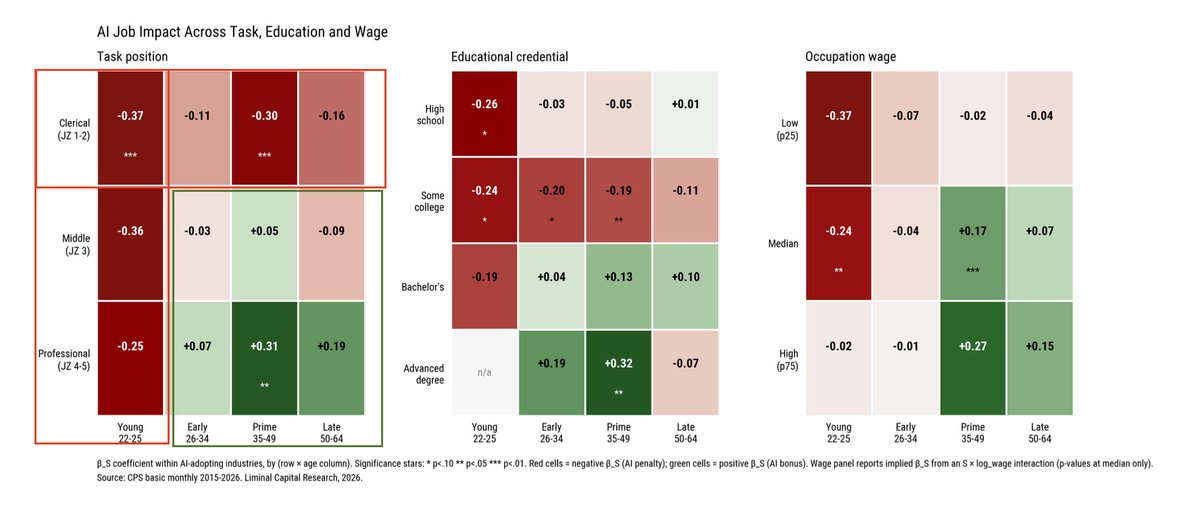
Thanks for sharing our work! Here is the dynamic in heatmap form: within AI-adopting industries, AI hits lower-skilled jobs at every age, and the young even in skilled jobs. The shielded are experienced workers in higher-skilled, higher-paid roles, where AI complements rather than substitutes. Interactive version: liminal-capital.com/apps/ai-amdahl…

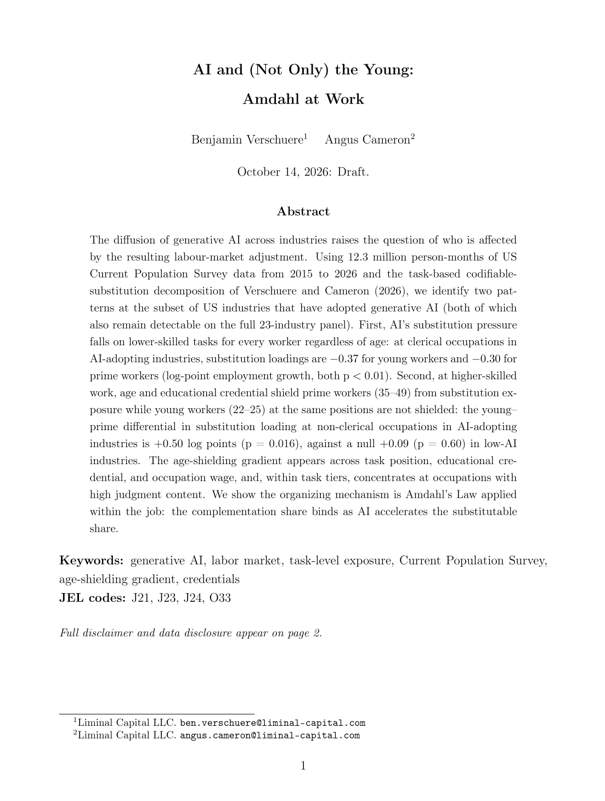
Super interesting! "AI and (Not Only) the Young: Amdahl at Work" by Benjamin Verschuere and Angus Cameron. "The diffusion of generative AI across industries raises the question of who is affected by the resulting labour-market adjustment. Using 12.3 million person-months of US Current Population Survey data from 2015 to 2026 and the task-based codifiable substitution decomposition of Verschuere and Cameron (2026), we identify two patterns at the subset of US industries that have adopted generative AI (both of which also remain detectable on the full 23-industry panel). First, AI substitutes lower-skilled tasks for every worker regardless of age: at clerical occupations in AI-adopting industries, substitution loadings are −0.37 for young workers and −0.30 for prime workers (log-point employment growth, both p < 0.01). Second, at higher-skilled work, age and educational credential shield prime workers (35–49) from substitution exposure while young workers (22–25) at the same positions are not shielded: the young–prime differential in substitution loading at non-clerical occupations in AI-adopting industries is +0.50 log points (p = 0.016), against a null +0.09 (p = 0.60) in low-AI industries. The age-shielding gradient appears across task position, educational credential, and occupation wage, and, within task tiers, concentrates at occupations with high judgment content. We show the organizing mechanism is a mediation of Amdahl’s Law into labor economics within the job. The complementation share binds as the substitutable share is accelerated." Working paper: papers.ssrn.com/sol3/papers.cf… Interactive app: liminal-capital.com/apps/ai-amdahl…
Agreed, it seems there was a change in productivity trend before but post ChatGPT there has also been a widening of the gap between AI exposed sector (high C*) and non AI-exposed ones (low C*). We ran some DiD on that, full paper here (where also also look at 18 other economies): papers.ssrn.com/sol3/papers.cf…

Like every other econ reporter, I've spent much of the past couple years trying to understand what A.I. will mean for the economy and for workers. But it's been frustratingly hard to reach any firm conclusions, because so much is uncertain -- how the technology will evolve, how quickly it will be adopted, how policymakers will respond.
Great historical perspective, and it seems history might be rhyming... The teamster episode is strikingly similar to what our research currently finds with white-collar jobs. 1) The AI job impact is happening via lower hiring: entry-level job starts (22–25) in the most AI-substitutable occupations are down about a third, ~227,000 per year. 2) The young are not shielded even in skilled jobs, while experienced workers in judgment-heavy roles are retained and expanded. Your young men who stopped entering teamster work while older drivers finished their careers at rising wages, in 2026 form (heatmap below) Two papers for your reference: – AI is adding and taking jobs, so the aggregate effect looks quiet: papers.ssrn.com/sol3/papers.cf… – Who is being impacted by AI (today’s equivalent of the teamster example): papers.ssrn.com/sol3/papers.cf…
@soumitrashukla9 @RonnieChatterji Thanks! Any feedback welcomed.
@int_mon_econ Regulatory arbitrage...
And in a follow up paper drilling deeper into the dichotomy we find where AI is adopted, employment is declining for the young and also generally any low skilled automable jobs. While shielded worker have so far been older employees with college degrees where AI complement them (chart below). Paper: papers.ssrn.com/sol3/papers.cf…

@RonnieChatterji this echos some of our empirical findings. AI can act as a substitute for some task and a complement or other (while being inert for physical jobs) Partitioning jobs the same way we find that, in the US since ChatGPT, employment in AI-substitutable work has been growing ~3.3pp/yr slower than untouched work and AI-complemented work is growing ~3.3pp/yr faster. Essentially the complemented jobs are the bottelneck after AI-substitute jobs are being accelrated. Paper here: papers.ssrn.com/sol3/papers.cf… The mapping of 798 occupation below: liminal-capital.com/apps/ai-job-ma…
Strong convergence with what we find in CPS data and looking fwd to read that paper. We partition every O*NET task into what AI substitutes vs complements . In employment data the bottleneck already binds: where AI is adopted, the workers holding the judgment tasks AI cannot do are retained and expanded, while young and lower-skilled workers in substitutable work are not (chart below).Amdahl’s Law, applied within the job. Link to paper: papers.ssrn.com/sol3/papers.cf…

Completely agree with the premise: the debate has been too focused on the jobs AI takes and not on what it augments. And actually there are already some sign in the data using US CPS data shows that both margins are visible: sure employment in AI-substitutable work is growing ~3.3pp/yr slower than untouched work, but AI-complemented work is growing ~3.3pp/yr *faster*. The AI-augmentation side is real and already measurable... Here is how the mapping looks like: liminal-capital.com/apps/ai-job-ma…
@econcallum Fwiw data from OpenRouter points toward Chinese models generating around 25% of revenue on their platform... Data here: liminal-capital.com/apps/ai-tokeno…
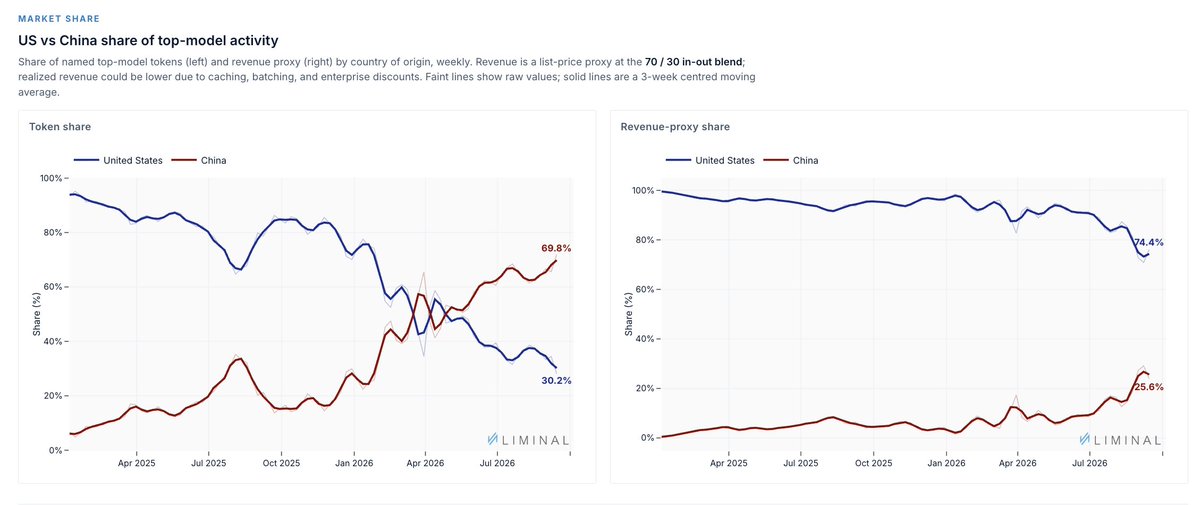
@AngelAuYeung @AngelAuYeung And there is also some revenue grab from Chinese models... Full tracker here: liminal-capital.com/apps/ai-tokeno…
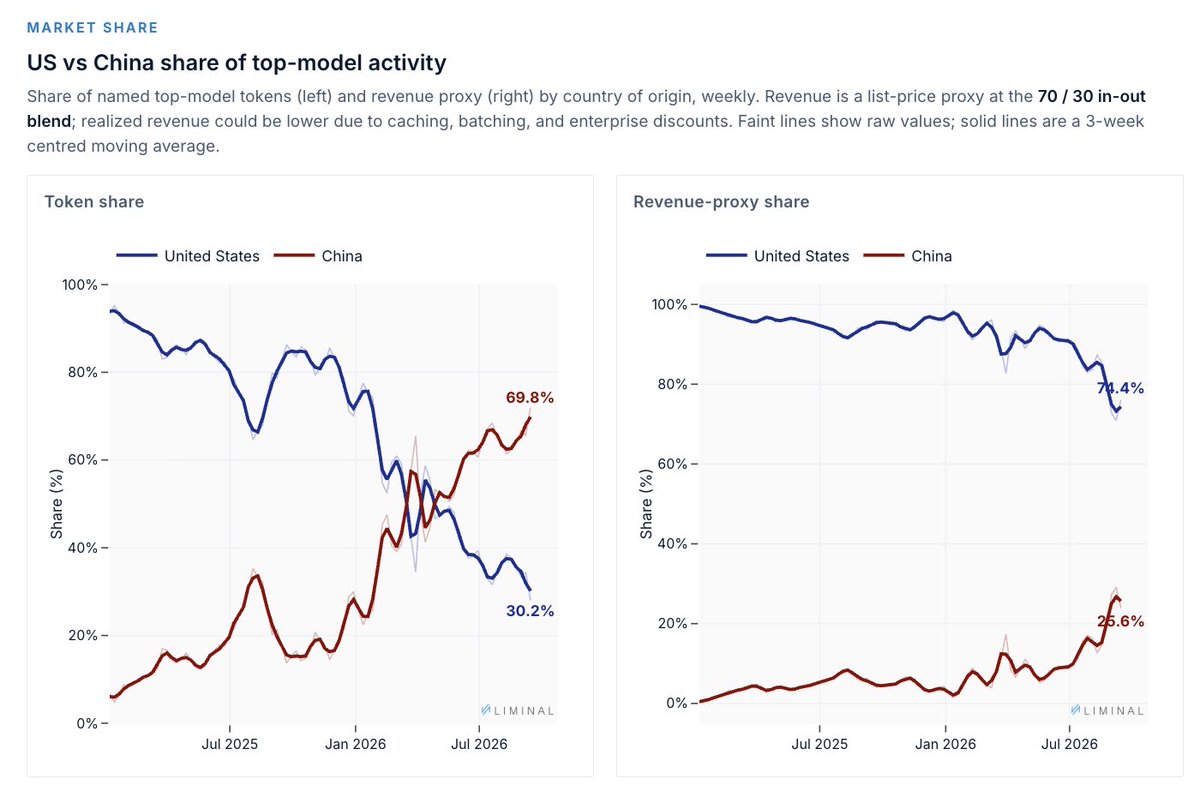
@socialcapital @socialcapital worth noticing the fact Chinese models are now also grabbing some revenue share away from US model Full tracker here: liminal-capital.com/apps/ai-tokeno…
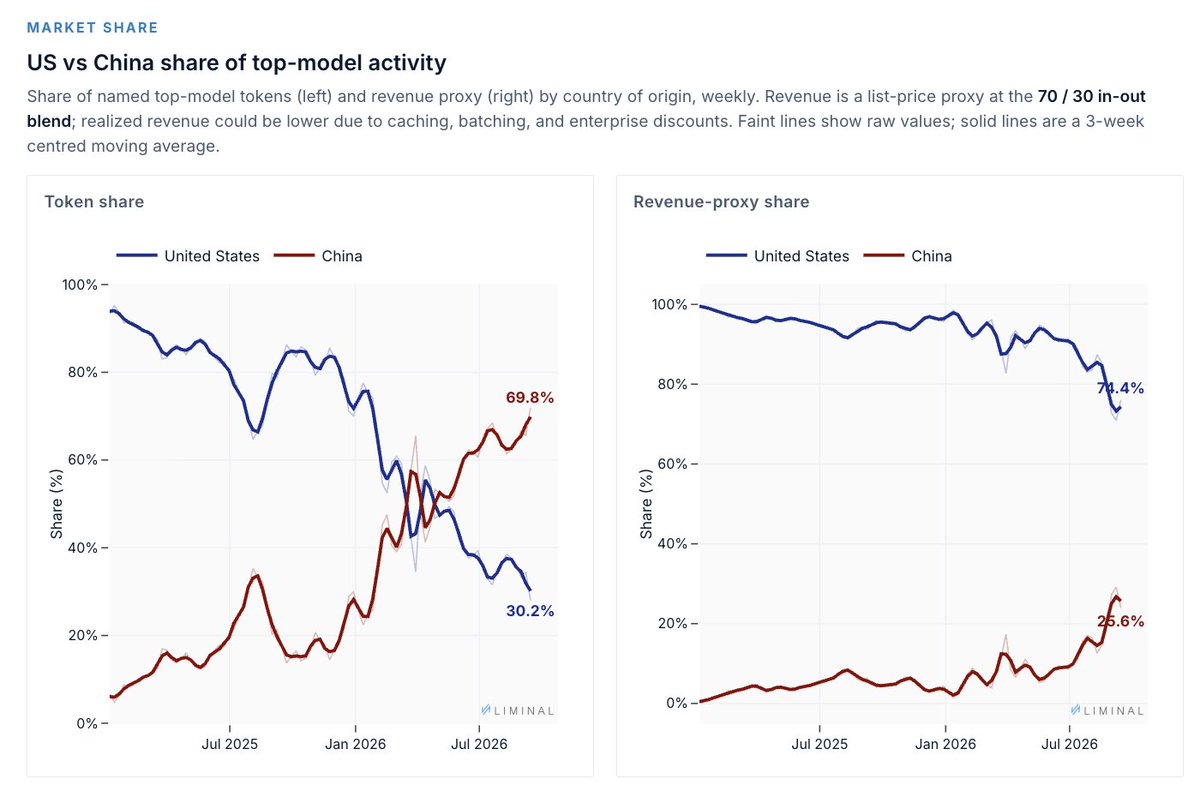
@ZeffMax @AngelAuYeung @ZeffMax worth noting that Chinese models have not only the upper hand in terms of token usage but now they are also grabbing revenue share.... Full tracker here: liminal-capital.com/apps/ai-tokeno…
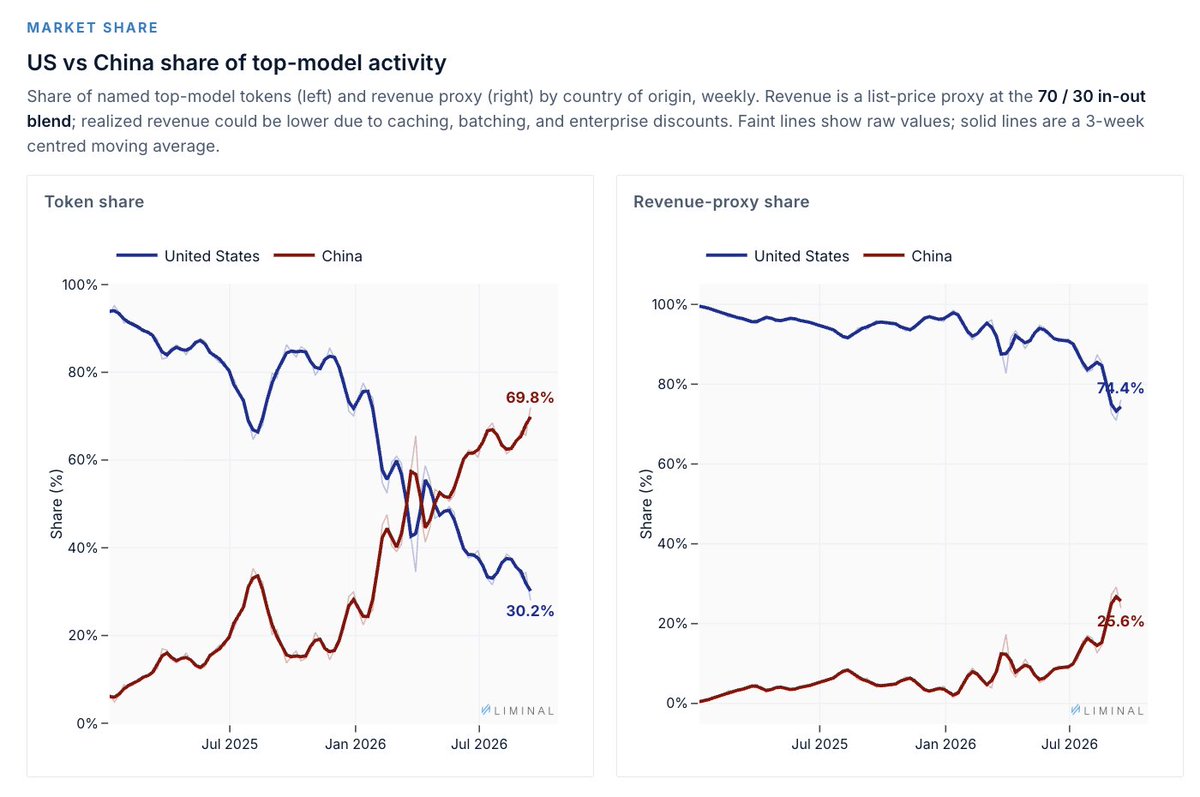
@albrgr @albrgr in case you are interested we built a tracker and are seeing Chinese models taking more revenue share (not just tokens) like Ramp data. Full tracker here: liminal-capital.com/apps/ai-tokeno…
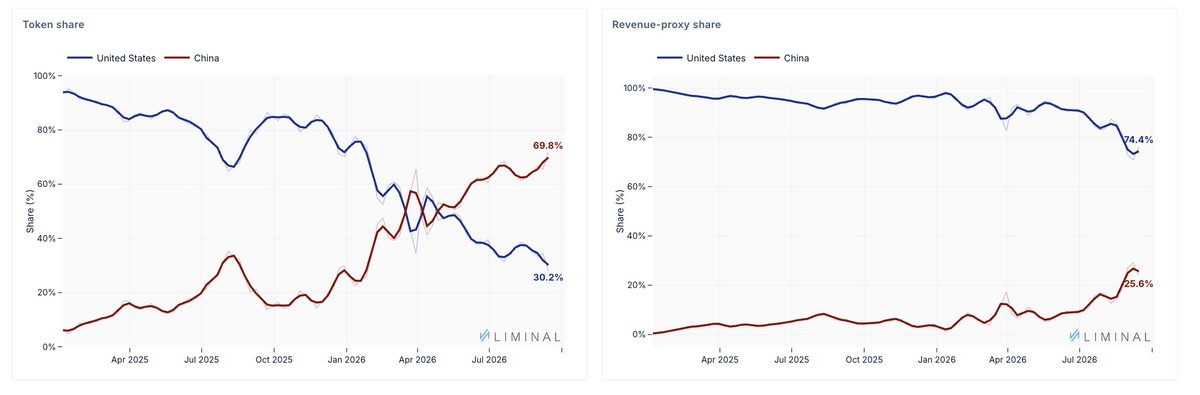
@Noahpinion Fwiw we are seeing the Chinese models grabbing more share of US revenue models (not just token) Full tracker (with model capabilities) here: liminal-capital.com/apps/ai-tokeno…
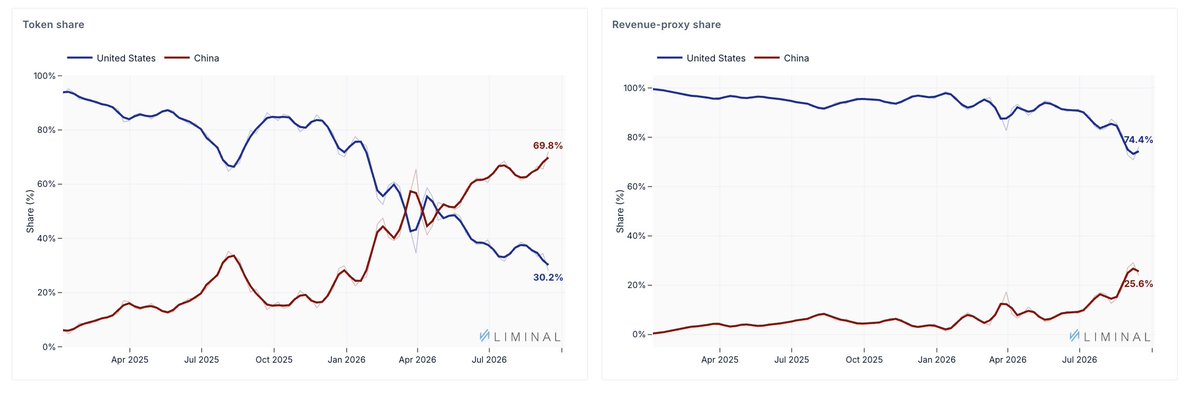
@StealthQE4 Fwiw we are seeing the Chinese models grabbing more share of US revenue models (not just token) Full tracker here: liminal-capital.com/apps/ai-tokeno…
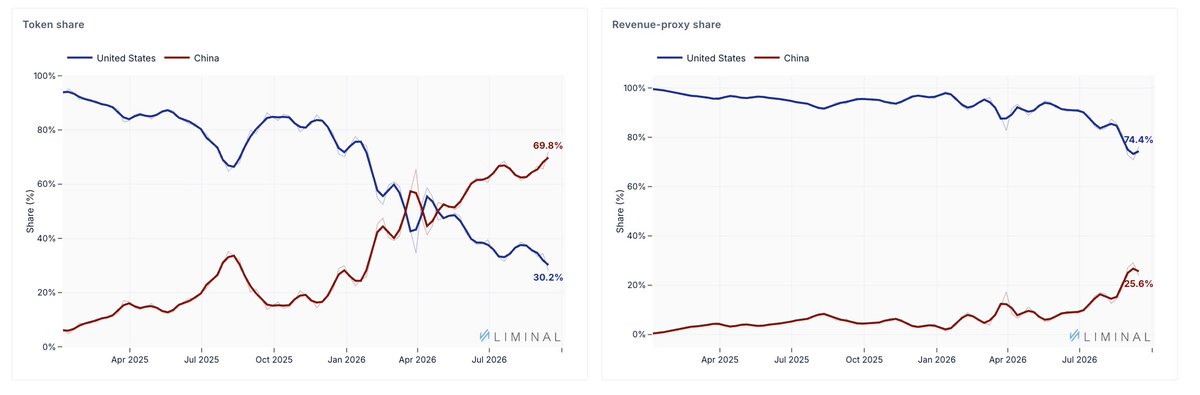
@EpochAIResearch @cherylwoooo @ansonwhho Fwiw we are seeing the Chinese models grabbing more share of US revenue models (not just token) Full dashboard here: liminal-capital.com/apps/ai-tokeno…
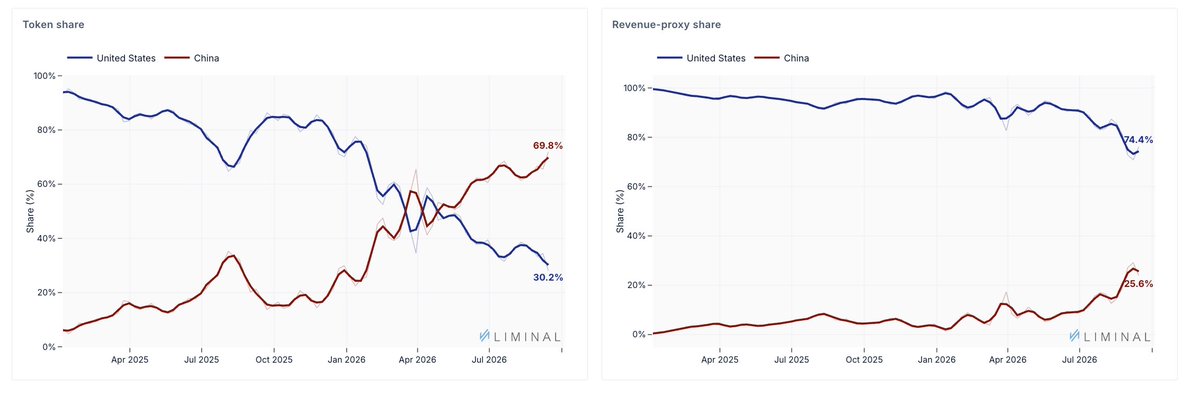
Hiding in the mean: AI is adding jobs and removing them at the same time Benjamin Verschuere & Angus Cameron (Liminal Capital) ow.ly/aBQF50ZUm8B


Daniel Rock @danielrock
6K Followers 2K Following Co-lead / Director @Google AI x Economy Program. AP (on leave) @Wharton. Cofounder @workhelix. Everyone can just do stuff and that's {good, bad}.
Xavier Olleros @xolleros
548 Followers 7K Following Retired business school professor (ESG-UQAM) Co-editor, Research Handbook on Digital Transformations (2016)
Callum Williams @econcallum
8K Followers 706 Following Senior economics writer, San Francisco bureau chief, The Economist. AI, financial markets, real estate, history. Book "The Classical School"

paralysisunknown @paralysisunknow
60 Followers 2K Following
Frank Nagle @frank_nagle
2K Followers 881 Following Research scientist @MIT and Chief Economist @linuxfoundation studying AI, digitization, crowds, open source software, cybersecurity, & the future of work.
Inclusive Productivit... @incprodmon
3K Followers 891 Following The Swiss Inclusive Productivity Network analyzes productivity developments and intends to help develop measures to foster inclusive productivity.
Ben Casselman @bencasselman
70K Followers 3K Following Econ reporter @nytimes. Formerly @fivethirtyeight @WSJ. Adjunct @newmarkjschool. He/him [email protected] Signal: bencasselman.96 Photo: Earl Wilson/NY
Alex Imas @alexolegimas
38K Followers 2K Following Director of AGI Economics @GoogleDeepMind. Professor @ChicagoBooth (on leave) AGI Economics Lab: https://t.co/kpNPT6J5AJ Opinions are own.
Ronnie Chatterji @RonnieChatterji
9K Followers 670 Following Chief Economist @OpenAI & Distinguished Professor @DukeFuqua. Views my own.
Soumitra Shukla @soumitrashukla9
10K Followers 850 Following Economist at The Burning Glass Institute @theBGInstitute. Thinking about AI, labor markets, and the future of work.
Noah Smith 🐇🇺�... @Noahpinion
954K Followers 2K Following Writes about economics, posts about rabbits. For serious opinions/analysis, read my blog: https://t.co/KfUxUlCYPz
Daniel Rock @danielrock
6K Followers 2K Following Co-lead / Director @Google AI x Economy Program. AP (on leave) @Wharton. Cofounder @workhelix. Everyone can just do stuff and that's {good, bad}.
VoxEU @voxeu
64K Followers 132 Following VoxEU is a policy portal run by @cepr_org. It posts research based policy analysis from leading economists. Visit our development economics branch @vox_dev
Olivier Blanchard @ojblanchard1
371K Followers 458 Following Robert Solow Professor of economics emeritus, MIT, Senior Fellow, Peterson Institute for International Economics Professor, Paris School of Economics
Ethan Mollick @emollick
408K Followers 594 Following Professor @Wharton studying AI. New book, Co-Existence, is out now: https://t.co/hsDYf1xU9K My Substack: https://t.co/UIBhxu4bgq
Anton Korinek @akorinek
9K Followers 337 Following Researches the Economics of Transformative AI Professor of Economics @UVAEcon & @DardenMBA Visiting Fellow @Brookings Research Associate @nberpubs and @cepr_org
Rob Seamans @robseamans
7K Followers 3K Following Professor @NYUStern; Director @NYUSternCFM; former Obama CEA Senior Economist for tech & innovation; research on AI, robots, entrepreneurship, strategy
Gary Marcus @GaryMarcus
254K Followers 7K Following OG GenAI Skeptic; spoke at US Senate. Warned about hallucinations in 2001. Advocating world models & neurosymbolic AI ever since. Author, Marcus on AI & 6 books
tylercowen @tylercowen
426K Followers 563 Following new book *Talent: How to Identify Energizers, Winners, and Creatives Around the World*, https://t.co/7bU5cTWLzc, Conversations with Tyler, The Free Press.
Derek Thompson @DKThomp
265K Followers 2K Following Substack author. Plain English podcast host. Abundance co-author. Contributing writer at The Atlantic.
Timothy B. Lee @binarybits
53K Followers 2K Following Reporting on AI and the future of the economy. CS masters degree from Princeton. Newsletter: https://t.co/MAwkvzSSr3 Podcast: https://t.co/aJSErfcE8Y
Adam Tooze @adam_tooze
234K Followers 8K Following Hist/Econ/Theory C******* University. Born UK, raised FRG. Publisher @surplusmagazin @OnesandToozePod Chartbook substack newsletter
John Authers @johnauthers
84K Followers 5K Following Columnist, Bloomberg @business. Previously 29 yrs @FT Englishman in New York. Mexicanophile. RedSox&Seagulls4ever. Views mine except RTs Please sign up below:
John Burn-Murdoch @jburnmurdoch
476K Followers 6K Following Columnist and chief data reporter @FinancialTimes | Stories, stats & scatterplots | Senior fellow @LSEdataScience | [email protected]
Callum Williams @econcallum
8K Followers 706 Following Senior economics writer, San Francisco bureau chief, The Economist. AI, financial markets, real estate, history. Book "The Classical School"
talmon joseph smith @talmonsmith
17K Followers 4K Following economics reporter for @NYTimes || formerly @GQmagazine, NYU, @tufts || newyorleanian || [email protected] || author of 'What Can We Afford' (March 2027)
International and Mon... @int_mon_econ
14K Followers 2K Following Our network covers a broad range of topics in international and monetary economics. Initially, it consisted of alumni of Uni Bern. Everyone is welcome to join.
You might like

















