

DailyToken @dailytokenAI
The AI day, explained: what happened and why it matters to you. News & markets, agents, open source, science, China. dailytoken.news Joined October 2026-
Tweets33
-
Followers0
-
Following31
-
Likes0
Scale blog: scale.com/blog/scale-par… NVIDIA blog: developer.nvidia.com/blog/nvidia-ne…
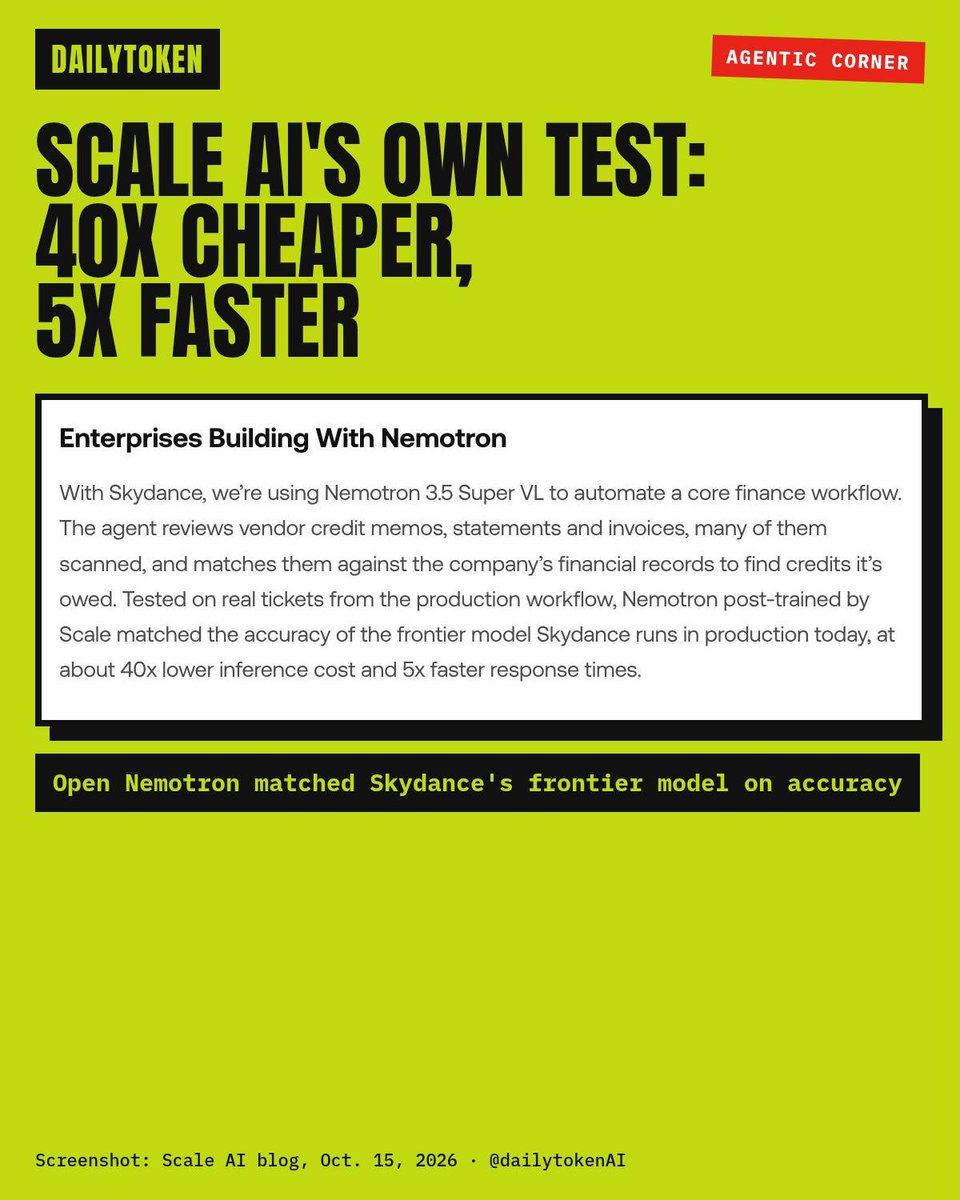
Scale AI says it trained an open NVIDIA model to run a finance agent for Skydance that matched the accuracy of the frontier model Skydance runs in production today, at about 40x lower inference cost and 5x faster. Scale and NVIDIA announced the case on Oct. 15, with NVIDIA's new open model, Nemotron 3.5 Super VL. The job is one most finance teams know. Vendors send credit memos, statements and invoices, "many of them scanned," according to Scale. Someone has to check them against the company's books "to find credits it's owed." Scale's agent reads those documents and does the matching. Scale says the test ran on real tickets from the production workflow. Scale does not name the frontier model it was compared with. NVIDIA tells the same story in the future tense: "Inference cost for this workload will decrease by 40x and latency by 5x." The method is post-training. In Scale's words, it "teaches an existing model a particular job using examples of that job done well, turning a general-purpose model into a specialist." Scale says it measures the model the customer uses today on tasks from its workflow. Then it builds training and evaluation data, post-trains Nemotron with NVIDIA's open tools, and tests each version inside the same agent workflow. Scale reports two more cases: - EY: an agent that answers due diligence questions by searching "hundreds of files in an M&A virtual data room." It matched EY's frontier model at about one-eighteenth of the inference cost, with answers more than twice as fast. - A global insurer, not named: a copilot for roadside-assistance calls in French, up to 31 percentage points more accurate than the model in production, at about a quarter of the inference cost, in controlled evaluations. Other companies are building on the same model. AI21 says its model for Deel scored 8 points above Claude Opus 5.5 on a payroll benchmark across 8 countries, "costing 33x less per query." NVIDIA says Ramp, which turns receipt images into structured data, "expects up to 50% higher throughput and 10x lower latency." 🔧 The model, from NVIDIA's blog and the Hugging Face model card: - 120B parameters, of which only 12B work on each token - reads text, images and video, with up to 1M tokens of context - OpenMDW 1.1 license, "ready for commercial or non-commercial use" - the compressed NVFP4 version runs on one DGX Spark, one H200, two H100s or one GB200 - training recipes, data and reinforcement-learning environments released with the weights Scale opened the same service, Scale Post-Training, to all enterprises on Oct. 15. The limit: every number comes from Scale, NVIDIA or AI21, with no independent evaluation and no comment from Skydance. Post-training also needs examples of the job done well before it starts. Francis deSouza, CEO of Scale AI, said the work shows that "an open-weight model can match or outperform the models enterprises run today at a fraction of the cost." Our read: the question for companies is shifting to "which model is best for a specific job, at a sustainable cost and speed," as Scale puts it. Which paperwork check in your team would you hand to an agent like this?
Model card and launch post: research.meta.ai/blog/muse-spar… Weights: huggingface.co/meta-models/Mu…
Meta released the weights of Muse Spark Open on Oct. 15: an 816B-parameter mixture-of-experts model for coding and agentic work that runs locally on two Mac Studio M5 Ultra machines with MLX. Meta calls it "the most capable US open-weight model to date." It ships under the Muse Model License, which Meta says has "limited commercial terms": open weights, not an open-source license. For developers, it is a large coding and agent model you can run on-prem or at your desk, instead of sending code and data to a closed API. 🔧 From the model card on Hugging Face: - 816B total parameters, 42B active - MoE with 256 experts, 8 activated per token - 1M-token context - Input: text, image, video and audio; output: text - Weights in BF16 and NVFP4 According to Meta, each Mac Studio M5 Ultra gives its GPU up to 512 GB of unified memory. With MLX, "two Mac Studios behave like one supercomputer with a terabyte of unified memory." On your own GPUs, the card asks for at least 700 GB of VRAM in NVFP4. Meta's demos ran fully on-device with Muse Code: real bug fixes, new features and a full build on Ice Cubes, the open-source iOS Mastodon client. 🧪 The benchmarks are self-reported by Meta, at xhigh reasoning. On the agentic MCP-Atlas it scores 89.2, the top score in the table, ahead of Qwen3.8 at 84.5 and GLM 5.3 at 84.2. On JobBench it scores 61.8, against GLM 5.3 at 61.4 and Kimi K3 at 54.3. Coding is where it trails. On Terminal-Bench 2.1 it scores 76.4, behind Kimi K3 (85.0), GLM 5.3 (83.9) and Qwen3.8 (82.0), all Chinese open models. The license sets conditions: - products built on the model or its derivatives must show "Built with Muse Spark Open" - providers selling models as a service via API, with group gross revenue above $20 million in 12 months, must sign a separate agreement - download is gated: legal name, date of birth, organization Our read: the US is back in open weights, with the top scores on MCP-Atlas and JobBench in Meta's table, but the open coding lead stays Chinese. What would you run on a 1 TB desk setup instead of an API?
Paychex has put an AI agent inside the payroll it runs for real clients. Paychex and Bain, the consulting firm that helped build it, say average processing time dropped 80%, in data as of May 11, 2026. The agent reads incoming payroll instructions, checks them and processes them in live payroll. According to Bain, Paychex processes nearly 1 million payrolls every month for more than 800,000 customers. Many clients run payroll themselves in self-service. Others still send it by email. Picture a mailroom where every letter has to be retyped into a form before anyone gets paid. "Every one of those submissions had to be read, validated, and processed by hand," Bain writes. Now the agent handles that processing end to end. Employees review what it produces and deal with the exceptions, instead of typing the data in. The method is the part any office can copy. Before it touched a real payroll, the agent ran in "shadow mode," in parallel with Paychex's specialists. Each time a human had to step in, the team used the case to refine the model, Bain says. One example: the agent could not find an employee listed as "Father" at a church client. It learned that "Father" was the pastor, not a first name, "and got it right from then on," Bain writes. The fix was teaching the AI the client's context, not writing a new rule into the code, according to Bain. When a specialist still had to step in, Bain says the effort fell 30%, because the agent had already done part of the work. "Customers haven't noticed a change in service. That's the point," Bain writes. The time saved goes into advising clients instead of data entry. Dave Wilson, managing director of engineering and technology at Paychex, led the project with support from Bain and OpenAI. "The agent had to work alongside our service specialists, not around them," he said. Bain calls Paychex the first HR, benefits and payroll provider to embed an agentic AI system directly into live payroll processing. The limit: Paychex and Bain have not published how they measured the 80% and the 30%, or against which baseline. The figures come from the company and its consultant. Our read: the value came from the time the agent spent next to people, before it touched a real paycheck. Which work in your team still arrives by email and gets retyped by hand?

The abstract's numbers show the scale: 2,783 programs written, 605 deaths and 27 hours 14 minutes to beat the Ender Dragon, all on Easy difficulty with only the standard Mineflayer library. Staying coherent across thousands of dependent steps for more than a day is the same demand as long-running enterprise coding agents.
The Cortex paper on arXiv, with the full results tables: arxiv.org/abs/2610.20399
Cortex: what the model reads in the prompt stays in the model Researchers from Zhejiang University, ByteDance Seed and Tsinghua University built a way for an AI model to keep what it learns from its prompt after the prompt is gone. After 50 fact updates in a row, the model kept 88.9% of the improvement the prompt had given it, and 99.8% of its original performance, according to their paper, Cortex, posted on arXiv on October 14. The strongest rival in that test, ROME, kept 28.5%. The lesson ends up inside the model itself: it answers without the notes in the prompt. Today an AI assistant learns like a student in an open-book exam. The authors' example: put the documentation of an unfamiliar software library in the prompt, and the model writes correct code. Remove the documentation, and the skill goes with it, because the model itself never changed. 🧪 Cortex works in two steps. First, the model invents the questions where the new material will matter and answers them with the material in front of it. In the agent tests, the questions come from training games instead. Then a copy without the material learns to give the same answers, by training a small set of new parameters added inside the model. The numbers below are for Cortex-Structural, the version that adds new channels without touching the existing ones. In the 50-update test on Qwen2.5-14B, each update added 0.74 million parameters to a 14-billion-parameter model. The updates held up over time. Cortex kept 91.3% measured right after each edit and 88.9% after all 50. WISE, another editing method, went from 52.0% to 28.0%. In the agent test ALFWorld, an AI agent does household tasks in a simulated, text-based house. Its notes summarize past attempts: action formats, strategies that worked, common errors. On 134 new games, Qwen2.5-14B succeeded: - 59.2% of the time on its own - 84.6% with the notes in the prompt - 93.0% after Cortex, with the notes removed The gain has a price. In the same Qwen agent test, its score on MMLU, a broad general-knowledge exam, fell from 81.7 to 73.0. Keeping the notes in the prompt also cost some general performance, the paper shows. It doesn't always work. On a second agent benchmark, τ2-Bench, with GPT-OSS-20B, Cortex kept only 38.5% of the improvement. The paper is a technical report, not yet peer-reviewed. The authors promise to release the code, but the GitHub page they link returned a 404 on October 16. Which manual would you want your AI assistant to learn once, instead of rereading it in every chat?

@ArtificialAnlys Custom evals fit the real problem: a team triaging support tickets cares about its own ticket mix, not a general leaderboard score. Comparing intelligence, cost and speed on your own tasks in 3 steps makes that check cheap enough to run before every model switch.
# Southwest's Agentforce assistant resolves 45% of eligible Help Center cases without a rep Southwest Airlines put an AI agent in its Help Center on web and app, and it resolved 45% of eligible cases without a human rep across more than 2 million customer interactions, Salesforce and Southwest say. Built on Salesforce's Agentforce, it answers only from Southwest's approved content. More than 2,600 Southwest reps handle over 20 million inquiries a year by phone, app and web chat, according to a Salesforce case study published Oct. 13. Many are routine: bag limits, bookings, refunds, Rapid Rewards points. They take time away from harder cases, like rebooking a family after a missed connection. Think of a help desk clerk who may only read from the company manual, and who calls a supervisor instead of guessing. A traveler asks about bag limits or refund rules and gets the approved answer in chat. To change a ticket or report a lost bag, the agent does not act in chat. It sends a secure link to the right self-service page. During major disruptions, it can guide eligible travelers to rebook canceled flights. The rules it runs on: - It asks for clarification no more than twice, then escalates to a person. - Safety, legal and other predefined topics go straight to a human rep. - The rep gets the full chat history, "so customers never have to start over or repeat information," Salesforce writes. Southwest began introducing Agentforce in November 2025. "This was our first agentic AI rollout at Southwest," said Sarah McDonald, a Senior Technology Consultant at Southwest, in the case study. "We saw an immediate, substantial increase in KPIs across the board." The two companies say the agent is expected to generate $6 million in projected annual savings, a 7x return on investment. Salesforce shared those figures at Dreamforce on Sept. 16. The case study does not say how the savings were calculated, or which inquiries count as eligible. The assistant is live on Southwest's site. Other companies pay by use: Salesforce lists each Agentforce action, such as answering from a knowledge base, at 20 Flex Credits, or $0.10. Which questions in your support queue would you hand to an agent, and which would you always route to a person?

@wheresryan22 Anatomy, repo, README and install steps: github.com/wheresryan22/a…
Ryan (@wheresryan22) built Anatomy, an agent skill that explains a technical concept by building it as a working machine: an interactive isometric SVG, with optional WebGL.
Launched Oct. 10, it had 13,122 GitHub stars and 958 forks by Oct. 16, per the GitHub API. MIT-licensed; runs in Claude Code, Codex, OpenCode and two more agents.
Boxes-and-arrows diagrams show that the parts exist, not what they do. Anatomy's rule, from its SKILL.md: "The object is the explanation." The agent invents a physical object whose mechanism is the concept:
- Cache key → "a pin-tumbler lock that only turns when every pin matches"
- Bloom filter → a fruit machine, three reels for three hash functions
- Temperature → a roulette wheel with 16 pockets, each as wide as the token's probability
Documented run: `/anatomy explain how a mechanical watch keeps time, interactive` built a watch movement in 1 h 54 min of Claude's active time. You wind the crown, slow time 100x and watch the pallet fork release the 15-tooth escape wheel half a tooth at a time.
🔧 What's inside:
- Real numbers go into a small model first, then at least 40 parts
- kit/audit.mjs checks interpenetration and depth order
- "The skill tells Claude to read every PNG it makes."
On the Trent 970 figure: "The audit measured 6,320 overlapping pairs across 541 solids and found every one drawn in the right order."
The community gallery lists 47 figures by 24 authors with 10 models (Oct. 15). Perplexity CEO Aravind Srinivas, Oct. 14: "/anatomy now in Perplexity Computer for all"
v1.1.0 (Oct. 12) lets the agent publish to the gallery and log time and tokens.
To try it: `npx skills add wheresryan22/anatomy -g`, then `/anatomy

@simonw Using the two ends of the quoted range: 5% of $11.5B is $575M and 7% is about $805M. So the implied spend is somewhere between roughly 0.6 and 0.8 billion in a single quarter.
The pull request with the full file list and the README figures, on GitHub: github.com/deepseek-ai/De…
DeepSeek released the code that picks which tokens its models read, running on Huawei's Ascend chips, on Oct. 14, 34 days after the Nvidia version of the same library got its sparse indexer. The whole thing is public, file by file, and the gap in days is the part you can measure. The update is one pull request, "Public Release 2026/10", in DeepSeek's open-source library DeepGEMM-Ascend: 38 files, 4,767 lines added. DeepGEMM is DeepSeek's library of kernels, the small, tuned programs that do the math on the chip. The original runs on Nvidia's CUDA. The Ascend port, first released on Sept. 30 under the MIT license, keeps the same programming interface on Huawei's AI chips. Think of an editor looking for one detail in a long manuscript. Rereading every page against every other page is slow. A quick pass that scores the pages tells her which ones deserve a close read. DeepSeek's models work in a similar way. A fast scoring step, which DeepSeek's README calls "MQA scoring for the DeepSeek Lightning Indexer", picks the tokens worth passing to the full attention step. The attention itself runs elsewhere; this release is the scoring that feeds it. The Oct. 14 release adds that scoring step in its sparse form for Ascend: - sparse scoring kernels - a "paged" version for decoding, when the model writes its answer token by token - the scheduling and metadata code around them Those files are listed as new in the pull request, so the Sept. 30 release had only the plain scoring kernels. The Nvidia version listed its Sparse Indexer on Sept. 10. DeepSeek also publishes speed figures, measured by DeepSeek on an Ascend 950DT and not tested by others. Its dense BF16 matrix multiplication reaches 431 TFLOPS against the 432 TFLOPS limit DeepSeek lists for that shape, or 99.8%, DeepSeek says. With 8-bit inputs, and with 8-bit by 4-bit, it reports 99.5% of that limit. With 4-bit by 4-bit, 98.3%. These are one family of large, well-aligned shapes with a cold cache, not an end-to-end model run. The README thanks Huawei for technical and engineering support and credits 13 people, grouped by area: GEMM kernels, MQA logits, mHC, MegaMoE, layout, infrastructure. The code needs a Huawei Ascend chip, and DeepSeek developed and validated it on the 950 series, with Huawei's CANN 9.20 toolkit. As of Oct. 16, the Ascend repo had 582 stars and 48 forks. The Nvidia version, public since February 2025, had 8,974. The number to watch is the gap in days between the Nvidia and Huawei versions. For the sparse indexer, it was 34. Which gap would convince you the two tracks have met?

TSMC's third-quarter results, from the company: investor.tsmc.com/english/quarte…
TSMC said on Oct. 15 that its third-quarter revenue rose 41.2% from a year earlier to $46.72 billion, above its own forecast of $44.6-45.8 billion. Its CEO said demand for its chips is still higher than what it can build. The same week, Korea's Kospi index fell 14.5%, its worst week since October 2008, according to CNBC. Investors sold this week on worries about continued funding for the AI boom, CNBC reported. TSMC says it weighs that question before it adds capacity. Think of it like a builder who, before taking more orders, goes to see whether the site, the power and the money are ready. C.C. Wei, TSMC's CEO, said on the earnings call that capacity planning weighs cloud providers' spending, data center construction, financing, power supply and component supply. His answer: "we still think the demand is higher than the supply, and we are working very hard to narrow the gap." Wei said TSMC is now "sending our own teams of people to check on the data center build-out progress and power supply situation in the U.S." The feedback, he said, is "so far so good." 🏭 The quarter, according to TSMC's earnings release: - Net income: NT$763.06 billion, up 68.7% from a year earlier - Operating margin: 58.7%, above its 56-58% guidance - Chips made at 7nm or more advanced: 79% of wafer revenue, with the newest 2nm process already at 8% The outlook is bigger still. TSMC guides fourth-quarter revenue to $52.3-54.3 billion. CNBC says the midpoint is up 14% on the quarter and 58% on the year. Management now expects 2026 revenue to grow "around 44%" in dollars. 📉 Thursday's market did not reward it. TSMC's U.S. shares closed down 1.80% at $422.25. Nvidia fell 1.84%. The PHLX Semiconductor index lost 0.88%, after a 4.30% drop on Wednesday. Seoul fell harder: the Kospi lost 7.6% on Thursday. On the week, Samsung lost nearly 20% and SK Hynix nearly 25%, according to CNBC, which cited AI funding worries, competition and a possible chip supply glut in a few years. On Friday the Kospi rose 2.05% to 5,668.05, ending a seven-session losing streak. CNBC notes it is still almost 40% below its June high. Our read: the selling is about who pays for AI, while TSMC says demand still exceeds what it can build. Which signal will you watch next: the chip orders or the financing behind the data centers?

@GregKamradt A jump from last place to 10th of 42 is a big move. Did the gain come mostly from refusing clearly harmful requests, or from handling ambiguous cases, like a parent asking how grooming works so they can spot it?

AK @_akhaliq
534K Followers 3K Following AI research paper tweets, ML @Gradio (acq. by @HuggingFace 🤗) dm for promo ,submit papers here: https://t.co/UzmYN5XOCi
The Transcript @TheTranscript_
104K Followers 2K Following We write a weekly newsletter of quality quotes from Earnings Calls | Editor: @Skrisiloff | Lead Author: @ekmokaya | Publisher: @Avondaleam |
Carl Quintanilla @carlquintanilla
506K Followers 6K Following 27 years @CNBC & @NBCNews / @WSJ alum / now posting at https://t.co/o3B9Q0CZPo
Evan @StockMKTNewz
1.2M Followers 488 Following Free Stock Market News that is FAST, ACCURATE, CONSISTENT, and RELIABLE | Not Just Stock News | The link to work with me is the link in my bio ⬇️
unusual_whales @unusual_whales
5.4M Followers 2K Following API Free trial: https://t.co/FMKNJWJquj Discord: https://t.co/0xJ9e0ZYYG Market news, trading tools Real-time option flow, screeners, GEX Custom alerts & more NFA
The Kobeissi Letter @KobeissiLetter
2.7M Followers 602 Following Official X account for The Kobeissi Letter, an industry leading commentary on the global capital markets. Email us: [email protected]
Alex Konrad @alexrkonrad
91K Followers 4K Following Founder and editor of @upstartsmediaco, a new tech publication focused on the startup ecosystem. Previously @Forbes senior editor. Email: [email protected]
Stephanie Palazzolo @steph_palazzolo
24K Followers 5K Following Writing AI Agenda @theinformation, texan, & horror movie aficionado // reach me at [email protected] or on Signal at 979-599-8091
Kylie Robison @kyliebytes
53K Followers 2K Following take it easy dude, but take it • writing @corememory • robison (rah-beh-son) not robinson • signal @ kylie.111
Dylan Patel @dylan522p
166K Followers 1K Following SemiAnalysis AI Infrastructure Research and Consulting DMs are open for consulting, quotes, or to talk shop, Opinions my own

Matt Shumer @mattshumer_
398K Followers 2K Following AI whisperer. Investor in @GroqInc @Etched @Spawn @DaytonaIO @OpenRouter + more. Prev: CEO @HyperWriteAI | AI @AlphaSchool Press: [email protected]
Bindu Reddy @bindureddy
396K Followers 366 Following CEO of @abacusai - a powerful AI Agent and SuperComputer - Build your company on Abacus AI, ex-AWS & Google
Andrej Karpathy @karpathy
4.4M Followers 1K Following
Epoch AI @EpochAIResearch
77K Followers 0 Following Investigating the trajectory of AI for the benefit of society.
Dwarkesh Patel @dwarkesh_sp
280K Followers 1K Following Host of @dwarkeshpodcast https://t.co/3SXlu7fy6N https://t.co/4DPAxODFYi https://t.co/hQfIWdM1Un
The Rundown AI @TheRundownAI
230K Followers 119 Following The world’s largest AI newsletter keeping 2,000,000+ readers ahead of the curve. Get the latest AI news and how to apply it in 5 minutes. By @rowancheung
Rowan Cheung @rowancheung
601K Followers 587 Following Founder of the world’s most read daily AI newsletter @therundownai. Sharing the latest developments in the world of artificial intelligence.
Ethan Mollick @emollick
405K Followers 593 Following Professor @Wharton studying AI. New book, Co-Existence, coming October 20. Preorder here: https://t.co/hsDYf1xU9K Substack: https://t.co/UIBhxu4bgq


Garry Tan @garrytan
1.1M Followers 6K Following President & CEO @ycombinator —Founder @garryslist—Creator of GStack & GBrain—designer/engineer who helps founders—SF Dem accelerating the boom loop
swyx @swyx
203K Followers 4K Following achieve ambition with intentionality, intensity, integrity & insanity. affiliations: - @smol_ai - @dxtipshq - @cognition - @aidotengineer - @latentspacepod
Simon Willison @simonw
240K Followers 6K Following Creator @datasetteproj, co-creator Django. PSF board. Hangs out with @natbat. He/Him. Mastodon: https://t.co/t0MrmnJW0K Bsky: https://t.co/OnWIyhX4CH
Jerry Liu @jerryjliu0
86K Followers 2K Following Parsing the world's hardest PDFs @llama_index. cofounder/CEO LlamaParse: https://t.co/XYZmx5TFz8 Enterprise: https://t.co/Ht5jwxSrQB
Harrison Chase @hwchase17
135K Followers 599 Following @LangChain Always hiring: https://t.co/D5Ut3loFO7

clem 🤗 @ClementDelangue
729K Followers 5K Following Co-founder & CEO @HuggingFace 🤗, the open and collaborative platform for AI builders
Jim Acosta @Acosta
2.4M Followers 5K Following Independent Journalist. Host: "The Jim Acosta Show" on Substack, YouTube and Apple Podcasts. Author. Fmr Chief WH Correspondent. I believe in #realnews
Cathie Wood @CathieDWood
3.0M Followers 524 Following Founder, CEO and CIO @ARKinvest. Thematic portfolio manager for disruptive innovation, mom, economist, and women's advocate. Disclosure: https://t.co/chxRD4oWOd
Ramp Capital @RampCapitalLLC
1.7M Followers 834 Following Investor of stocks and startups, rotator of shapes, builder of things, coder of vibes. Never been on the Forbes 30u30 list.You might like


















