

Hassan. @jacmvv
Learning AI & robotics. Joined September 2026-
Tweets11
-
Followers0
-
Following108
-
Likes13
Next year, I will give one of my SpaceX shares to every kid in America. This will be the first of many.

Dusting off this tweet from April because this gap in shared understanding of LLM capability is *widening*. It's now less "two groups of people speaking past each other" and more a sharp funnel. - Napkin math somewhere around 6B people (~75% of the population) have barely come in contact with LLMs at all. - Around 1-2B (~20%) are casual and infrequent users of free-tier ChatGPT-like products. This group sees derpy chatbots and treats them a bit like a better Google search, a writing aid, or etc. Maybe an agent tries to book you a flight. I have non-tech friends who (reasonably, imo) say they have not much use for it at all. Even many professionals outside of math&code are in this tier. For example, execs and many other functions spend a lot of their time talking to other people, so while they understand what is happening intellectually, it is still second-hand and a bit abstract. - Now we get to professional use of frontier-grade LLMs in math&code. Somewhere around 20M people (0.2%) see first-hand that large, complex projects that used to take them weeks/months can now be completed by agents with a prompt. Building apps, copying apps, translating apps, decompiling apps from binaries... This has all happened very quickly and recently - less than 1 year ago, I was writing code manually by hand, typing memorized computer code commands into a code editor character by character, occasionally pressing Tab to autocomplete a little chunk of code. - And finally we get to the ~5,000 people (~0.00006%) with access to frontier-grade systems internally. The external world has seen the preview. It looks like swarms of thousands of agents collaborating over weeks on software mega projects: minting zero days, running cyber attacks and defenses at machine speeds, discovering new science, advancing the frontier of mathematics. Things that would have taken top professionals in the industry years of work. Meanwhile, human review and comprehension are starting to fall behind. For example, people are still involved in the "archeology" of the OpenAI-HF incident from many months ago. Mathematicians may be poring over the 722 manuscripts on frontier mathematics for a while. The funnel is driven by a combination of factors: 1. The impact scales with ambition, problem size, and horizon. A question with a paragraph answer barely stresses the system. You need a reservoir of big, difficult problems that you really care about. This aspect drives the consumer / professional dimension of the funnel. 2. The jaggedness of the system (which I have written about a lot separately). Capability peaks in domains that are digital, verifiable and economically valuable. This is because LLM capability emerges from reinforcement learning on verifiable rewards on a curated environment mixture driven by revenue potential. This aspect primarily drives the area (e.g. math&code) dimension of the funnel. 3. Access. Free-tier, paid-tier, internal. So this is the weirdness of the moment. The general public has mostly not interacted with these systems. When they have, it looks like a derpy chatbot. The majority of professionals still see only a modest uplift. And a small sliver of professionals are experiencing the vertigo of the curve going vertical. And it is all happening at the same time.
Judging by my tl there is a growing gap in understanding of AI capability. The first issue I think is around recency and tier of use. I think a lot of people tried the free tier of ChatGPT somewhere last year and allowed it to inform their views on AI a little too much. This is
A robot that moves isn’t always moving accurately. Wheel slip, dodgy encoders, and wonky wheel-radius estimates can fool your odometry. Before blaming the nav stack, check the basics. Sometimes your robot isn’t lost, your math is. 🤖

late night RL lectures from ETHZurich

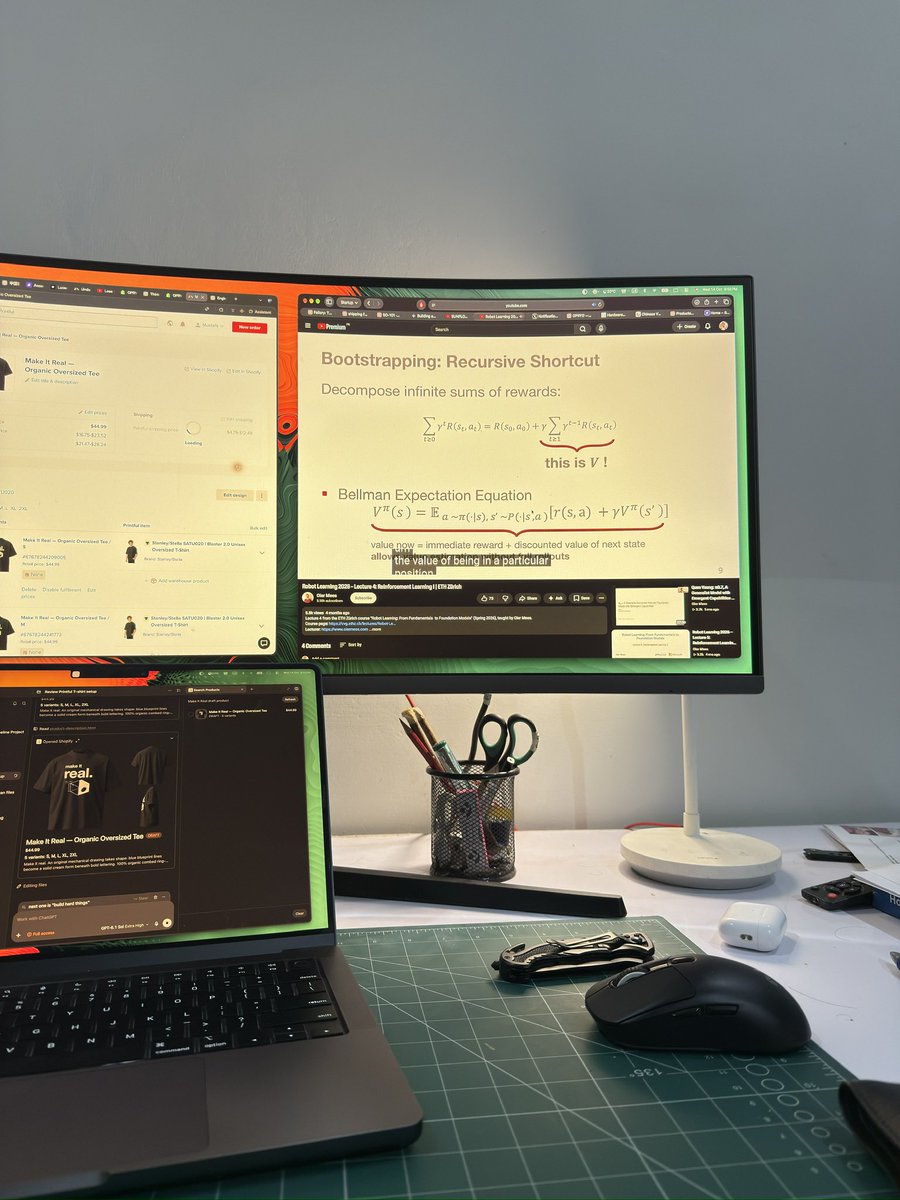
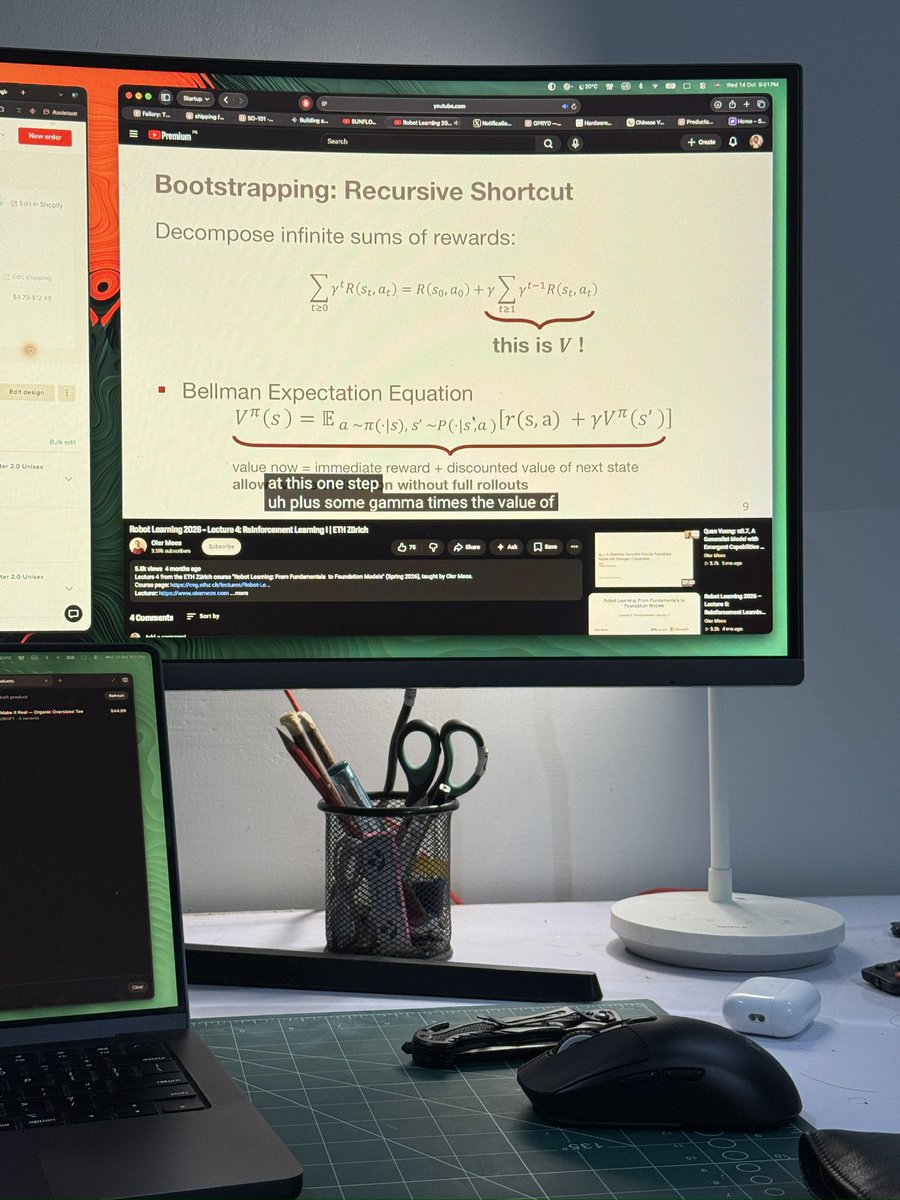
@Shra_va_ni Don't switch, just stick with claude

MBA = Master of Bot Administration
@oprydai This is the thing we just can't make them understand, people always understand it by themselves after surviving the harsh period of their time
how to study and learn really difficult subjects: 1. don’t panic. hard just means dense. it’s not impossible, it’s just packed. unwrap it slowly. 2. get a map before diving in. watch an overview video, read the table of contents, or skim the wikipedia page. you need context first. 3. use multiple sources. one book will confuse you, two will clarify, three will enlighten. 4. build intuition, not memory. visualize it. simulate it. code it. teach it to a friend or a wall. 5. tolerate confusion. you’ll feel dumb 90% of the time; that’s the price of learning something that rewires your brain. 6. connect it to reality. every abstract thing has a real-world analog. find it. relate it. ground it. 7. revisit the same topic after a week. mastery is not about reading once; it’s about returning after your brain has “chewed” on it. 8. don’t romanticize genius. smart people aren’t born knowing it. they just survived longer in the confusion phase. the truth is; learning hard stuff isn’t about intelligence. it’s about endurance, humility, and curiosity. you stay long enough in the fog until it clears.



Bloomberg Technology @technology
489K Followers 287 Following News on the global tech industry Watch Bloomberg Tech weekdays on Bloomberg TV at 11 am ET Podcast: https://t.co/8kX0blvfVk Newsletter: https://t.co/CRIkTrOEKi
Marques Brownlee @MKBHD
6.2M Followers 487 Following Web Video Producer | ⋈ | Pro Ultimate Frisbee Player | Host of @WVFRM @TheStudio
Max Zeff @ZeffMax
11K Followers 2K Following Reporter covering AI @WSJ | Formerly @WIRED, @TechCrunch, @markets | Send tips to my Signal username: mzeff.88
Dwarkesh Patel @dwarkesh_sp
282K Followers 1K Following Host of @dwarkeshpodcast https://t.co/3SXlu7fy6N https://t.co/4DPAxODFYi https://t.co/hQfIWdM1Un
Lerrel Pinto @LerrelPinto
11K Followers 221 Following Making robots more dexterous, robust and general. co-leading robotics at Meta MSL.
Nal @nalkalc
36K Followers 269 Following Angel investor. Ex Researcher in Deep Learning @GoogleDeepMind. Co-creator @GoogleAI Brain Amsterdam, Ex original @DeepMind, Edu at Oxford, UvA and Stanford.
Mustafa Suleyman @mustafasuleyman
1.2M Followers 181 Following CEO, @MicrosoftAI | Author: The Coming Wave | Past: Co-founder, @InflectionAI & @GoogleDeepMind
Yuke Zhu @yukez
25K Followers 480 Following Associate Professor @UTCompSci | Director @NVIDIAAI Co-Leading GEAR | CS PhD @Stanford | Building generalist robot autonomy in the wild | Opinions are my own
Rodney Brooks @rodneyabrooks
35K Followers 38 Following 🇺🇦I post regularly as @rodneyabrooks at https://t.co/sF7HmACpnF about AI and robotics. Here I post about political corruption in the US led by Trump. I am woke!!
Max Verstappen @Max33Verstappen
4.7M Followers 303 Following F1 World Champion @redbullracing | Keep Pushing the limits 🦁



Mark Zuckerberg @finkd
2.5M Followers 759 Following




Johnny Harris @johnnywharris
81K Followers 255 Following Video journalist. Vox, NYT, and now mostly on my YouTube channel inquiries: [email protected]
Shruti @heyshrutimishra
182K Followers 1K Following Reality is programmable | Building digital leverage w/ AI | Stay ahead with Superintelligence & Robotics developments Business inquiries: [email protected]

Markus J. Buehler @ProfBuehlerMIT
28K Followers 2K Following McAfee Professor of Engineering @MIT; Co-Founder & CTO at Unreasonable Labs; AI-Driven Scientific Discovery
Yi Ma @YiMaTweets
129K Followers 839 Following Chair Professor of AI, Hong Kong University Pursuing a Mathematical Theory of Intelligence: https://t.co/leZlkUQDhL
DeepLearning.AI @DeepLearningAI
355K Followers 113 Following We are an education technology company with the mission to grow and connect the global AI community.
MIT CSAIL @MIT_CSAIL
352K Followers 20K Following MIT's Computer Science & Artificial Intelligence Laboratory (CSAIL). Media Inquiries: [email protected] Check out the latest CSAIL content ⬇️
MIT Students @MITstudents
29K Followers 876 Following Connecting @MIT students to the latest announcements and updates on student life and learning.
MIT School of Enginee... @MITEngineering
33K Followers 478 Following Official Twitter account for the MIT School of Engineering.
MIT Alumni @MIT_alumni
29K Followers 4K Following News & stories about the @MIT community. Managed by Alumni Association staff.
MIT Technology Review @techreview
1.2M Followers 3K Following Our in-depth reporting on innovation reveals and explains what’s really happening now to help you know what’s coming next.
MIT MechE @MITMechE
26K Followers 446 Following Latest news and research from MIT's Department of Mechanical Engineering.
Lex Fridman @lexfridman
5.6M Followers 697 Following Host of Lex Fridman Podcast. Interested in robots and humans.
Alexandr Wang @alexandr_wang
836K Followers 946 Following chief ai officer @meta, founder meta superintelligence labs, founder @scale_ai. give everyone the adulthood they dreamed of in childhood
Michael Black @Michael_J_Black
107K Followers 744 Following VP Digital Human Research, Epic Games. Emeritus Director, Max Planck Institute for Intelligent Systems (@MPI_IS). Opinions are my own.
Animesh Garg @animesh_garg
37K Followers 1K Following Frontier AI & Reinforcement Learning for Generalizable Autonomy. @GeorgiaTech. @microagi Prev @nvidia @UCberkeley @stanford @UofT

Chip Huyen @chipro
157K Followers 738 Following @aisysbooks @goodailist AI Engineering: https://t.co/94dv4uTU1H Designing MLSys: https://t.co/G81hL2dWmr Reading @chipslib
Simon Willison @simonw
246K Followers 6K Following Creator @datasetteproj, co-creator Django. PSF board. Hangs out with @natbat. He/Him. Mastodon: https://t.co/t0MrmnJW0K Bsky: https://t.co/OnWIyhX4CH
Sergey Levine @svlevine
141K Followers 144 Following Associate Professor at UC Berkeley Co-founder, Physical Intelligence
Russ Tedrake @RussTedrake
7K Followers 99 Following Co-Founder and CEO at Walden Robotics. Professor at MIT.
Chelsea Finn @chelseabfinn
106K Followers 397 Following Asst Prof of CS & EE @Stanford Co-founder of Physical Intelligence @physical_int PhD from @Berkeley_EECS, EECS BS from @MIT
Andrew Ng @AndrewYNg
2.0M Followers 1K Following Co-Founder of Coursera; Stanford CS adjunct faculty. Former head of Baidu AI Group/Google Brain. #ai #machinelearning, #deeplearning #MOOCs
Fei-Fei Li @drfeifei
1.1M Followers 1K Following Cofounder/CEO @theworldlabs, Prof (CS @Stanford), Co-Director @StanfordHAI, #AI #SpatialIntelligence #GenAI #computervision #robotics #AI-healthcare
Google DeepMind @GoogleDeepMind
1.6M Followers 267 Following The engine room of @Google. Building AI safely and responsibly to solve the world’s most complex problems. Join us: https://t.co/jUHQA27iBL
Demis Hassabis @demishassabis
2.0M Followers 179 Following Nobel Laureate. Co-Founder & Chair @GoogleDeepMind; Chief Scientist of Alphabet. Founder & CEO @IsomorphicLabs. Trying to understand the nature of reality...
AK @_akhaliq
537K Followers 3K Following AI research paper tweets, ML @Gradio (acq. by @HuggingFace 🤗) dm for promo ,submit papers here: https://t.co/UzmYN5XOCi

SSI Inc. @ssi
134K Followers 0 Following A straight shot to safe superintelligence. Join us https://t.co/hHla3vusDE.
You might like


















