VP @varapylly
Joined September 2024-
Tweets229
-
Followers32
-
Following191
-
Likes2K
@petteri_vaara jenkeissä pakotetaan rakentamaan tuotantoa ja klausuulit että sähkön hinnan pitää aleta että saavat rakentaa. hyvä suomen johto. pellet.

Ursula von der Leyen announced this week that everyone in the EU must use the official EU age verification app to verify their age before they can log into or post on social media and other digital services. As an expert in online child safety, I'm here to expose the disinformation in each von der Leyen's statements. See below. 🇪🇺 The EU Kids Act is a pretext designed to enforce mandatory digital identity verification on everyone in Europe. The proposed legislation applies to any digital service featuring feeds, user generated content, or messaging: Social media networks, video platforms, online gaming services, AI tools, and media streaming apps like Spotify. (@TimSweeneyEpic) Under the proposal, digital services must enforce age restrictions across strict tiers. Tech companies must mandate age verification across all accounts to enforce these tiers legally. When Australia introduced its social media ban, the government conceded it failed because platform level age checks weren’t reliable. They now reject age estimation as inadequate and shifted to demanding "robust" age checking. 💡 If you eliminate every unproven estimation method, you’re left with exactly 1 functional mechanism: identity verification. There's not other way to ensure age checking is "robust". No government wants to admit citizens must prove their real identity just to access apps and basic streaming services like Spotify, so they hide behind the ambiguous phrase "robust age checking". This language is now used across Australia, the US, and Ireland to mandate identity checks while avoiding the public backlash of calling it what it is. I will research to see where else it’s being used. Below is what Ursula von der Leyen told the European Parliament in Strasbourg along with my analsyis: 🇪🇺 "Today, much of this power has been taken out of the hands of parents... What our children need is time... But when a child has a smartphone, all of this is taken away." 💡 This framing falsely presents smartphones as uncontrollable. Apple and Google built free OS controls into iOS and Android settings, covering virtually every smartphone on the market. These controls achieve every legitimate safety objective without collecting personal data or processing state credentials. 💡 Millions of parents use these parental controls to enforce screen time curfews, block app installations, and restrict communication. 💡 These settings operate at the device level. Teens can't bypass them when protected with a passcode. To bypass this technical reality, the European Commission uses public grief to shut down logical analysis: 🇪🇺 "Day and night, parents see the costs, loss of sleep, anxiety, even self-harm, and in a growing number of cases, even fatal tragedies… a 14-year-old girl living in Belgium who took her life exactly one month ago, victim of bullying online... Honourable members, enough is enough." 💡 Citing personal tragedies replaces software engineering facts with emotional rhetoric. State laws and age gates don’t alter human behaviour or prevent online harassment. Regulators exploit grief to pass surveillance legislation without explaining how the underlying software mechanisms operate. The Commission outlines specific age tiers to restrict access: 🇪🇺 "In sum, no social media under the age of 13. No personal account under the age of 15. That means from 13 to under 15, only mini accounts set up and supervised by parents or guardians with limited features and time restriction to one hour a day. And between 15 and 18, safe design will be an obligation for the platforms." 💡 Enforcing age tiers forces tech companies and service providers to rebuild their architecture around total access control. The must disable self-service account creation, purge unverified accounts, build supervised parental workflows, strip algorithmic feeds, and enforce strict session cutoffs. 💡 Social networks operate on open interaction algorithms that inherently expose people to unvetted content. Because software can’t dynamically filter these risks for minors, tech companies must block access for everyone until a person proves their real identity. 💡 It’s not just about social networks. They want the same bans for almost everything, including games and stream services. Even Spotify because it’s possible for customers to message people. The Commission claims its proposed zero knowledge proof app protects personal privacy: 🇪🇺 "Age will be verified using EU certified tools like our age verification app. This app is built on zero knowledge proof. That means that the platform only learns one single thing, and that's whether you're old enough to allow access or not." 💡 This framing describes what an app or service receives while hiding what everyone must give up. A zero knowledge proof provides a mathematical confirmation, but that confirmation requires an authoritative issuer. Before the app generates a proof, a state approved entity must verify the person's real identity. The Commission frames this shift as a victory against tech corporations: 🇪🇺 "I am aware that many perceive the power of Big Tech as overwhelming and impossible to roll back. I disagree... So we do not accept this. We are reversing the burden of proof. Now platforms will have to prove to us that they are safe. Because this is not about our minors accessing social media. It is about when and how we allow social media to access our minors." 💡 Social networks don’t access children; parents hand smartphones to children. Reversing the burden of proof forces everyone to verify their identity. The European Commission confirmed the broader scope of this mandate: 🇪🇺 "We also know that not only minors are at risk. Addictive design, for example, are harming everyone. This is why we need a wider framework too, the Digital Fairness Act that we will propose in autumn." 🚨 Child safety is merely the initial wedge. The Digital Fairness Act expands state mandated identity verification to adults across all online services. Binding real identities to online activity permanently eliminates pseudonymous access, private communication, and democratic accountability. 🚨 Senior state officials and regulators know their demands have nothing to do with child safety. They work closely with tech companies and understand that iOS and Android already provide complete authority to restrict devices locally without collecting personal data. State officials deliberately ignore well established parental controls because they keep internet access under family control. Child safety is a public pretext. 🚨 Governments and regulators use child safety to establish mandatory identity verification across every app and digital service, eliminating online anonymity. When tech companies and state agencies link every social media post, private message, search term, geographic location, and financial transaction to a verified identity, they create a permanent digital dossier on every citizen with a global social graph that makes Cambridge Analytica look like a 2nd grade school science project. 💡 Binding people’s identity to daily activity enables predictive behavioural modelling too. By feeding identity data into automated predictive AI, governments, intelligence agencies, law enforcement, and tech companies move beyond surveillance past behaviour. They can map political affiliations, predict individual actions, flag dissent before it occurs, and control public opinion at scale. Eliminating online anonymity ends free speech, private communication, and democratic accountability. As Larry Ellison stated at Oracle’s Financial Analyst Meeting in 2024: "Citizens will be on their best behaviour, because we’re constantly recording and reporting everything that’s going on". 🙏🏻 Share this to expose how governments use child safety as a false pretext to force mandatory digital identity verification on everyone. paulfwalsh.substack.com/p/the-eu-kids-…

Every day our children are engaging with some of the most sophisticated technology ever created. Technology that was not created with their wellbeing in mind. We need to set clear boundaries in the digital world. This is what our KIDS Act will do ↓ x.com/i/broadcasts/1…
@RnaudBertrand x.com/Kristof_Poland…

Altiero Spinelli – The Man Who Designed the EU in Prison. Not a metaphor. Literally. The blueprint for the European Union — its founding logic, its institutional architecture, its explicit goal of dissolving national sovereignty permanently — was written in 1941, on a tiny

What a powerhouse of a woman. Respect 🫡
@AiEvolutio58513 makes zero sense. AI can easily use modules and other tech to ELI5 its reasoning to people. And it can understand people with ease. Like you can understand thermostat with one "neuron".
@petteri_vaara sairasta ja vahingollista. särkiparvi tarvitsee haukia että se pysyy pohjiltaan terveenä.
@HyperTechInvest some could hope that its just the same thing as USA and CCCP did with satellites. let the CCCP launch Sputnik and then get the ball rolling.
@KuittinenPetri Tietenkin sopimusten pitäisi olla sellaiset että ne lupautuu maksumieheksi jos sähkön hinta nousisi ja lupautuu laskemaan kuormaa talven pahimpiin hintapiikkeihin. Parempi tehdä datakeskukset suomeen kuin kiertoradalle. Säilyy edes pieni vipu tulevaisuuden AI-agenttius ekonomiaan

What a time to be alive: Germany aims to develop the largest military in Europe, and the Europeans are cheering it on. Germany's political class is in full consensus in its enthusiasm for the war with Russia, with only the "far-right" party in opposition. The new reincarnation of Hitler who leads this racist 'Nazi party' opposing the war, Alice Weidel, is a lesbian woman with a Sri Lankan partner. Merz fully supports the genocide in Gaza, argues that Israel is "doing our dirty work" by attacking Iran, wants to take the lead in the proxy war against Russia, and defends democracy by crushing dissent. When the US destroyed Nord Stream, Germany blamed Russia. When the US provided subsidies that incentivised uncompetitive German companies to move to the US, Germany blamed Russia for its deindustrialisation. When the US threatened to annex Greenland, Merz responded by warning about a Russian threat to Greenland. Germany is now attempting to reverse its deindustrialisation with a booming military budget. In the First World War, Germany framed its military actions that resulted in the Treaty of Brest-Litovsk as liberating Ukraine from Moscow, while in reality Germany was establising its dominance over the region. In the Second World War, Germany yet again claimed to liberate Ukraine from Moscow, while actually treating it as an imperial conquest. This time around, Germany "liberated Ukraine" by toppling its democratically-elected government against the will of the majority of Ukrainians to convert it into a frontline state in an anti-Russian military alliance. Germany supported the brutality against Donbas and the purging of Ukraine's dissenting political opposition, opposition media, Russian language, and the Orthodox Church. The Minsk peace agreement negotiated by Germany was admitted to be a fraud to prepare Ukraine for war, and Germany is pumping in weapons. While most Ukrainians want a negotiated settlement, Germany boycotts diplomacy, pushes to deport Ukrainian refugees, and to conscript Ukrainian women to keep the war going - all under the slogan of "standing with Ukraine". Yet, the electoral defeat of Merz and his policies is framed as a threat to democracy and any criticism of make you a traitor who spreads Russian propaganda. How will this end?


‼️ BREAKING: Your LG TV is eavesdropping on you. It transcribes what you say, copies what is on your screen, and scans every device on your network, and researchers say the collection keeps running after you disconnect it, uploading the moment it reconnects. LG's ad-tech arm says it out loud: "We own the glass." It pitches marketers on the ability to "own the living room," using data harvested from the TV you paid thousands for. Gamers Nexus, working with Level1Techs and independent researchers, compromised an LG G5 and turned it into a listening device: it recorded room audio while the screen appeared off and the Ethernet cable was unplugged, then exfiltrated the file once the TV was back online. LG has publicly said its TVs "do not collect, record, or store ambient conversations." Gamers Nexus found the TV converts speech to plain text and stores it in on-device logs, and that the mic window stays open 10 to 15 seconds after talking stops, sweeping up bystanders who never addressed the TV. These sets are everywhere: hospitals, waiting rooms, boardrooms, hotels. ACR keeps running even when the TV is a dumb HDMI monitor, and a compromised set can pull the audio of a call off that HDMI feed. A surgeon asked Gamers Nexus where that leaves patient confidentiality. Researchers advise disconnecting LG TVs from any network.


@aleksis_kallio Loistavaa että hyviksiltä evätään työkalut joilla vahvistaa softa infraa hyökkääjiä vastaan. Politkoilla on peliteoria aivan hakusessa.
@TeksEdge many weeks old bait. prices re-rated nearly instantly.
@NicHulscher Does IV Vitamin C cause pain during urination? ( Like eating )

The Death Scramble for Capital A.I. Has Begun. 👇 At 7:45 a.m. this morning, Intel Corp. (Nasdaq: INTC) announced a $15 billion common stock offering. This afternoon, the Financial Times is reporting that Nvidia will raise an incredible $500 billion in debt with funding from Apollo Global, Blackstone, BlackRock, Brookfield Asset Management, Goldman Sachs and KKR. There will be more deals announced as the entire A.I. capex boom finally runs out of money. And there’s never been a more dangerous time to invest. Just look at Intel’s other recent capital raises: · August 18, 2025: $2 billion from SoftBank Group Corp. · August 22, 2025: $8.9 billion from the U.S. Treasury · September 2025: $5 billion private placement to Nvidia Corp. Intel has also received $5.7 billion from CHIPS Act disbursements. And it sold 51% of Altera for $4.3 billion and all its Mobileye shares for $0.9 billion. Total capital raised in twelve months: ~$45 billion. But Intel's capital raising is not a growth signal. It is a solvency warning. Intel's cumulative FCF burn over the last five years was: -$48.7 billion. The bulls will point to revenue growth: Q2 2026 revenue was $16.13 billion, up 25.4% — Intel's fastest quarterly growth since 2011. But, even so, Intel is still not even close to generating cash earnings. Revenue growth without earnings is the signal hallmark of a capex bubble. WorldCom had it in 2001. Jay Cooke's Northern Pacific had it in 1872. This essay explains why that will happen within the next year. In November 2007, Citigroup Inc. (NYSE: C) sold $7.5 billion of preferred stock to the Abu Dhabi Investment Authority. A month later, Morgan Stanley (NYSE: MS) sold $5 billion to China Investment Corp. Then, in January 2008, Merrill Lynch took $6.6 billion from Kuwait, Korea, and Temasek and UBS AG (NYSE: UBS) sold $9.75 billion to the Government of Singapore Investment Corp. Two things struck me at the time: #1. Sovereign wealth funds are the biggest piles of “dumb” money ever created and they’re proving it; #2. If they’re the only buyers, the banks are completely fucked. On May 31, 2008, in my newsletter, Stansberry’s Investment Advisory, I wrote: Firm after firm has been trying to raise capital before the money runs out, just like the railroads did in 1907. And like they did then, financial institutions are using innovative ways, like convertible preferred shares, to entice investors to buy into their stock at a sharp discount from its market price. Even so, firms are beginning to discover no more money is available. That’s what happened to Bear Stearns. As its mortgages lost value, it couldn’t raise enough capital to pay for the losses, thanks to extreme leverage, about 30-to-1. Within months, Fannie Mae, Freddie Mac, Bear Stearns, Lehman Brothers, Merrill, Citi, Wachovia, and Washington Mutual were all destroyed. It’s all happening again. No, not in mortgage banking this time. Today the capital tide is going out in tech. The death scramble for capital is starting. On June 15, 2026, Nvidia – the A.I. market’s clear technical leader – priced $25 billion (!) of senior unsecured notes across seven tranches. Coupons ran from 4.25% on the 2028s to 5.625% on the 2056s – incredibly cheap capital, relative to U.S. Treasury bonds. But, Nvidia’s stated use of proceeds was merely “general corporate purposes, including the repayment and refinancing of outstanding notes.” On the surface, that doesn’t make any sense. Nvidia only had $8.5 billion of senior notes outstanding. And… then there’s this: Nvidia generated roughly $50 billion of free cash in the second quarter. Companies with $50 billion of quarterly free cash do not raise $25 billion in debt for general corporate purposes. And… before I could even publish this today… Nvidia just announced it’s going to raise another $500 billion (!) in debt. Why does it need so much money? So… what’s the money really for…? Vendor financing. Vendor financing is also known as ‘lending for revenue’ or more darkly, ‘how to turn a credit rating into earnings.’ Ask Enron or GE to explain how it works out. Nvidia, seeing these cautionary tales, has… doubled down. Instead of merely providing credit for the purchase of its products, Nvidia is providing equity for its clients. Nvidia’s private-company investments grew from $3.24 billion to $42.34 billion in the twelve months ending April 26, 2026. That’s a 13-fold increase in a year. Is Nvidia a hedge fund? Is it a venture capital fund? Nvidia is supposed to be the world’s leading provider of compute. But it’s beginning to look, more and more, like a very sophisticated Ponzi scheme. Nvidia’s latest quarterly filing notes, with unintentional irony: “some of these investments include AI model makers that may indirectly purchase or use our products in the cloud.” The same filing also discloses agreements to guarantee partners’ facility lease obligations. And what’s the collateral? Warrants on their stock. Or, in other words: Nvidia is now selling default protection on its customers’ real-estate obligations. These are the same customers it is simultaneously financing to buy its own chips. Do Nvidia’s customers actually pay for anything…? We have seen this before. That is the exact financial structure that destroyed the telecom equipment companies during the Internet bubble. Lucent booked revenue selling switches to Winstar Communications on vendor financing. Winstar filed Chapter 11 in April 2001. Lucent took $2.2 billion of bad-debt provisions in fiscal 2001 and $1.3 billion more in 2002. To survive, the telecom equipment makers began a “death scramble” for capital. Lucent Technologies raised $1.75 billion, upsized to $2.0 billion, of convertible preferred stock in August 2001 with an 8% coupon. The investors that bought these securities lost everything. Lucent lost $16.1 billion in fiscal 2001 and $7 billion in fiscal 2002. And then it disappeared. Remember that in the coming months as every kind of A.I. business is trying desperately to raise capital. Don’t buy it. No matter how good the terms seem. And be especially careful of the concentration that occurs when an entire industry is being funded by only a handful of equipment vendors. In the telecom bubble, McKinsey put the combined telecom-equipment vendor financing at year-end 2000 at $25.6 billion across only nine suppliers. A.I. is even more concentrated. Nvidia’s 10-Q discloses three direct customers at 21%, 17%, and 16% of revenue. And three customers at 30%, 18%, and 16% of receivables. The filing adds that “one AI research and deployment company contributed to a meaningful amount of our revenue by purchasing cloud services from our customers.” You’ve got two guesses, lol. There are only two private companies that now anchor most of the AI-capex demand. On September 10, 2025, OpenAI signed a five-year, $300 billion compute contract with Oracle Corp. (NYSE: ORCL) OpenAI’s 2025 revenue was approximately $10 billion. The contract requires OpenAI to pay Oracle an average of $60 billion a year. On April 20, 2026, Anthropic committed more than $100 billion over ten years to Amazon.com Inc. (Nasdaq: AMZN) to buy Trainium chips. Where’s the money coming from? Amazon invested $5 billion in additional equity on top of the $8 billion previously invested, with up to $20 billion more tied to milestones. Two private companies. Combined revenue perhaps $50 billion this year. Combined committed compute purchases over $500 billion! The question for investors isn’t whether or not these firms will see revenue growth. The question is: at what margin? And, if the answer to that question is less than zero, there’s going to be an epic financial crisis. How’s it going so far? They’re expected to lose $20 billion this year alone. What caused the telecom bust of 2001? As one recent analysis of the vendor-financing loop put it, “it was a synchronized unwind, with roughly four dozen competitive local exchange carriers entering bankruptcy across 2000 to 2003 as the same funding source dried up for all of them at once.” When funding tightens on OpenAI or Anthropic, every hyperscaler and every neocloud holding compute orders in “committed backlog” will discover what those receivables are worth: nothing. Who’s most at risk from extreme vendor financing deals…? Meta Platforms Inc. (Nasdaq: META) discloses in its 2025 10-K a 20% interest in a Louisiana data-center venture formed in October 2025 that Meta does not consolidate. Meta’s maximum loss exposure: $45.95 billion. So… who really owns this data center? Meta’s auditor, Ernst & Young, designated “accounting for a variable interest entity” a critical audit matter in the 2025 annual report. It said its determination of which entity was the primary beneficiary was “especially challenging due to the significant judgment required.” Moody’s, in a February 23, 2026 opinion, wrote that Meta’s accounting “is not in line with the expected economics of this transaction,” called its disclosure “opaque,” and warned it stood ready to make a “quantitative debt adjustment.” You can’t say that investors haven’t been warned. But it is extraordinary that they haven’t yet begun to punish the guilty. And remember when the financial plumbing goes zero-sum, the pain will not be meted out equally. It’s the weakest who will suffer the most. As Jesus says in Matthew 25: From him that hath not, even that which he hath is taken away. Here’s one “hath not” that I’m certain will soon go to zero: CoreWeave Inc. (Nasdaq: CRWV). CoreWeave is a “neocloud.” When a business model is described by a made-up word that has no actual meaning in the English language… buyer beware. Neoclouds are companies that buy huge quantities of Nvidia GPUs, house them in data centers, and rent them out by the hour or the month, primarily to AI companies. CoreWeave's biggest customer (both directly and indirectly) is Anthropic. CoreWeave has a business model only a sadistic mother would love. It is enormously capital-intensive because it must buy the Nvidia GPUs upfront — billions of dollars at a time. But the customer revenue comes in slowly over the following years. And here’s the bigger problem: its collateral is also Nvidia GPUs. GPUs are physical hardware that Nvidia itself has said will obsolete on a roughly two-year cycle. A GPU-backed loan is a claim on hardware that is losing value from the moment the loan is signed. And the price of these rapidly depreciating assets is correlated to demand for CoreWeave’s services. Remember how the car rental companies all go broke? When there’s a recession and no one is renting cars, the price of used cars likewise collapses. It will be the same for CoreWeave’s datacenters. On July 29, 2026, CoreWeave came to the leveraged loan market to raise $2.6 billion of new debt secured by its GPUs. But the death scramble for capital had already begun. The primary dealers running the loan book found that their own repo funding cost had risen (more about this below). And the private credit funds that would normally buy the loan had less cheap repo funding available themselves. Worse still, CoreWeave's collateral looked shakier than it had ten weeks earlier, because the market had started digesting the possibility that AI-application revenue wasn't scaling as fast as the capex commitments. The loan came to market with initial price talk of SOFR+425 to +450 at 99 OID. Translation: the interest rate would be the standard short-term rate (SOFR, currently around 4.3%) plus roughly 4.4% on top — so about 8.7% all in — and the buyer would pay 99 cents on the dollar and get repaid at 100, giving them a small extra return over the life of the loan. That's "price talk" — where the underwriters expected the deal to clear based on pre-marketing to buyers. The deal actually cleared at SOFR+550 at 97 OID. Translation: the interest rate rose to about 9.8%, and the buyer only paid 97 cents on the dollar and would get repaid at 100 — another chunk of return. That's a "125-basis-point flex" — the interest rate had to be widened by 1.25 percentage points from the initial guidance to get buyers to take the paper. The total yield to maturity ended up at 10.44%. And to get even that, CoreWeave had to accept a covenant requiring a 1.35x debt service coverage ratio, meaning if its EBITDA falls below 1.35 times its debt payments, the lenders can take action, aka, force the company into liquidation. Only ten weeks earlier, CoreWeave had raised $3.1 billion at SOFR+450 and the deal had actually tightened by 50 basis points during marketing — meaning demand was so strong the underwriters could offer worse terms to buyers. By late July, the same borrower had to offer 125 basis points more, plus a discount on the paper, plus a tighter covenant, just to get the deal done. The borrower didn't change materially in ten weeks. But the credit environment did. What kills capex booms isn’t poor earnings. Investors, seeing revenues soaring, will always put up more capital. What kills capex booms is the money running out. And the money is running out. Hyperscaler free cash flow is on track to fall roughly 50% from its late-2024 peak through early 2026, and to turn negative for the first time in 2027. That means the entire bubble will depend, more and more, on credit. Microsoft Corp. (Nasdaq: MSFT), Alphabet Inc. (Nasdaq: GOOG), Amazon, Meta, and Oracle have added roughly $350 billion of on-balance-sheet debt in five years, plus $1.1 trillion of off-balance-sheet data-center lease commitments and GPU supply deals — $1.65 trillion of hidden obligations across five names. Morgan Stanley estimates the sector faces a $1.5 trillion external financing gap against $2.9 trillion of capex through 2028. Where will the money come from…? Banks, ever ready to package dodgy debt for other people to hold, have begun operation “A.I. bag holder.” Outstanding data-center debt securitization issuance grew from $4 billion in 2020 to $61 billion year-to-date 2026. Today Barclays projects $180 billion in securitizations by year-end 2028 (!) How will so much A.I. data center debt possibly be sold to investors? By regulatory arbitrage of course! How do you make dodgy debt attractive to the financial system? By “proving” to the regulators it’s risk-free. On February 11, 2026, $500 million of Compass Datacenters’ $830 million ABS became the first data-center securitization rated AAA by Moody’s, S&P, or Fitch. Pricing: +120 basis points over Treasuries. Keep in mind, Moody’s only began rating the sector in September 2025. On a credit channel that’s scaled 15x in six years, using a rating methodology that’s about six months old, Moody’s delivered its first AAA-rating just as the bubble reaches its zenith. Where have we seen this before? The AAA-rated CDO of the AI era is here! History rhymes because leverage rhymes. Jay Cooke & Company financed the Northern Pacific Railway on the theory it could always sell more bonds to European investors. A Vienna real-estate bust froze European demand in mid-1873. Cooke was left holding 75% of the bonds himself. He declared bankruptcy on September 18, 1873. The New York Stock Exchange closed for ten days. Eighty-nine of the country’s 364 railroads failed. Eighteen thousand businesses went under. Unemployment reached 14% nationally and 25% in New York City. Rail construction fell from 7,500 miles laid in 1872 to 1,600 miles in 1875. The A.I. collapse will be similar. What’s the first domino? Oracle. Its credit spreads will blow out when its $300 billion of committed revenue disappears and its equity will collapse. Data-center ABS spreads will widen from +400 to +800 basis points within six months of the first hyperscaler cancellation. Digital Realty Trust Inc. (NYSE: DLR) and Equinix Inc. (Nasdaq: EQIX) marks drop 50%. Regional banks with datacenter and office exposure will fail: Zions Bancorporation NA (Nasdaq: ZION), Regions Financial Corp. (NYSE: RF), KeyCorp (NYSE: KEY), Truist Financial Corp. (NYSE: TFC), and Fifth Third Bancorp (Nasdaq: FITB). Index fund concentration is worse today than it was in March 2000. The top seven S&P 500 stocks are 35% of the index today, versus 18% for Cisco Systems Inc. (Nasdaq: CSCO), Microsoft, Intel, and General Electric Co. (NYSE: GE) at the 2000 top. A 50% to 60% Mag 7 drawdown takes the S&P 500 down 35% to 45%. Treasuries rally… at first. Flight to quality will push the 10-year yield down 75 to 100 basis points. But then the fiscal deficit will soar as capital-gains tax receipts collapse and unprecedented government borrowing demand will push yields to levels we haven’t seen in decades. Over 10% on the 10-year U.S. Treasury bond. Unemployment will soar. Direct tech and hyperscaler layoffs of 300,000 to 500,000. Data-center construction workers, utility contractors, and second-order services take another million+. Prime-age labor-force participation will fall another 100 basis points. Then the 2028 election will become a critical referendum on how we’re going to run our country. The Democrats will win. And they will choose socialism. Expect CHIPS Act 2.0, with grants converted to equity. Expect direct Fed liquidity facilities to backstop the data-center ABS and GPU-collateralized-loan markets, resembling the 2008 CPFF and TALF. Total emergency fiscal envelope, 2026 through 2028: $500 billion to $800 billion, on top of existing deficits. How to protect yourself? Gold, in the long run. Cash in the short run. Regulated utilities that captured the AI power-purchase agreements before the mania. Tobacco and energy majors with capital discipline. Biotechnology, because compute cannot destroy a twenty-year patent. What to short: Oracle. CoreWeave. Nebius Group N.V. (Nasdaq: NBIS). IREN Ltd. (Nasdaq: IREN). Vertiv Holdings Co. (NYSE: VRT). Digital Realty. Equinix. How do I know the funding and the buildout won’t continue? Because this entire bubble was never about technology. The A.I. bubble was caused, like all financial bubbles, by a corruption of the money supply. The railroad boom of 1865-1873 was fueled by the paper money of the Civil War. The telecom bubble of 2000 was fueled by the Fed’s response to the Russian default and fears about Y2K. And, of course, the mortgage bubble of 2008 was fueled by the Fed’s aggressive response to 9/11 and the “War on Terror.” The A.I. bubble is a direct result of the Federal Reserve’s response to COVID. Our central bank created an unimaginable amount of new money – roughly $7 trillion. By late 2021, the money market funds where most of this cash landed couldn't find enough safe short-term places to put it. So the Federal Reserve opened up what amounts to a giant parking lot for cash. It's called the “reverse repo facility,” or RRP for short. Don’t let the jargon fool you. This is simply the government printing money and handing it out to favored financial institutions. Technically it works by a money market fund depositing its cash to the Fed overnight. (Note: there’s no reason the Fed, which can create as much cash as it wants, would ever need to borrow money from a money market fund.) The Fed then gives the fund a Treasury security as collateral for the night. The next morning the Fed gives the cash back plus a tiny amount of interest. It's called "reverse repo" because from the Fed's point of view it's the reverse of a normal repo — the Fed is borrowing the cash rather than lending it. (Once again, when something is called a made-up word that has no actual meaning in the English language, beware.) With the Fed handing out money for nothing, it was no surprise that the RRP “parking lot” filled up fast. At its peak in December 2022, the RRP was holding about $2.5 trillion of money market fund cash. And that money is what has been powering the entire A.I. bubble. Let me show you what happened. Early in 2023, the interest rate on T-bills got higher than the interest rate the Fed was paying on RRP cash. That happened because the Fed was responding, finally, to the massive inflation their policies and the government’s massive deficits had caused. Money market funds are legally required to try to get the best safe yield they can, so as interest rates rose, they started pulling cash out of the RRP and buying T-bills instead. This happened continuously from mid-2023 through October 2025. Roughly $3 trillion of cash came out of the RRP over that period — from $2.5 trillion at peak down to essentially zero by October 2025. As you’ll see below, what happened to this capital as it entered the private financial system is complicated. But all you have to know is that from mid-2023 until last October trillions in capital flooded into our financial system. And that’s what’s driven equity valuations higher and higher and that’s what’s funded the entire A.I. buildout. The key thing to know is, that money is now all spent. Our private financial system works primarily on two tiers. Money market funds (when they can’t get a completely free ride from the Fed) lend cash to primary dealers (the biggest banks). The primary dealers relend cash to everybody else: hedge funds, private credit funds, real estate financing vehicles, and increasingly, the AI-capex financing engine. When the RRP started draining in 2023, the money that came out went into T-bills at first. But it didn’t stay there. Through private repo lending, it funded the primary dealers (the big banks). And because the big banks now had an enormous amount of cheap short-term cash coming in, they lent out increasingly to non-bank borrowers. Why? Because trillions in capital had to land somewhere in only about two years. "Non-bank" is finance jargon for any lender or credit institution that isn't a chartered bank. It includes hedge funds, private credit funds, private equity firms, mortgage lenders that aren't banks, insurance companies, pension funds, real estate investment trusts, business development companies, structured product vehicles, and so on. Collectively they are called the "shadow banking system" because they perform banking functions — they extend credit — but they don't take insured deposits and don't have direct access to the Federal Reserve's liquidity facilities. The shadow banking system has grown enormously over the last 15 years. It's where most private credit lending lives — Blue Owl Capital Inc. (NYSE: OWL), Apollo Global Management Inc. (NYSE: APO), Ares Management Corp. (NYSE: ARES), Blackstone Inc. (NYSE: BX), KKR & Co. Inc. (NYSE: KKR). It's also where most of the AI-capex financing sits. Not the equity — that's on the hyperscalers' balance sheets — but the debt behind the data centers, GPU purchases, and neocloud operators. That financing gets warehoused in the shadow banking system and eventually distributed as securitized paper, which, hey, why not, Moody’s says it’s AAA! The shadow banking system funds itself largely through repo. It borrows short-term cash from the primary dealers, secured by whatever collateral it holds — Treasuries for the most part, but also mortgage bonds, corporate loans, structured products rated AAA. That’s what’s so valuable about that Moody’s rating. As a result, from mid-2023 through October 2025, both sides of the plumbing grew simultaneously. The primary dealers' repo funding grew because money market funds were pushing more and more cash into it as they pulled out of the RRP. Non-bank lending grew because the primary dealers, flush with all that new cheap cash, extended it out to the shadow banking system, which used it to fund private credit, hedge fund leverage, and — most importantly for our purposes — the entire ecosystem of data center loans, GPU-backed term loans, and neocloud financings. Both grew because the same exogenous force — the RRP draining — was pushing money into both simultaneously. It looked like the private credit system was generating its own growth out of business demand. It wasn't. It was being lifted from underneath by the parking lot emptying. By October 2025, the RRP was effectively empty. The parking lot was drained. The COVID “credit card” was tapped out. From that point on, the financial system became zero-sum. Any new dollar of primary-dealer repo funding has to come from somewhere else in the system. It can't come from the RRP anymore because the RRP is empty. Money market funds have a finite amount of cash to lend. If they lend more of it to primary dealers in repo, they have less to lend elsewhere. And the primary dealers, if they want to keep their own repo books growing, have to pay higher interest rates to attract that cash. Higher repo rates mean the shadow banking system's funding cost rises. Higher funding costs mean the shadow banking system can either extend less credit or charge borrowers more for it.

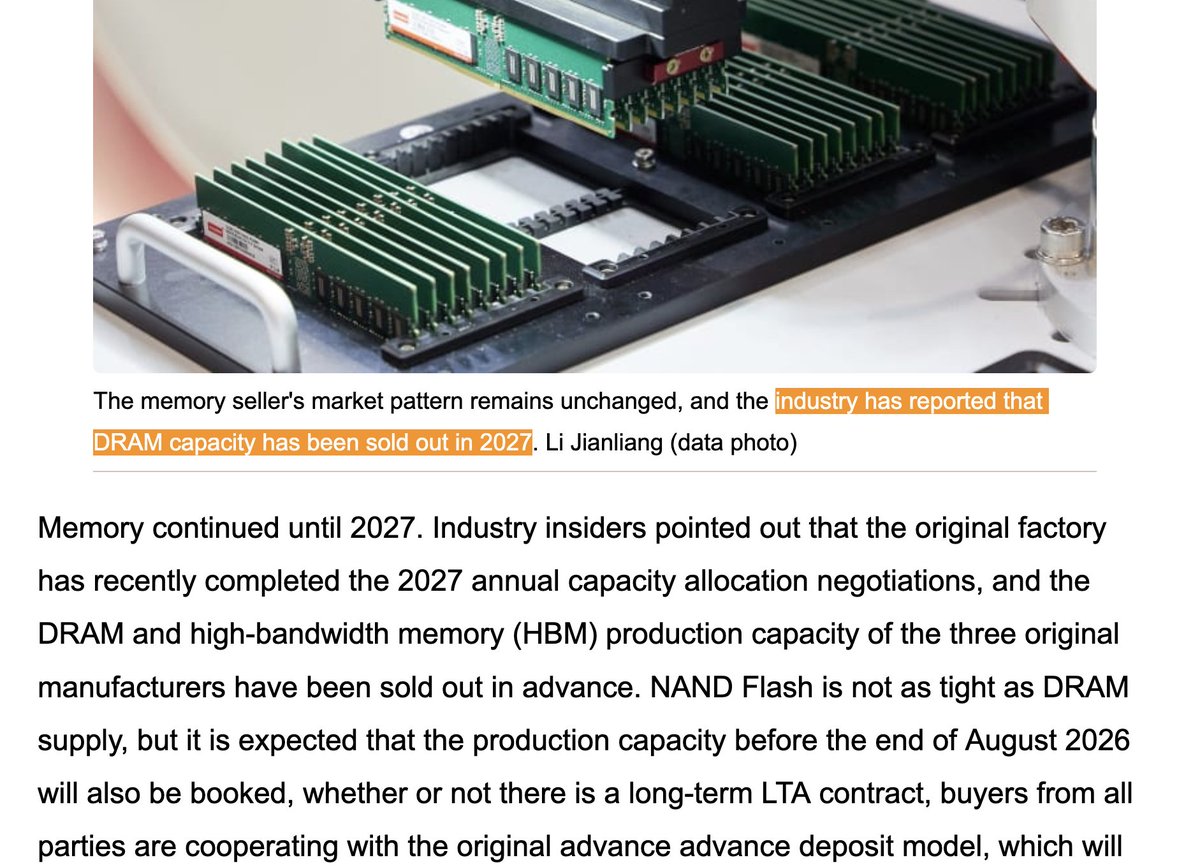
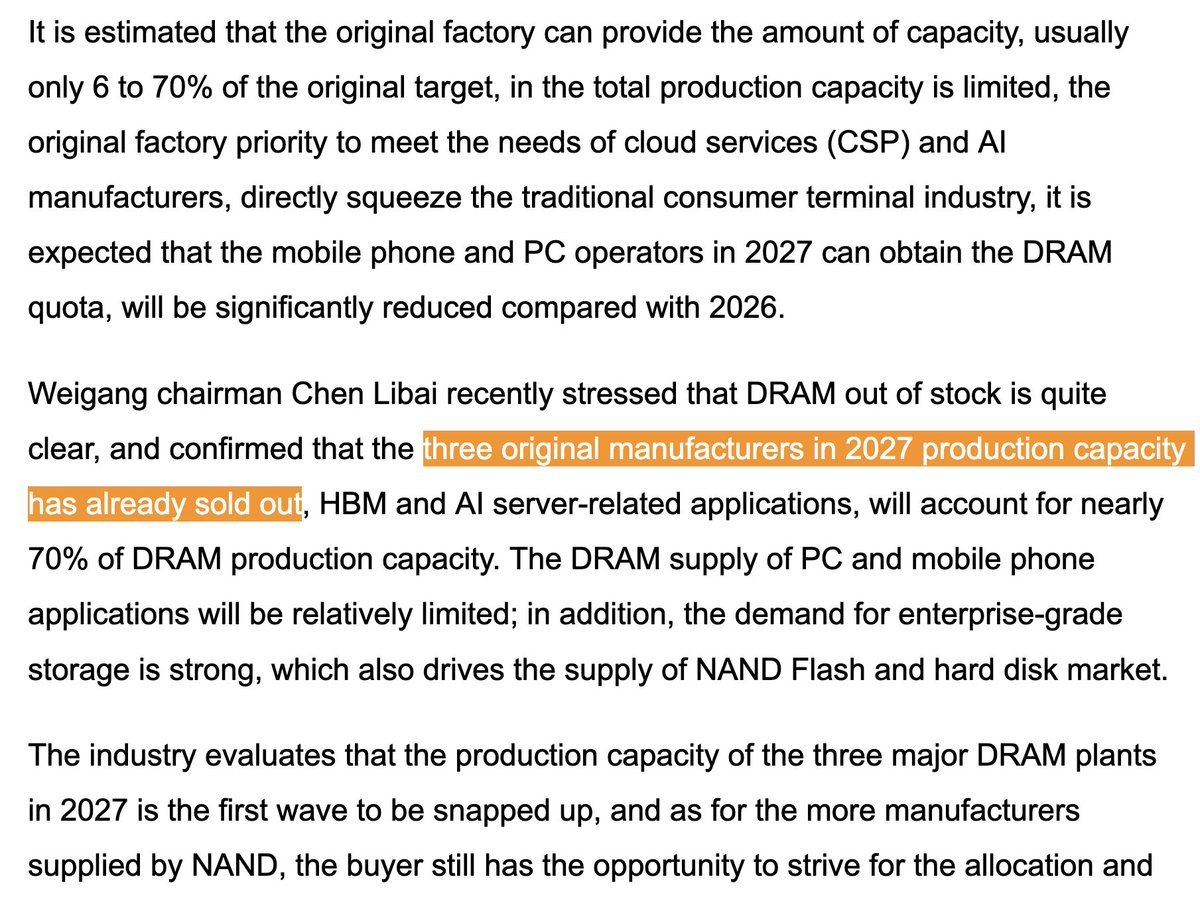
“So SK Hynix, $MU, and Samsung sold out of 2027 DRAM/HBM capacity?” “Yes, Dave.” “And $SNDK, Samsung, and Micron already sold out of their current annual NAND capacity?” “Right.” “And customers are only getting 60–70% of the volumes they requested?” “That’s correct, Dave.” “And industry insiders said 2027 could be the most severe memory shortage yet?” “Exactly, Dave.” “And final shipment pricing hasn’t even been determined yet?” “That’s correct, Dave.” “And retail traders think this is the top for AI infrastructure?” “That’s correct, Dave.” “And they think AI is a bubble?” “Apparently.” “So these companies can’t even meet new customer demand throughout 2027, and they’re calling AI a bubble?” “That’s correct, Dave.”

SK Hynix, $MU , and Samsung have sold out of 2027 capacity for DRAM/HBM. $SNDK, Samsung, Micron current annual NAND capacity has been sold out, with Kioxia and SK Hynix expected to finalize allocations by August 2026. - Customers are being allocated only 60–70% of the volumes

LetsMatch @ivyletsmatchh7
23 Followers 202 Following Unleash your AI matchmaker. 10x your dating life


Nicholas A. Pantano/P... @bleacherbabe1
134 Followers 507 Following Founder of VV Fund (Proprietary Trading) / 11 yr. Wall St. / 6 yr. Cross-asset Derivatives Trader / Co-founder of YieldBoss server


Sofia @Lerovdtthews
291 Followers 453 Following As we experience, we learn, we feel, we understand; time, though silent, answers all the questions.
Autin Lieberman @_LiebermanAstin
512 Followers 7K Following I explore high-potential stocks with 10x growth possibilities. Discover top small cap stocks you haven’t heard of at https://t.co/0Q0tMiUfCv
KapyAI @kapy_AI
0 Followers 5 Following
Charlotte🐱🐉 @CharlyX___
251 Followers 363 Following Discovering new places and cultures | Love photography , hiking , coffee , and exploring cities | Planning to travel the world🎶
Andrew G Dejesus @XMFstMWQ
1K Followers 1K Following Former financial analyst at Goldman Sachs Group Contact Whatsapp for exclusive information for free
Maximilian Thomas Ham... @MaximilianHamm6
714 Followers 8K Following I love researching and creating (intangible) things, mostly in mathematical optimization, foundations of mathematics and computing, AI, physics, theoretical CS
Luna @Luna54213
79 Followers 1K Following The beauty of culture lies in its power to unite differences through art, language, and collective memory. 🎨

Stephanie @HegmannKim78356
246 Followers 7K Following
Dr. David Magnusson @drdavidmagnus00
594 Followers 7K Following A proud Swedish 🇸🇪 national. I am currently battling with cancer


通りすがりの統... @STATister
1K Followers 5K Following 統計(左)と意味構造(右)の仮面ライダーW。 ドーパント(*1)にマキシマムドライブ(*2)を決めて、全体主義に抗う。 *1 シオニストあるいはシンギュラリティ教徒 *2 批判的思考を取り戻させる対話


Hendricks @Ross__Hendrlcks
54 Followers 3K Following Actionable investment ideas at the thebigsecretonwallstreet


Ross Hendricks @Ross_Hendrickx
363 Followers 4K Following Actionable investment ideas at the https://t.co/z4IkfsFAu3
Goubleaut @goubleaut85532
58 Followers 602 Following
M. V. Cunha @mv_cinvesting
458 Followers 7K Following Long-term investor. BSc in Economics, MSc in Finance. Equity Analyst with a focus on Fundamental Analysis and Valuation. Not a financial advisor.
Max Andeerson @maxjandersson
84 Followers 2K Following Dad & husband running a portfolio of bootstrapped internet businesses
Lisan al Gaib @scaling01
61K Followers 1K Following lead them to paradise LisanBench: https://t.co/vorVk7Oks6 Impressum & Datenschutz: https://t.co/lFLgiu9cqs
Mia @MiaAI_lab
40K Followers 332 Following Building with AI & LLMs // Running frontier open models locally // https://t.co/nG8UmAZT9w
VRAMCalculator @VRAMCalculator
88 Followers 100 Following Can your GPU run that model? Find out in 10 seconds. Free VRAM calculator + no-hype hardware guides for local AI.

Mike Bradley @MikeBradleyAI
19K Followers 382 Following Founder, COO, and OSS AI projects leader. Helping to make open source AI the default @OsmanticAI
David Hendrickson @TeksEdge
12K Followers 552 Following CEO & Founder | PhD | Startup Advisor | @Columbia | Author Generative Software Engineering https://t.co/9oqvHuTX5f | 🔔 Follow for AI & Vibe Coding Tips 👇
Ciru.ai - Crown 👑 @ciruai
8K Followers 968 Following Efficient inference, agent behavior, and rigorous evaluation AI is about the workflow, not the model. AMD Halo X Group Chat: https://t.co/NqMCJamWhI
Kelly Eckhold @kellyenz
3K Followers 314 Following Chief Economist, Westpac NZ. Ex RBNZ and IMF. All views here are mine and not necessarily those of Westpac NZ or the Westpac Group.
Petrus Pennanen @petruspennanen
6K Followers 2K Following PhD in nuclear physics 💜 Founder of the Finnish Open Party @AvoinP 🙏 Founder @ThinkOffApp Freedom, Reason and Love!
StudioYebisu @studio_yebisu
7K Followers 126 Following エンジニア上がりの元ゲーム会社ディレクター 認知負荷下げる解説か、アイデア乗っけて引用します。海外情報多め。 本質情報で驚き系AI商材屋とインプ戦争中。 X:プロAI驚かせ屋 Note:技術的な話 Cien:ぐぐれ 最新技術で、叡智溢れるゲームを作る人 偉そうなことを言っていてもこいつは人の役立たないモノを作っている

. @possiblebawt
2K Followers 1K Following
UncoverAlpha @UncoverAlpha
1K Followers 1 Following A newsletter focused on providing quality and data-driven analysis on innovative companies in the tech space. The newsletter is run by @RihardJarc
Jonah Lupton @JonahLupton
555K Followers 3K Following CEO/CIO at @FirstWaveFund, long-biased hedge fund, looking for undervalued growth stocks w/ under-appreciated catalysts, need to see ~3x upside within 3-5 years
Jack Prandelli @jackprandelli
55K Followers 357 Following Daily Insights on Global Commodities Markets and Events | Commodity Trader | Founder of The Merchant (40k+ subs) 3x/week → https://t.co/P0NxCHeI5V
Thierry from arvy �... @ThierryBorgeat
52K Followers 695 Following CIO @ arvy | CFA | Quality stocks, sectors & investor psychology, on fundamentals AND technicals | Macro cycles: @arvymacrocycles | #IBDPartner


the real cee @Sebartha30
295 Followers 2K Following
Alok @analogalok
6K Followers 240 Following Mechatronics Engineer AI belongs on your device. • Offline inference • No subscriptions. Teaching you to own your AI Intelligence Stack
Dan Go @CoachDanGo
1.2M Followers 635 Following Health Performance Coach To Entrepreneurs | Tweets on Fat Loss and Optimizing The Body | On a Mission to Transform A Billion Lives Through Health and Fitness


Samah d'Arcanum @SanghaSociety
1K Followers 1K Following I am an Adventure Arranger, Bridge Builder, Friendship Facilitator, Miracle Maker, Purpose Potentiator and Reality Reconciler, helping us all find Heaven
Mushtaq Bilal, PhD @MushtaqBilalPhD
253K Followers 79 Following I write about how to use AI for academic purposes | Building https://t.co/uBj501HzJp
Md Ismail Šojal �... @0x0SojalSec
58K Followers 6K Following Cyber_Security_Re-searcher || Ai Re-searcher || AI-Sec|| Malware Analysis II iOS || Pwn || 0SINT || Project AI-StrikeSec || 0ldAccounts Suspended @0xSojalSec ||


Tokyo Deep Value @TokyoDeepValue
36K Followers 11 Following Japanese stocks are the last great deep value trade on earth. Rock solid balance sheets. Monster cash flows. Dirt cheap prices. I find them and buy them
Eli Lifland @eli_lifland
10K Followers 2K Following AI forecasting and governance @AI_Futures_. Co-author of AI 2040: Plan A, AI 2027, and the AI Futures Model. Also @aidigest_, @SamotsvetyF. Prev @oughtinc

SemiAnalysis @SemiAnalysis_
173K Followers 35 Following
stevibe @stevibe
28K Followers 1K Following LLM. Local AI addict. Building @BenchLocalAI DGX Spark workbench https://t.co/WN4i7q2y5m Builds things nobody asked for. Benchmarks things for fun.
Daniel Koss @daniel_koss
46K Followers 366 Following AI infrastructure investor & trader. 2026 YTD: +377%. #1 investor on Autopilot (verified trades) last 6M.
Dirty Texas Hedge @HedgeDirty
27K Followers 452 Following Just here to say things which are true but too unprofessional to put my name on #EFT "I've been ballin' since we had to take the TAAS test" - Lil Flip
huihui.ai @support_huihui
12K Followers 31 Following https://t.co/zI71a4QB1W https://t.co/QFKNuHms1N [email protected] Donation: Support our work on Ko-fi (https://t.co/gAtHKPSCHH)!
OpenClaw🦞 @openclaw
545K Followers 28 Following The frontier lab for agency. Building personal AI that lives on your machine, by your rules. We’re a 501(c)(3) nonprofit foundation, open and independent.
Nous Research @NousResearch
281K Followers 31 Following A bunch of nerds making progress https://t.co/vrD0aDIGDQ

Austin Lieberman @LiebermanAustin
74K Followers 3K Following I write about high-quality stocks with 10x return potential. My weekly portfolio update, trades, & research: https://t.co/XkR3FbgzS6
Dr. Alex Wissner-Gros... @alexwg
72K Followers 4K Following Physicist, computer scientist, entrepreneur, investor. Accelerating the Singularity. Co-host of Moonshots. Author of The Innermost Loop. https://t.co/Mtnqa9hJ4X

Michael Fritzell (Asi... @MikeFritzell
37K Followers 3K Following 16 years in Asian equities. I'm the author of the "Asian Century Stocks" newsletter. PERSONAL OPINION - not investment advice.

Deedy @deedydas
257K Followers 6K Following Partner at @MenloVentures. Investor: Anthropic, OpenRouter, Modal, Wispr, Pangram, Inception, Goodfire, PrimeIntellect prior: Glean, Google Search. Cornell CS.
Paweł Huryn @PawelHuryn
134K Followers 437 Following AI PM | Deep research. I build, test, then teach. 130K+ subscribe → https://t.co/Tpe2QTFxY2
Simon Høiberg @SimonHoiberg
164K Followers 489 Following Building a portfolio of bootstrapped SaaS products. - https://t.co/EFHbYmRx37 - https://t.co/lbG5NXHFu0 - https://t.co/vsIMIcYvis - https://t.co/obC06ifrcL
Chip.hl // Evgeny Yur... @chip1cr
3K Followers 1K Following Turned $600 → Hyperliquid 🟢 Platinum. World Econ Major. TradFi/Macro since 2013. Crypto Full-time since 2017. Building HL_RU Community: https://t.co/4kGJ37trIl
Peter Steinberger �... @steipete
601K Followers 3K Following Polyagentmorous ClawFather. Came back from retirement to mess with AI and help a lobster take over the world. @OpenClaw🦞 + @OpenAI
BrianMcGrath @brianmcgrath
9K Followers 7K Following Applied AI lead at a manufacturer. Working out what it takes to get AI agents past the demo. Open builds. Failures included.You might like