CRay @Raymenchua
Joined February 2022-
Tweets521
-
Followers39
-
Following278
-
Likes8
Wow, this is a really nice tool! With earnings season, you have to update every model by hand overnight. This tool does it in the background, in your own format. It allows you to connect any data source to external providers and materials and helps you get real time updates in your excel model based on the task you describe. Imagine you made a model for a company, and now you have to get the new SEC filings to update it yourself but its all tedious and time consuming. With this tool, you can do it automatically, with better accuracy, and saves you time. I definitely recommend checking it out...personally I do a lot of modeling and believe this can be useful to me.

Today we're launching Financial Modeling Autopilot. It's the first AI that operationalizes financial modeling across your entire book of coverage. Autopilot builds and updates models the way you would, fully in the background, and in a way you can fully trust.
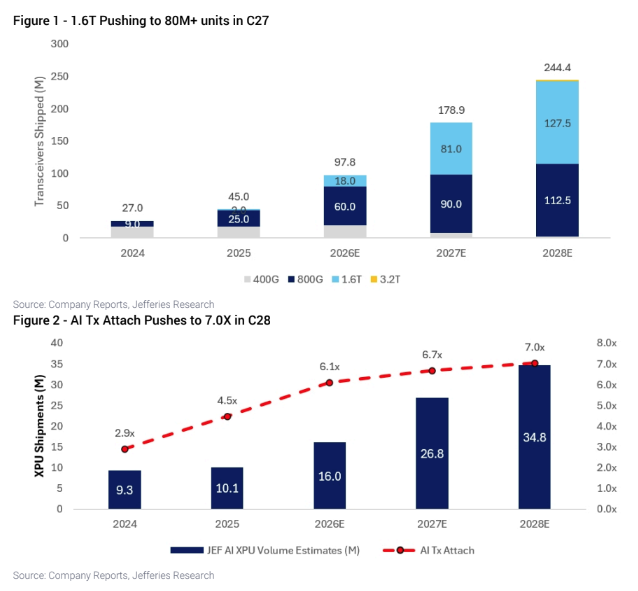
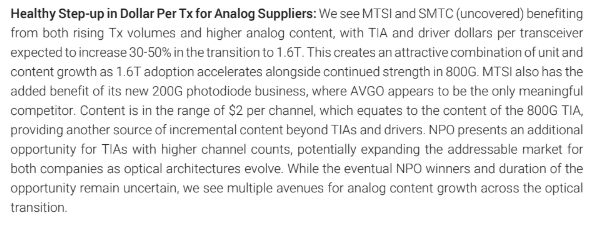
$AAOI $CRDO $LITE $COHR The optical AI trade may be more powerful than simply, more GPUs = more optics. Jefferies just raised its optical model and now sees the 1.6T ramp happening faster than expected. AI transceivers: 2026E: 98M 2027E: 179M 2028E: 244M 1.6T alone reaches 81M units in 2027E and 128M in 2028E. But the more interesting part is optical attach. AI XPU shipments are scaling rapidly, while optical attach per XPU is rising at the same time: 2.9x → 4.5x → 6.1x → 6.7x → 7.0x So the equation increasingly becomes: More accelerators × more optics per accelerator × faster optics And there may be another cycle forming between pluggables and CPO. Jefferies is seeing strong NPO interest from $AMZN, $MSFT, $META and $AMD, with potential initial shipments around late 2027. So instead of - Pluggables → CPO We could get - Pluggables → NPO → CPO 1.6T also brings higher content: Jefferies estimates TIA + driver dollars per transceiver increase ~30–50%. That's what makes the optical setup interesting. It isn't just a unit growth story.


KTMB is adding four ETS services between KL Sentral and JB Sentral every Friday, Saturday and Sunday for travel until December 27. The additional services will provide 63,200 seats, bringing the total weekend capacity on the route to 189,600 seats. KTMB is also adding eight EMUPlus services between Bandar Tasek Selatan, Ipoh and Klang from today until Sunday.


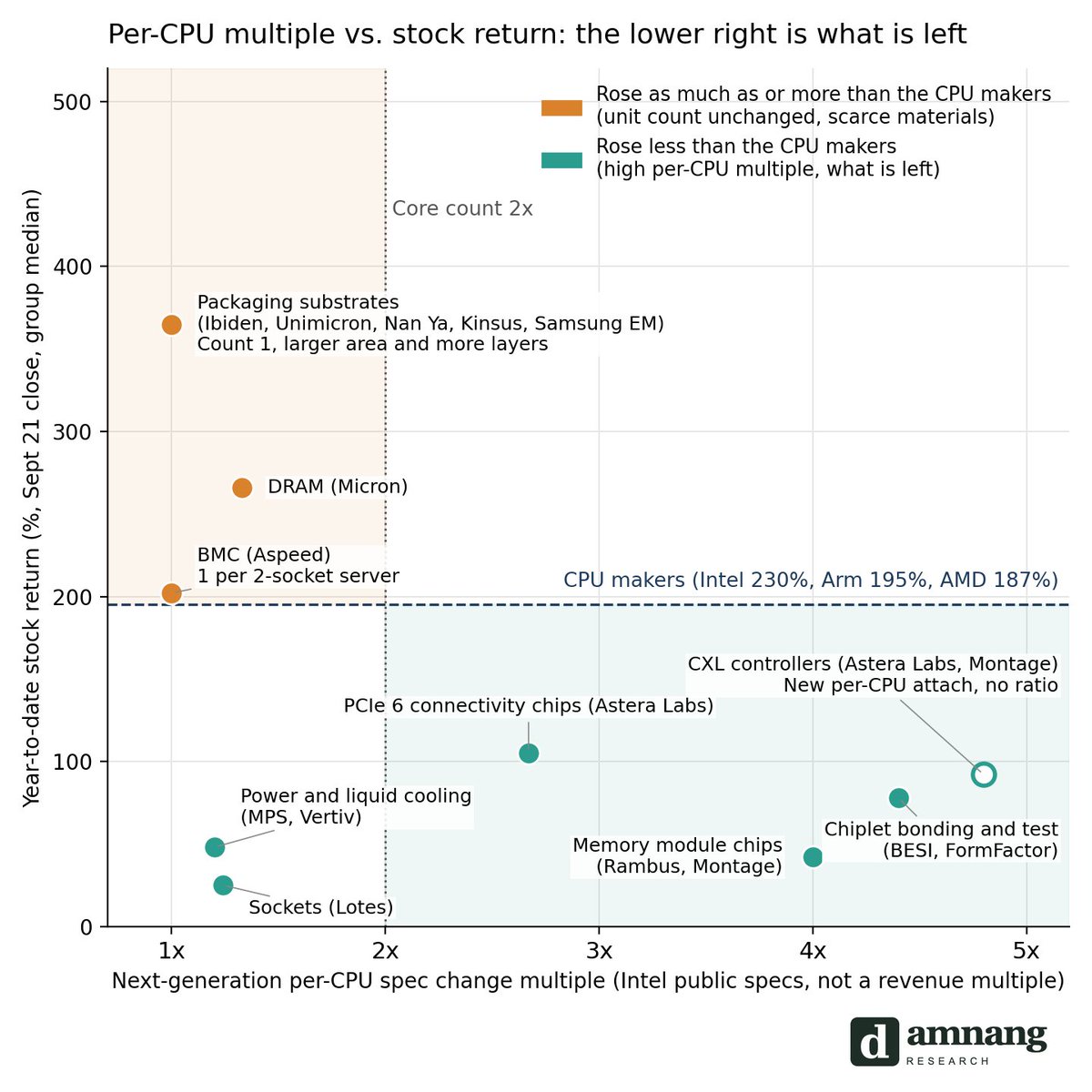
I’ve been working on an article called “What Comes After the CPU?” but I just can’t seem to finish it with everything else going on. If I wait much longer, it’ll probably lose its timeliness, so I’m just sharing the rough draft of the figure I made on X for now....

🚨InP substrate prices: 6-inch wafers up 250% to $5,000 since China's export curbs, with a further 10%-plus rise brewing for Q4 TAIPEI, Sept. 19 — The average price of a 6-inch indium phosphide (InP) wafer has surged 250% to $5,000 since China introduced export restrictions on InP, Reuters reported on June 11. The curbs began in February 2025, so that is roughly 16 months of cumulative gains. The Reuters story, written by seven reporters, said AXT ($AXTI) and Sumitomo Electric (5802 JT) together make almost 80% of the world's InP substrates, with JX Advanced Metals (5016 JT) at around 10%. AXT produces most of its substrates in China, and its Chinese subsidiary received its first export permits only in June 2025, leaving a significant order backlog. Three people familiar with the matter told Reuters that Coherent ($COHR) Chief Executive Jim Anderson joined the U.S. business delegation accompanying President Donald Trump to China in part to raise the licensing delays. SemiAnalysis analyst Konrad Wang said Lumentum ($LITE) is sold out through 2028 despite quadrupling output, and that Taiwan's VPEC (2455 TT) and LandMark Optoelectronics (3081 TT) faced substrate disruptions from AXT's permit delays. Analysts said a new substrate plant usually takes two to three years to come online. Prices kept climbing after June. Taiwan's Economic Daily News reported on Aug. 17 that InP substrate prices have been raised three times since they started rising in the fourth quarter of 2025 and are heading for a fourth increase in the fourth quarter of this year, while epitaxial wafer prices, up twice, are heading for a third. The size of each increase has widened from 3% to 5% to more than 10%, the paper said, calling it the largest on record, and quoted suppliers as saying that even buyers with money may not be able to get supply. The two Taiwanese epi makers named by Reuters posted rising revenue over the same period. LandMark's August consolidated revenue was NT$520 million, up 180.9% from a year earlier and above NT$500 million for a second straight month, a company record. Revenue for the first eight months was NT$3.147 billion, up 129.0%. In the remarks column of its monthly filings, LandMark gave the same reason every month from June 2025 through August 2026: higher data center product shipments than a year earlier. VPEC's August revenue was NT$471 million, up 71.2% year on year and 11.6% from July, also a record for a second straight month. Optoelectronics made up 46.1% of the month's revenue, up from 40.1% in July. Taiwanese financial outlet MoneyDJ, reporting VPEC's August sales, said InP substrate supply is gradually easing. Buyers are moving to long-term contracts. LandMark announced on Aug. 26 a four-year supply contract with a U.S. customer for data center CW lasers covering 2027 through 2030. On the supply side, it signed a four-year InP substrate purchase contract for 2026 through 2029 with a Japanese supplier and its Taiwan subsidiary, and a substrate purchase contract covering all of 2027 with a U.S. supplier. Its board approved up to NT$2.27 billion in equipment purchases the same day. Upstream figures are getting bigger too. AXT's second-quarter revenue was $47.6 million, compared with $26.9 million in the first quarter and $18.0 million a year earlier. InP revenue reached a company record of $30.7 million, up from $3.6 million a year ago. Chief Executive Morris Young said on the earnings call that the order backlog is well over $100 million and extends into 2027, and that about $66 million of third-quarter revenue either already has an export permit or does not need one. On its mid-August earnings call, Coherent said "indium phosphide capacity continues to be our primary constraint," adding that it will double internal InP output year over year by the end of the current quarter and more than double it again by the end of 2027. On Lumentum's call the same week, management said of substrates: "if this vector continues, we're probably going to need to look for more help on substrate." Taken together, the 250% figure captures the first leg of the move, driven by the export curbs. The 10%-plus increase being lined up for the fourth quarter would be a second leg, arriving after substrate supply has started to scale. Reuters reported that Yunnan Germanium (002428.SZ) announced in April a 189 million yuan investment to expand capacity to 450,000 InP wafers a year. The next markers: Taiwan's September revenue filings, due by Oct. 10; the actual transaction prices for fourth-quarter substrates and epi wafers; and whether AXT converts the roughly $66 million of permitted third-quarter revenue.


The complete technical overview of advanced packaging fundamentals that allows you to more thoroughly understand TSMC's CoWoS variants and industry trends: siliconcodesign.com/p/a-masterclas…

New, with Ozeco: The Advanced Packaging Primer. Value in AI chips is moving off the wafer. This piece follows where it lands: who owns the yield loop, why HBM switches to hybrid bonding last, what the quoted yield numbers actually measure, and which suppliers survive the panel reset.

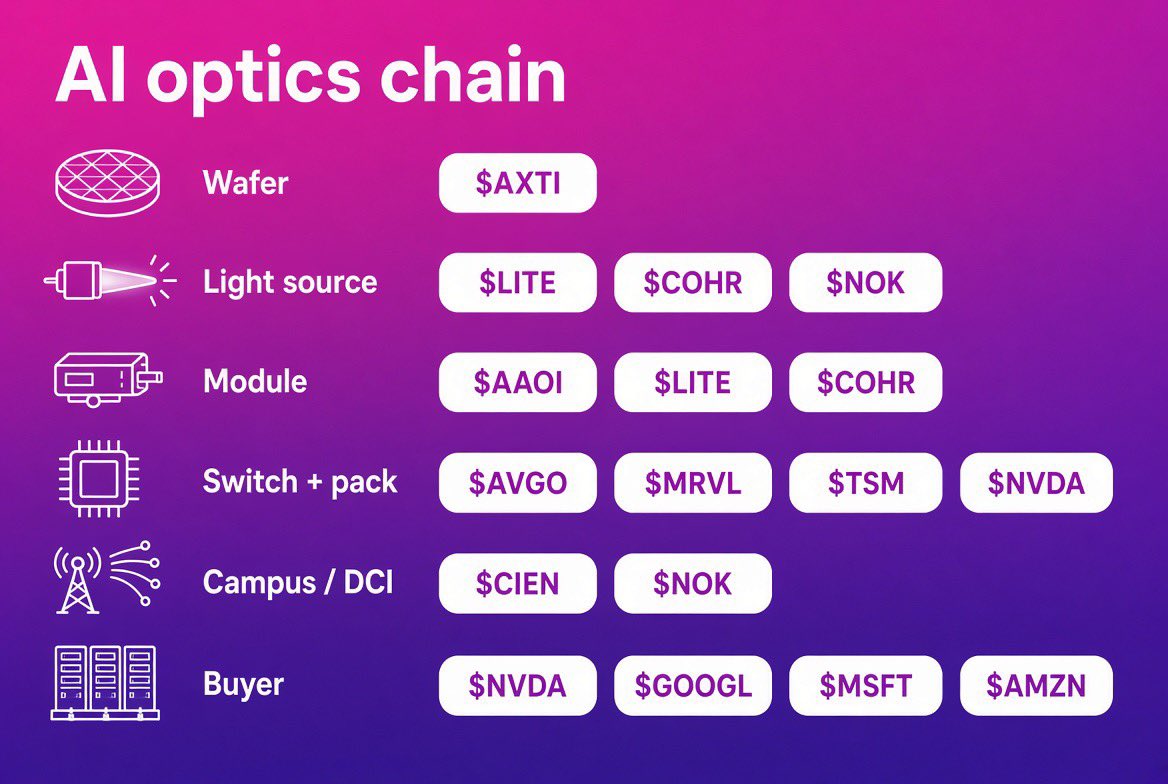
At SEMICON Taiwan, TSMC’s advanced-packaging people said silicon photonics is becoming the normal way to build an optical transceiver. They also said the thing that will slow the ramp is not TSMC’s factory. It is lasers, fiber, connectors, and test. On the same island, $LITE CTO put a number on the laser. Their ultra-high-power CPO laser used to put out about 400 milliwatts. They have now taken it through 1 watt. Means one laser can feed more channels, so the switch needs fewer external laser boxes. That is a cost cut for the customer, not a slide. There are 2 different optical jobs inside an AI cluster. Scale-out is rack to rack. That is the 800G and 1.6T pluggable book you already know. $AAOI, $LITE and $COHR sell into that. $NVDA clusters buy it. Scale-up is inside the rack. At 800G, copper can still run maybe 10 meters. At 1.6T, copper is done after 2 or 3 meters. Light has to take that job. CPO and similar packaged optics are how you put that light next to the switch chip. $LITE told investors the laser demand in that scale-up CPO case can be 5 to 10 times the laser demand of scale-out, counted per GPU. Read that again. CPO is not fewer parts, worse for laser vendors. NONONONOOO CPO is many more lasers per chip, because the light now lives inside the rack. That is why $NVDA wrote about $2 billion each into $LITE and $COHR in March. They were not buying a brand. They were buying a place in the indium phosphide queue. Silicon can guide light. It cannot generate it. TMSC said the same thing today in different words. $NOK sits on the same material, not on the same invoice. Through Infinera it owns an indium phosphide line. That is why $NVDA had to write checks to $LITE and $COHR and did not have to rent $NOK’s fab. Same shortage. Different product. $LITE $COHR $AAOI sell the scale-out module and the CPO laser into the rack. $NOK and $CIEN still sell the campus / metro / long-haul layer that ties those racks to the rest of the network. ICE-D is $NOK trying to walk into the module layer in 2027. CPO slipping toward 2028–2029 still helps that walk. CPO arriving later still helps anyone who can print InP. Those are not opposite calls. One is the module clock. One is the laser clock. What is already shipping, so this is not only a 2028 story: $LITE printed over $1 billion in one quarter. 1.6T modules have started to go out. Their optical circuit switch ramp is tied to a multi-year, multi-billion purchase agreement. In the last fiscal year $GOOG looks like ~27% of sales, up from ~15% the year before. $COHR is the other InP house. They have been doubling that capacity and saying the limit is the factory, not the order book. $AAOI is the US-made module sitting on the same 800G / 1.6T shortage. Different product, same choke: somebody still has to sell them a laser. $AXTI sits underneath a piece of the wafer supply. Further down the chain, higher risk, same physics. $AVGO and $MRVL already got paid for the switch silicon. $TSM already got paid for the package. The unpaid line is the thing that actually makes the photon. To watch next: 1. Does $LITE keep talking about CPO laser shipments becoming real revenue by the end of calendar 2026. 2. Does 1.6T stay a sample story or become a mix story through 2027. 3. Do $COHR and $LITE keep raising InP output without the shortage breaking. 4. Does TSMC’s own silicon-photonics roadmap stay “lasers are the gate,” or do they claim they solved the light source. 5. Thursday’s $CIEN print cloud mix and the guide as the demand tape for the campus layer $NOK shares with them. Remember $NOK owns the glass and still sells the pipes that leave the building.


$LITE likes VCSELs for AI scale-up interconnects Their main limitation is reach


Anthropic at a $65 Billion Revenue Run Rate: This Is No Longer an Experiment, AI Is Becoming an Industry Anthropic reaching more than $65 billion of annualized revenue by the end of July is an absolutely insane number, because the company was running at only around $9 billion at the end of 2025 and $47 billion as recently as May, which means the run rate has increased more than sevenfold in approximately seven months and another 38% in only the last two months, while $65 billion annualized translates into roughly $5.4 billion of revenue at the current monthly pace, compared with only around $750 million per month at the end of last year. We need to be precise that run-rate revenue is not the same as audited full-year revenue, because it simply annualizes the current pace of business and can move in either direction very quickly, particularly in an industry growing this fast, but even after making that adjustment, I struggle to think of many examples in corporate history where a company founded only at the beginning of 2021 has reached this scale of commercial activity this quickly. And I think this number significantly weakens one of the favorite AI bear arguments, which is that the entire industry is simply circular financing where Microsoft gives money to OpenAI, OpenAI spends the money on Azure, Amazon invests in Anthropic, Anthropic buys AWS compute, Nvidia finances customers that subsequently buy Nvidia GPUs, and everyone books revenue from everyone else until eventually the circle collapses. There is certainly some circularity in the financing structure and investors should continue scrutinizing it, but the problem with the extreme version of that bearish thesis is that it forgets the end customer, because somewhere underneath all those infrastructure commitments are companies and consumers actually paying for tokens, subscriptions, coding agents, APIs and increasingly autonomous work, and Anthropic’s revenue growth is becoming increasingly difficult to reconcile with the idea that demand is purely financially manufactured. Anthropic disclosed earlier this year that the number of business customers spending more than $1 million annually had already exceeded 1,000, doubling in less than two months, while eight of the Fortune 10 were already Claude customers, and enterprise customers were expanding from one product into Claude API, Claude Code and broader organizational deployments. Claude Code itself became a multibillion-dollar revenue business extraordinarily quickly, with enterprise usage representing more than half of its revenue. That is the important distinction. If Amazon invests $5 billion into Anthropic and Anthropic spends exactly $5 billion back on AWS while nobody outside the ecosystem pays Anthropic anything, then yes, I would be worried because Amazon would effectively be financing its own revenue. But if Amazon invests in Anthropic, Anthropic buys compute, JPMorgan, Salesforce, startups, developers and thousands of other companies then pay Anthropic because Claude saves engineers hours of work, writes code, automates workflows and performs economically useful tasks, and Anthropic subsequently uses those external customer dollars to buy even more compute, then the supposed circle has been broken. That is not circular financing anymore. That is an economy. The cloud numbers reinforce this point because external enterprise demand is exploding across the broader ecosystem at exactly the same time that AI infrastructure spending is exploding, with AWS revenue growing 37% in Q2 to a $169 billion annualized run rate, Google Cloud growing dramatically on AI workloads, and Microsoft reporting extraordinary cloud and AI demand while continuing to expand infrastructure capacity. If AI capex were exploding while cloud revenue, token consumption and enterprise adoption were stagnating, I would take the circular-financing bear case much more seriously. Instead, both sides of the equation are accelerating simultaneously. And then there is Anthropic’s extraordinary $190 billion to $200 billion 2028 revenue forecast, which Reuters reports is becoming central to how bankers and investors are thinking about the IPO valuation. Put $195 billion, the midpoint, into perspective. Meta generated approximately $201 billion of revenue for the entire year of 2025, so Anthropic is effectively telling investors that by 2028 it could become approximately the same revenue size as Meta was only three years earlier. AWS currently operates at a $169 billion annualized revenue run rate, meaning Anthropic’s 2028 target would actually be around 15% larger than AWS is today. Microsoft generated $90 billion of revenue in its latest quarter, equivalent to roughly $360 billion annualized, Alphabet generated $119.8 billion or around $479 billion annualized, Apple generated $109.4 billion or roughly $438 billion annualized, Meta generated $60.8 billion or roughly $243 billion annualized, while Amazon generated $200.6 billion or roughly $802 billion annualized, so a $195 billion Anthropic would already represent roughly 54% of today’s Microsoft, 41% of Alphabet, 45% of Apple, 80% of Meta and 24% of Amazon, using simple annualization of their latest quarterly revenues rather than forecasts. Obviously those companies will also be significantly larger by 2028, so this is not a prediction that Anthropic will suddenly become bigger than Big Tech, but the comparison demonstrates how abnormal the trajectory is. This is not normal corporate growth. This is one of the fastest monetization curves we have ever witnessed. Perhaps the craziest part is that the $200 billion 2028 forecast actually looks less ridiculous today than it did only three months ago, because from the current $65 billion run rate Anthropic needs to grow only approximately threefold to reach the target, while it has just increased its run rate more than sevenfold since December. Maintaining anything remotely close to the recent trajectory is obviously impossible forever because the base is becoming enormous, but the burden of proof has shifted meaningfully. The question used to be whether AI companies could generate meaningful revenue. Then it became whether they could reach $10 billion. Then $30 billion. Then $50 billion. Anthropic has now blown through $65 billion, while OpenAI reportedly has a roughly $40 billion current revenue run rate and more than 900 million weekly ChatGPT users, alongside more than 50 million paying consumer subscribers disclosed earlier this year. So yes, for me, Anthropic and OpenAI IPOs are must-have events, although “must-have” does not mean “buy at any valuation”, because the public market finally gets direct exposure to what may become one of the largest new profit pools created since cloud computing itself. My investment thesis would be: 1) AI is beginning to compete with labor, not merely software. The TAM therefore ultimately extends far beyond today’s software market because every hour of coding, research, customer service, financial analysis, legal review, administration and digital knowledge work potentially becomes addressable by models and agents. 2) Anthropic has established an extraordinary enterprise position, particularly through coding and agentic workflows, while its ability to distribute Claude across AWS, Google Cloud and Microsoft Azure reduces dependency on a single cloud ecosystem and makes Claude easier for large enterprises to adopt. 3) OpenAI owns perhaps the most powerful consumer AI distribution asset in the world, with more than 900 million weekly users and more than 50 million consumer subscribers disclosed earlier this year, which gives it an enormous funnel through which it can sell subscriptions, enterprise products, agents, commerce, developer services and products that probably do not exist yet. 4) Agentic AI should dramatically increase token consumption, because a chatbot might answer one question with several thousand tokens while an autonomous agent can operate for minutes or hours, call other models, browse databases, write code, test results and repeat the loop hundreds of times, so falling inference prices can paradoxically increase total compute demand through Jevons paradox. 5) The frontier model market does not need to become winner-take-all for both companies to become enormous, because enterprises will increasingly route workloads across multiple models according to intelligence, latency, security and cost, while the hardest and highest-value problems can continue commanding premium pricing even as simpler intelligence becomes commoditized. 6) The real moat may eventually become the accumulated ecosystem rather than the model itself, meaning enterprise integration, proprietary workflows, developer tools, agent platforms, distribution, customer relationships, safety infrastructure and enormous installed token usage can become increasingly difficult to displace even if individual model leadership changes every few months. The valuation is where discipline becomes essential. At Anthropic’s last $965 billion private valuation and today’s $65 billion run rate, the company is already valued at roughly 15 times current annualized revenue, which is expensive but not incomprehensible for a company growing at this rate. But if Anthropic comes public around the $2 trillion valuations being discussed, investors would be paying roughly 31 times today’s revenue run rate and approximately 10 times management’s 2028 revenue target, which means the investment case would require not only exceptional revenue growth but eventually very substantial margins as inference economics improve. This is where I would focus during the IPO roadshow. At $195 billion of revenue, a 25% operating margin would produce roughly $49 billion of operating profit, a 35% margin would produce approximately $68 billion, and a 40% margin would produce $78 billion, so the difference between Anthropic eventually becoming a mediocre infrastructure-like business and an extraordinary software-like platform completely changes what a $2 trillion valuation is worth. That is the real debate investors should be having. Not whether the revenue exists. It increasingly does. Not whether businesses are willing to pay for AI. They clearly are. The remaining questions are how durable that demand is, how much pricing power survives model commoditization, how much compute is required to produce each dollar of revenue and what normalized return on invested capital Anthropic and OpenAI can eventually earn after paying for the enormous infrastructure underneath them. Those are legitimate bear questions. “Circular financing means nobody actually wants AI” is increasingly becoming a much harder argument to defend when Anthropic is already doing more than $5 billion of implied monthly revenue and businesses are still increasing their consumption. The end customers are voting. They are voting with dollars. And right now they are voting for more AI. For me, Anthropic and OpenAI will probably become two of the most important IPOs of this decade and, at sensible valuations, both are must-have exposures because they offer something public-market investors currently cannot obtain cleanly anywhere else: direct ownership of the intelligence layer itself. We already own the companies making the GPUs. We own the memory. We own the foundries. We own the networking. We own the cloud. Eventually, we should own the companies selling the intelligence too.

Anthropic revenue run rate tops $65 billion, source says reut.rs/4gAvVoa reut.rs/4gAvVoa

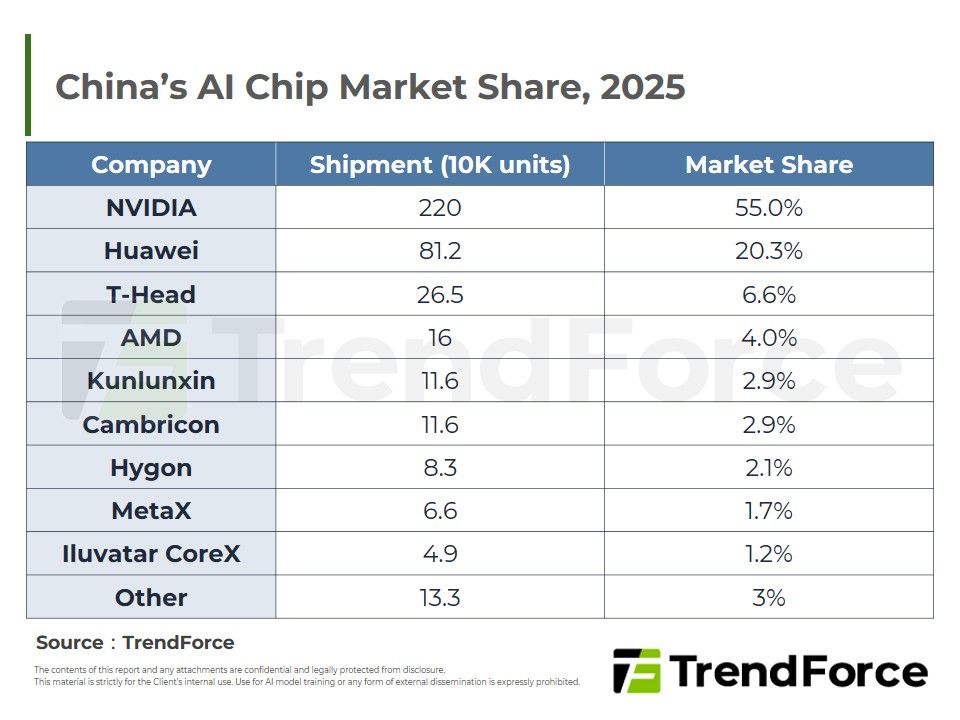
⚛️ NVIDIA Leads China's AI Chip Market Share. With 55% market share, NVIDIA holds the top spot. Huawei is at 20.3%, but domestic substitution remains a steep challenge. As U.S. BIS tightens export controls, access to HBM and CoWoS stays constrained and China's AI compute gap keeps widening. Explore opportunities and risks in China's AI chip market 👉 buff.ly/e3OEhxO #TrendForce #SelectedTopics

华为半导体首席科学家廖恒专访,近5个小时,满满的干货与细节,朴实里蕴含着中国AI硬件十足的底气。 如果说梁文锋代表中国AI发展软的一面,华为半导体就代表着中国AI发展硬的一面。 原来朴实点的华为也可以不让人讨厌的,希望菊花厂以后改改作风。大众对战狼已经审美疲劳了! 原片在B站,我强烈建议朋友们去B站开收听模式,完整听一遍。

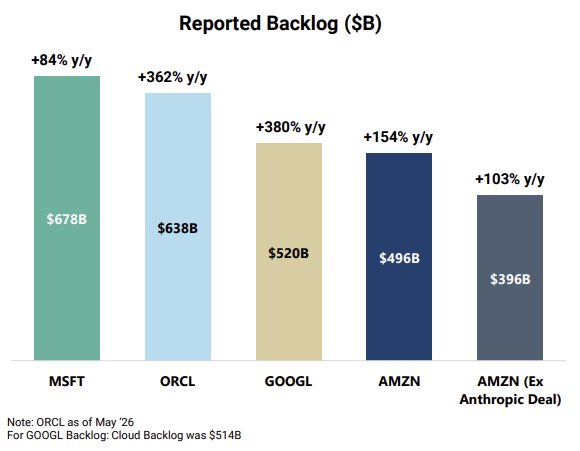
Hyperscaler backlogs. Chart from Jefferies.
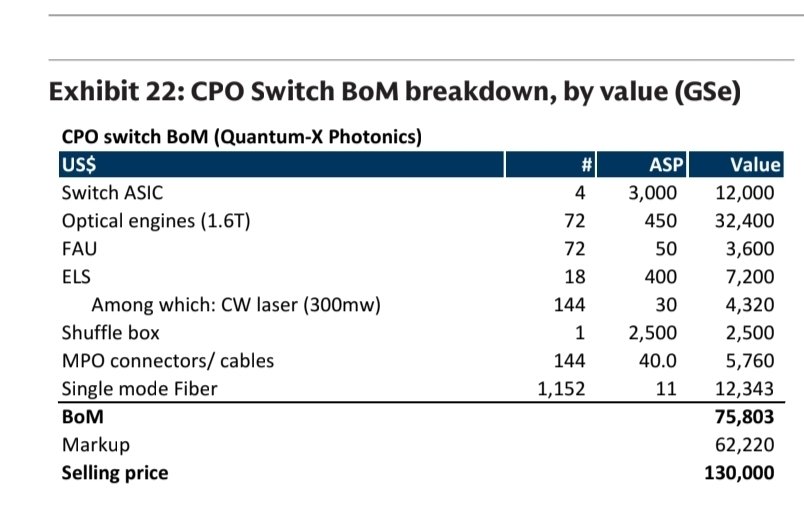
According to GoldmanSachs, CPO Switch BoM Revenue Contribution per Unit (Quantum-X Photonics / NVIDIA): Estimated supplier revenue per $130k switch (based on BoM values): NVIDIA (Switch ASICs + Optical Engines design): ~$12k (ASICs) + significant share of engines → major portion. TSMC (Fabrication/Packaging of ASICs & engines): Substantial share of ~$44.4k combined ASIC/engines value. Corning (FAUs + SM Fiber): ~$3.6k + $12.3k = ~$15.9k. Lumentum / Coherent / Sumitomo (ELS + CW Lasers): ~$7.2k. Senko / others (MPO connectors): ~$5.8k. Additional (Shuffle Box, assembly): Balance to total BoM ~$75.8k.

Rosenblatt report on InP is out As an industry the growth mentioned is staggering. Was following AAOI for long and actually own it through a CSP. But some fact blew my mind $AAOI row of their capacity table (laser revenues): ▸ 2025 → $60M ▸ 2026 → $150M ▸ 2027 → $350M ▸ 2028 → $700M ▸ 2029 → $1.2B ▸ 2030 → $2.1B!!! That’s ~35x growth, the steepest trajectory of ANY supplier in the model. And separately, Rosenblatt sees AAOI roughly doubling its transceiver market share from under 5% to nearly 10%, while entering the ultra-high-power CW laser market for CPO. This report is dated May 28, when $AAOI traded at ~$180. The model hasn’t changed. The stock is ~$100. What’s stopping you from owning this stock? Execution fears or Lack of conviction Great share from @JonkooTrades
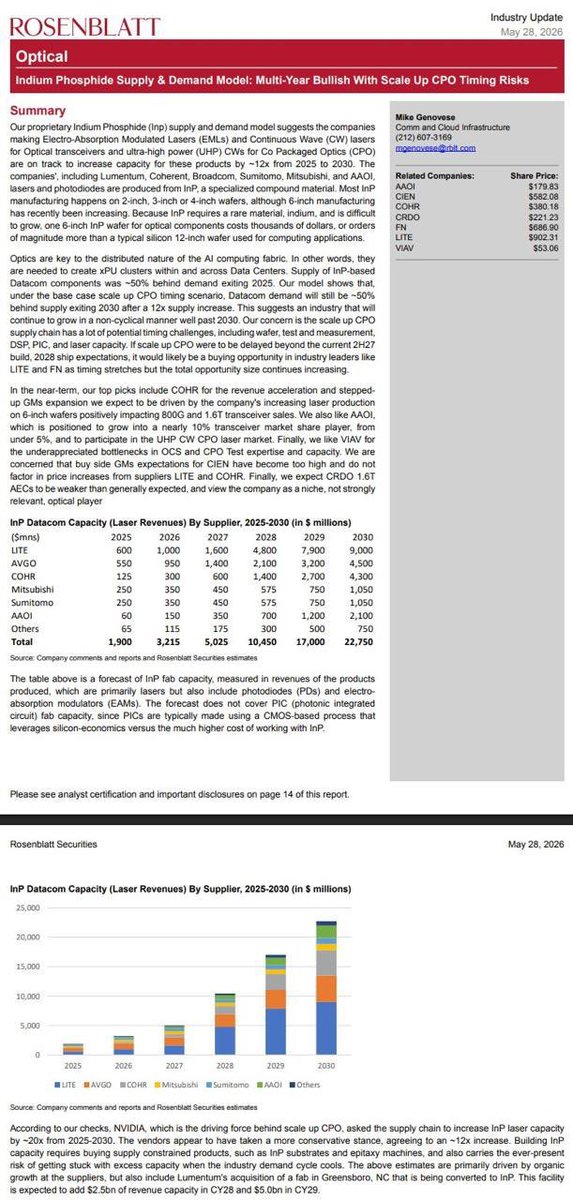
Rosenblatt built a proprietary supply & demand model for the entire InP laser industry. Buried in the table is the single most bullish $AAOI datapoint I’ve seen. Every EML and CW laser for AI optics is made from indium phosphide, a rare compound so hard to grow that ONE 6-inch

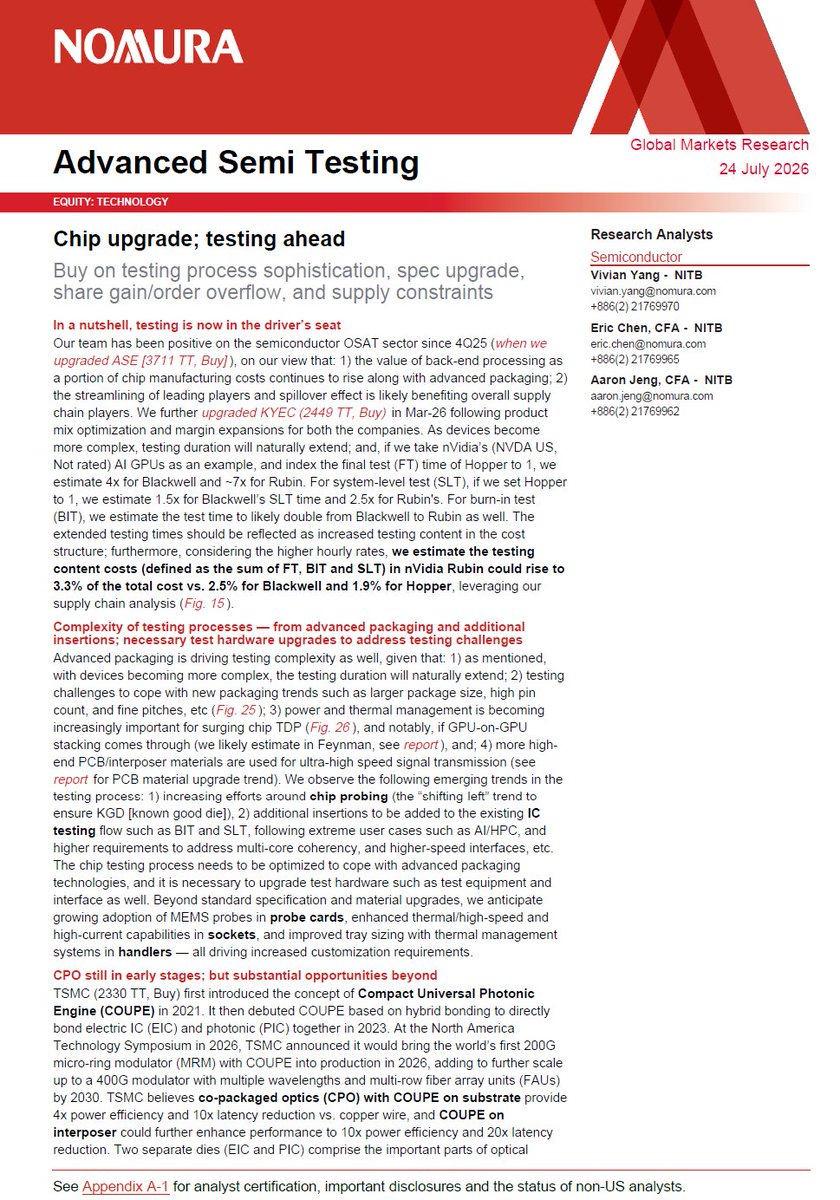
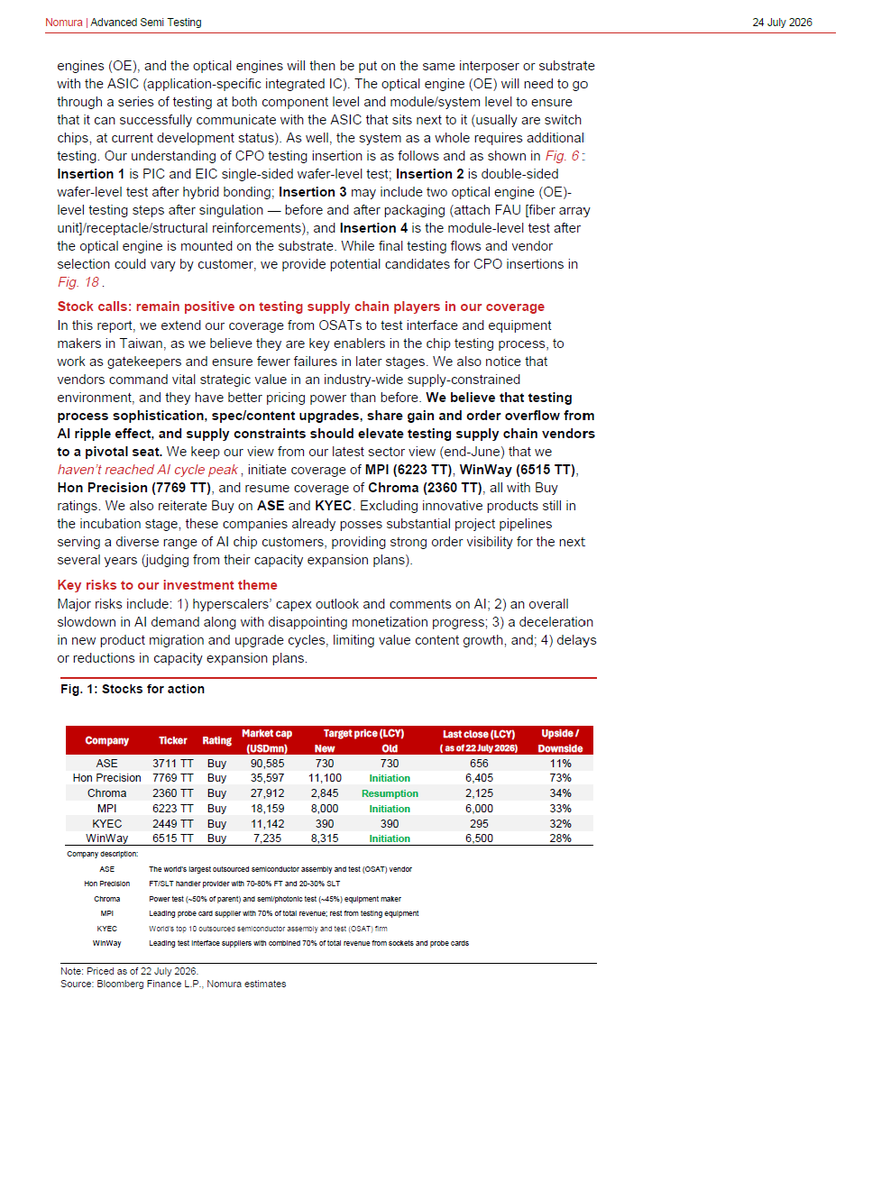
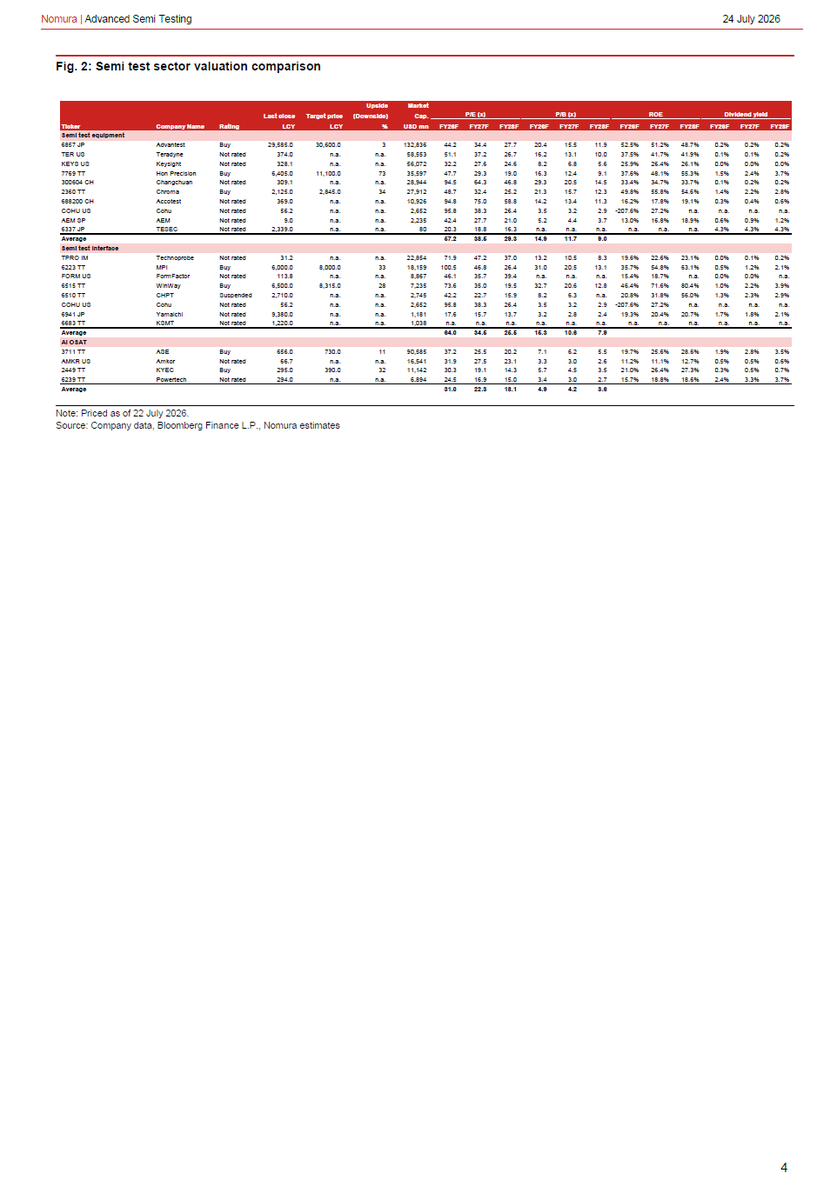
Nomura's report reinforces what we believe is one of the most underappreciated structural shifts taking place across the semiconductor industry today, namely that testing is no longer a low-value manufacturing step performed at the end of production, but is rapidly evolving into one of the most critical value-added processes within the entire AI hardware supply chain, because as chips become exponentially more complex through chiplets, stacked HBM, advanced packaging, silicon photonics and eventually co-packaged optics (CPO), the economic cost of failure rises disproportionately, making every additional dollar spent on testing significantly more valuable than it was during previous semiconductor cycles. The market has understandably spent the past two years focusing almost exclusively on GPU designers, HBM suppliers and advanced packaging companies, yet what this report demonstrates is that testing is quietly becoming the next bottleneck, because increasingly sophisticated AI accelerators cannot simply be manufactured, they must be validated repeatedly throughout the production process to ensure every component performs flawlessly before being assembled into AI systems that may ultimately be worth several million dollars each, effectively transforming testing from a manufacturing support function into an essential yield protection mechanism. Historically, testing was largely viewed as a necessary manufacturing expense whose primary objective was to filter out defective chips before shipment, but AI has fundamentally altered that equation because testing today is increasingly about protecting economic value rather than merely measuring quality, and when a single package contains multiple GPU chiplets, twelve stacks of HBM, advanced substrates, hybrid bonding interfaces, silicon photonic engines and increasingly expensive packaging materials, discovering a defect late in the production process can destroy vastly more value than in previous semiconductor generations. That is precisely why Nomura estimates testing content continues to increase materially with every GPU generation, using Hopper as the baseline, where final testing time increases approximately fourfold for Blackwell and roughly sevenfold for Rubin, while system-level testing rises approximately 1.5 times for Blackwell and 2.5 times for Rubin, with burn-in testing roughly doubling, resulting in testing content increasing from approximately 1.9% of total GPU cost for Hopper to 2.5% for Blackwell and approximately 3.3% for Rubin, a progression that may appear modest when expressed as percentages but becomes extraordinarily meaningful when applied to AI systems whose selling prices continue rising dramatically. Perhaps the most important observation in the report is not simply that testing content is increasing, but that testing itself is migrating earlier throughout the manufacturing process, effectively shifting from a single inspection performed after fabrication into a continuous validation framework that begins at wafer probing, continues through known-good-die verification, hybrid bonding validation, package testing, burn-in qualification and ultimately system-level testing before deployment inside hyperscale AI clusters, meaning the industry is increasingly adopting multiple quality gates rather than relying on one final inspection at the end of production. This shift has enormous implications for the supply chain because every additional testing insertion creates incremental demand for specialized equipment, probe cards, sockets, handlers, MEMS probes, thermal management systems and high-speed interfaces, thereby expanding the opportunity set well beyond traditional outsourced semiconductor assembly and test companies, which explains why Nomura has broadened its coverage to include interface suppliers and test hardware manufacturers rather than limiting its investment thesis solely to OSAT providers. Another theme that deserves significantly more attention is the interaction between advanced packaging and testing, because while investors have understandably focused on CoWoS capacity as one of the industry's largest bottlenecks, packaging capacity alone cannot solve the industry's challenges if testing capacity fails to expand at a similar pace, since every additional layer of complexity introduced through chiplets, hybrid bonding, HBM stacking, heterogeneous integration and silicon photonics simultaneously increases the probability that expensive failures will occur after substantial value has already been added to the product, making testing increasingly indispensable as AI hardware becomes more sophisticated. The discussion surrounding co-packaged optics is equally compelling because most investors naturally associate CPO with optical component suppliers, whereas Nomura correctly argues that the real opportunity extends much further into the testing ecosystem, given that every optical engine must communicate flawlessly with adjacent ASICs under extremely demanding thermal, electrical and optical conditions while maintaining signal integrity across increasingly complex architectures, thereby introducing entirely new categories of testing that simply did not exist in previous semiconductor generations and creating an additional secular growth driver for testing vendors. We also agree with Nomura's conclusion that the AI infrastructure cycle remains considerably earlier than many investors assume, because every successive GPU generation is becoming disproportionately more difficult to validate than its predecessor, allowing testing content to grow materially faster than semiconductor unit volumes themselves, which means the industry's next major beneficiaries may not necessarily be the companies designing the chips, but increasingly the companies ensuring those chips actually function reliably inside increasingly expensive AI systems. Our preferred way to position for this theme is to own the entire testing value chain rather than focusing solely on OSATs, because different parts of the ecosystem benefit from different stages of the testing process. ASE (3711 TT) remains our highest-conviction OSAT exposure given its scale, broad customer base and dominant position across advanced packaging and testing. Hon Precision (7769 TT) stands out as one of the most attractive pure-play beneficiaries of final testing and system-level testing, areas where AI complexity is expanding the fastest. WinWay (6515 TT) offers differentiated exposure through sockets and probe cards, which should experience rising content per AI accelerator as electrical and thermal requirements become increasingly demanding. MPI (6223 TT) is well positioned through wafer probing, benefiting directly from the industry's shift toward earlier testing insertions and known-good-die validation. KYEC (2449 TT) remains an attractive second OSAT exposure with meaningful leverage to AI testing demand, while Chroma (2360 TT) provides exposure to automated testing equipment, allowing investors to participate in the hardware upgrade cycle required to support increasingly sophisticated AI devices. Ultimately, we believe semiconductor testing has quietly transitioned from a manufacturing support function into one of the industry's most valuable strategic chokepoints, and just as HBM suppliers, advanced packaging companies and foundries have enjoyed structurally stronger pricing power because they occupy indispensable positions within the AI value chain, testing vendors increasingly appear poised to achieve similar economics as AI hardware becomes more heterogeneous, more thermally demanding, more optically integrated and substantially more expensive to manufacture, making testing one of the highest-conviction secular investment opportunities across the broader semiconductor ecosystem.

If your knowledge of co-packaged optics stops at definitions of EICs, PICs, lasers, and modulators, you run a massive risk of being blindsided by delays and bad investments. Of all the components in AI Infrastructure, CPO has become one of the trendiest markets investors jumped into to scale interconnect speeds. However, CPO is fundamentally an immature technology compared to pluggable transceivers. It still needs heavy R&D to iron out the rough edges—especially around reliability, testing, and repairability. The biggest risk investors face in CPO is blindly relying on someone else’s opinion because they don't understand the challenges engineers on the floor are facing to make smart market choices. Right now, the timeline is flooded with FUD—some outlets claim CPO is facing massive delays, while others claim it’s perfectly on schedule. To actually understand why technologies like CPO face brutal deployment delays, you need to first master the fundamentals of intensity-modulated, direct-detect (IM-DD) architecture in pluggable transceivers. Only then can you put CPO and NPO into their proper structural context, allowing you to truly understand the macro supply chain movements tracked by writers like @PhotonCap , @iamfabian , and @vikramskr. My highest-viewed article provides a complete overview of the optical communications field to give you the exact mental framework you need to critically analyze these optical trends. siliconcodesign.com/p/optical-comm…

陆知遥的美股档... @candanc28830847
0 Followers 411 Following 为关注的美股公司建立研究档案,持续跟踪业务与财报变化。随缘分享跟踪方法,欢迎一起学习成长。点下方WhatsApp链接:进美股学习交流群、领取课件、个股分析诊断、投研个股推荐,欢迎验证、也经得起验证!我们不开户、不推产品、不做币,只做美股量化技术研究。
인포마켓 강용�... @yongwoonkang
1K Followers 652 Following 인포마켓 | AI·반도체·포토닉스·우주산업 심층 분석 InfoMarket | In-depth analysis of AI, semiconductors, photonics & space.
TeamAlt 🌺 🎌 �... @TheresaHal84653
7 Followers 2K Following If you want to quickly turn $10,000 into $1,000,000, follow the link below to join us and learn more details.👇 👇🏼 🌱 🚩 💰
Marko Kolanovics @markoiny1
270 Followers 7K Following Former Chief Strategist / coHead of Global Research JPM, II Hall of Fame, BSC, BofA/ML, Physics PhD NYU. Gandalf, man who moved) markets. Not Financial Advice.

_Duckman1717 @duckmam1717
24 Followers 687 Following Imperfect Catholic, hunter, fisherman, dog lover, and PM. Disclaimer: Trade at your own risk. All opinions not investment advice. Investing/trading since 2004
Teresa @Ylaawnaq9060
205 Followers 7K Following In order to be irreplaceable one must always be different. — Coco Chanel



AgnesDickey @8vr63kKuE723Z6O
40 Followers 957 Following

Kaxea @Kaxea64176
34 Followers 1K Following
Mr crypto whale @LeahJulie65094
645 Followers 7K Following Crypto trader, market analyst and cryptocurrency giveaway
Monica @Navea3069883
76 Followers 2K Following You are never too old to set another goal or to dream a new dream.

Ramona @hgESduy0m76PG
17 Followers 801 Following
投資はゲームだ @Swuixeh471
32 Followers 2K Following 【完全無料】 25年の株式投資プロチーム(運用資産500億円以上)が提供:毎日の市場分析レポート + 優良成長株のピックアップ。プロの情報を無料で。まずはお気軽にお問い合わせください。
QuantumTrading🇺�... @Ijalve0795050
50 Followers 2K Following 15-30% Monthly | 2 High-Conviction Stocks.Short-Term Gains: 15-20% in Days/Weeks.DM "JOIN" for WhatsApp Alerts. Live Trade Signals • Market Analysis
Michelle @Auguarqar42554
5 Followers 141 Following The individual investor should act consistently as an investor and not as a speculator. - Ben Graham https://t.co/ARyczI2dHV
Vruiho @Vruiho590
28 Followers 2K Following
AI Tools Network @aitoolsnetwork
350 Followers 4K Following an online hub to find the the best AI tools
投資はゲームだ @Imwirardo361
44 Followers 2K Following 【完全無料】 25年の株式投資プロチーム(運用資産500億円以上)が提供:毎日の市場分析レポート + 優良成長株のピックアップ。プロの情報を無料で。まずはお気軽にお問い合わせください。
家族のための投... @Voumpe5338660
38 Followers 1K Following 【完全無料】 25年の株式投資プロチーム(運用資産500億円以上)が提供:毎日の市場分析レポート + 優良成長株のピックアップ。プロの情報を無料で。まずはお気軽にお問い合わせください。
Noalle @Noalle837368
10 Followers 46 Following
Vweadu @Vweadu871
26 Followers 2K Following

Jessica Menton @JessiicaMenton
81 Followers 2K Following Deputy team leader & senior equities reporter for US stocks @business. Formerly @USATODAY @WSJ. Proud Texan living the dream in NYC. @TAMU alumna. Views mine.
M. V. Cunha @mv_cinvesting
460 Followers 7K Following Long-term investor. BSc in Economics, MSc in Finance. Equity Analyst with a focus on Fundamental Analysis and Valuation. Not a financial advisor.
Samantha Russell 🧑... @SamanthaTweity
455 Followers 805 Following MAIN ACCOUNT: @SamanthTweity | Speaker | Marketing @fugsuite Investmentnew 40 Under 401@wealth_mgmt 10 to Watch | former @twentyoverten CMO
Delia @Delia_Jions
111 Followers 1K Following Embrace the sunshine, face challenges bravely, and make your life better
Smata @Smata1442731
27 Followers 2K Following
Noote @Noote1436669
36 Followers 2K Following
Feckusm @feckusm89735
26 Followers 2K Following
Thetea @Thetea749268662
23 Followers 783 Following

Alexander Lorenzo @1aIexoncrypto
964 Followers 3K Following Crypto Analyst, Youtuber, & Entrepreneur. Community of roughly 10,000 investors and growing.
J Young Tan @jyoung_tan
13 Followers 172 Following
David Ng @davidngkc
81 Followers 814 Following

인포마켓 강용�... @yongwoonkang
1K Followers 652 Following 인포마켓 | AI·반도체·포토닉스·우주산업 심층 분석 InfoMarket | In-depth analysis of AI, semiconductors, photonics & space.
Steve Wozniak @stevewoz
3.7M Followers 91 Following Engineers first! Human rights. Gadgets. Jokes and pranks. Segways. Music and concerts. Gameboy Tetris.


Serenity @aleabitoreddit
1.1M Followers 220 Following Only on X, don’t trust fake accs AI/Semi Supply Chains Research Nothing is investment advice. No paid promos; may trade/hold names disc, views my own.
P Equity Research �... @pequityresearch
58K Followers 893 Following Research 📃 & News 🗞️ | Semis & Tech | Research & Discord: https://t.co/6jzqR9TN4j | China Tech Research: https://t.co/vptHyJJu79
SemiVision 🇹🇼 �... @semivision_tw
16K Followers 2K Following Expertise in Semiconductor Industry │Silicon Photonics│AI Industry│Supply Chain│ASIC│Ecosystem │Food │Travel

Paradis @ParadisLabs
80K Followers 151 Following AI & tech investment research. No financial advice.
Semi Doped @semidoped
10K Followers 4 Following The industry powering AI, explained by @vikramskr and @austinsemis. Weekly podcast and daily takes. Sign up at https://t.co/wSYNiNJYqL and subscribe on YT
qinbafrank @qinbafrank
160K Followers 1K Following Investor in AI、Crypto、TMT,跟踪最前沿科技趋势、野生宏观政经观察、研究全球资本流动性、周期趋势投资。记录个人学习和思考,经常出错常态掉坑爬坑。Runner🏃
Jonkoo Capital @JonkooTrades
9K Followers 211 Following Asymmetrical Market Analyst - 200%+ YTD, hunting trades and long term setups. AI Engineer. Partnered with @liquidtrading - https://t.co/xE5Yc6GHc2
Jeff Pu @sssjeffpu
39K Followers 75 Following Tech Enthusiast. 20 years tech equity research + industry.
The Kobeissi Letter @KobeissiLetter
2.7M Followers 598 Following Official X account for The Kobeissi Letter, an industry leading commentary on the global capital markets. Email us: [email protected]
Alex Wickham @alexwickham
123K Followers 3K Following UK Political Editor for Bloomberg [email protected]
June Goh @JuneGoh_Sparta
20K Followers 95 Following Senior Oil Market Analyst for Sparta Commodities. Seasoned oil professional, with roles spanning Refining, Trading & Strategy in Shell. Views are my own.
Dhaval Joshi @DhavalVJoshi
11K Followers 13 Following Global macro strategist known for his outside-the-box-thinking.

James Chanos @RealJimChanos
69K Followers 509 Following
Dario Perkins @darioperkins
78K Followers 3K Following MD Global Macro @TS_Lombard, macro themes/research/risks, central-bank specialist, started career at HM Treasury in late 90s, ex ABN AMRO, AC Milan fan
LiveMarketChat @LiveMarketChat
1K Followers 3K Following I chat about what i see that interests me and i run my own book. If you see me posting about something DYODD as im talking my own positions.
Alexandr Wang @alexandr_wang
768K Followers 910 Following chief ai officer @meta, founder meta superintelligence labs, founder @scale_ai. rational in the fullness of time


MEJE ✪ @callmeMEJE
86K Followers 9K Following nothing about this is accidental. fitness | football | fashion | the finer things
Speaker Mike Johnson @SpeakerJohnson
1.2M Followers 749 Following 56th Speaker of the House | Christian, husband, dad, Constitutional law attorney & small biz owner.
Marko Kolanovic @markoinny
68K Followers 231 Following Former Chief Strategist / coHead of Global Research JPM, II Hall of Fame, BSC, BofA/ML, Physics PhD NYU. Gandalf, man who move(d) markets. Not Financial Advice
David Sacks @DavidSacks
1.8M Followers 4K Following Tech founder & investor @Craft_Ventures @theallinpod. Co-Chair, President’s Council of Advisors on Science & Technology.

Ray Wang @rwang07
33K Followers 2K Following Ex-SemiAnalysis "when your motivation runs low, your discipline takes over" “always stay humble, hungry, and curious”
Daily Chartbook @dailychartbook
45K Followers 470 Following The day's best charts & insights, curated: https://t.co/N9qmOV94DF Backtests: https://t.co/wxCAzTDjPz
Anna Wong @AnnaEconomist
241K Followers 288 Following Chief US Economist, Bloomberg LP @economics. Former Fed/CEA/US Treasury, PhD @uchi_economics BA @UCberkeley. All opinions are my own.
Commentary Trump Dail... @TrumpDailyPosts
3.0M Followers 25K Following Donald J. Trump daily posts from Truth Social, commentary & news. Profile artist: @ElenaRuseva1 Unofficial not affiliated with @realDonaldTrump
White House Press Off... @PressSec
2.0M Followers 203 Following Official account for the Press Office of President Donald J. Trump.
Treasury Secretary Sc... @SecScottBessent
988K Followers 25 Following 79th United States Secretary of the Treasury
Omer Cheema @Omercheema
11K Followers 485 Following Semicon expert. Ex AMD, Ex Samsung. Now at Renesas. PhD Paris Tech. MBA from INSEAD. Opinions my own. https://t.co/vrQ6HkBsVC
Ryangreat @ryangreat1121
1K Followers 5K Following Long-term Tesla investing, Semiconductor, Model S Plaid

Nomad Semi @MooreMorrisSemi
5K Followers 519 Following Deep-dive semiconductor research & AI compute
Jim Keller @jimkxa
58K Followers 169 Following CEO @tenstorrent, Cofounder @Fab2 @BayaSystems, Castle, @realoxmiqlabs, AheadComputing boards Fan of 2x2 matrixes, books, refactoring
Austin Lyons @austinsemis
7K Followers 2K Following semis analyst. asking questions + explaining. read by chipmakers, funds, model labs. @chipstrat · @semidoped

Zijing Wu @zijing_wu
12K Followers 578 Following Technology and all things interesting @FT in HK. Returning to journalism (ex BBG) after a decade as investor/entrepreneur. Still an idealist. Opinions mine.
Ryan McMorrow @rwmcmorrow
4K Followers 2K Following Tech and finance reporter in SF after a long time in China @ft formerly @afp @nytimes @FulbrightPrgrm @ucla bruin. [email protected]

Chips & Wafers @ChipsandWafers
10K Followers 88 Following Reliable source for actionable semiconductor data. Let the data guide your decision making process. Now part of @SemiAnalysis_
Deirdre Bosa @dee_bosa
77K Followers 5K Following Pronounced Dear-dra. Anchor & reporter @CNBC for 15 yrs. Now building something new. still a Leafs fan 🇨🇦You might like