Bob @palmtrees_guy
Joined December 2024-
Tweets309
-
Followers165
-
Following2K
-
Likes750

I was there:

Can LLMs reach AGI—and genuine explanatory creativity? A discussion at Oxford Physics with David Deutsch, Adam Brown, Nick Bostrom, Vedika Khemani, Roger Myerson, Rahul Nandkishore, Toby Ord, Martin Rees, Anders Sandberg, Umesh Vazirani & K. VijayRaghavan drive.google.com/file/d/1kxvkhe…

Here is the quick version: Out of college I was a Mortgage Loan Officer for ~2.5 years. Real boiler room style bank - cold calling off of call sheets etc… In 2016 I decided I was miserable enough to make a real change and went to General Assembly Coding Bootcamp 1/1/2017 I started my first job in tech at a small AdTech startup. 10 people in a room at a wework I spent the next ~8 years bouncing around different Technical Account Manager & Sales Engineering jobs until I landed at (what I thought) was the pinnacle - my last job I held making about the number I mentioned in the quoted tweet Fast forward to 2023 and to no surprise… I was still miserable The problem: I had a wife, kid on the way, mortgage, 2 cars, a dog, and a white picket fence I started The Outgoing Co (Ramp Health then) at the beginning of 2023 Shipped out first orders by July 2023 By November 2024 we were doing ~$50k/mo and I decided to grab my nuts and quit Liquidated investments & 401k, opened an “oh shit” line of credit, and took on an investment partner That was almost 2 years ago and here we are 🫡
@elonmusk You could read that or just watch this: @ToKTeacher youtu.be/q5-6G8d9IEE?si…
I just fixed my dishwasher with the help of ChatGPT. A trivial task. I had been about to order a new one. So this software has increased the country's real wealth yet decreased the measured GDP. The main economic indicator is structurally incapable of registering the thing that actually makes people better off, namely the growth of knowledge
@JensenHuang @ChaseLochmiller @OpenAI @DavidDeutschOxf @ToKTeacher this is a big AGI statement

Best way to “rehab” the shoulder (aka how to use it correctly) is to get the big arch out of the low back This is forcing the scaps to adduct (squeeze together) and rotate down when they need to do the opposite. This just feeds the problem you probably already have.


@biohacker x.com/bengal_dpt/sta…
This thumbs forward/palms down method is very shoulder friendly fly version. If you have pain with flys this usually eliminates it The pain is a pec mobility problem. Mobility meaning you can’t keep pec tension at end range so the shoulder joint is over stressed.
@the_no_mind @DavidDeutschOxf @ToKTeacher @astupple isn’t this just another way of him saying public speaking is an important problem he wants to solve?
uatx.substack.com/p/forget-yours… Hmm. I'd say the Enlightenment version of individualism is the historically unique idea that individuals exist not for the sake of their ruler, their class, their ancestors, their gods, or any other such superstition, but for their own sake. Meaning does not require subordination to something "greater than oneself". It is created by the idea that progress is possible and desirable – not by a leap to utopia, but endlessly into the future by undirected problem-solving, carried forward voluntarily by individuals for their own reasons.

More than can go into one tweet! I’d start by doing one of the following (or both, frankly). Full disclosure: I’m the creator of Option A. Option A: 1. Install Tailscale on your computer and phone to create a secure device-to-device connection tbat works over cellular and wi-fi, and log in on both. Takes 2-3 minutes. tailscale.com/download 2. Install VoiceClaw Realtime on your iPhone and install the Voiceclaw Realtime computer Companion app on your computer. Takes 2 minutes. voiceclawrealtime.com 2. In VoiceClaw Realtime on your phone, tap sign in with ChatGPT using the in-app button. This lets you use OpenAI models, including its Realtime/Live two-way voice models. 3. In VoiceClaw Realtime on your phone, press the QR button and scan the QR code from the VoiceClaw Realtime desktop companion app to securely pair it to your phone. (Note: the data is not transmitted to a third party; the QR pairing is just a convenient way to send VoiceClaw Realtime’s desktop settings to the iOS app, instead of manually typing in the settings yourself.) Now you can live voice chat continuously with natural voice to operate OpenClaw, have it do real computer work (anything you can think of), and send/receive files, right in the app. (To have it do computer work even more effectively, install the ChatGPT app on the computer as well, sign into it with your ChatGPT account, tell OpenClaw “please set up the OpenClaw ChatGPT/Codex Computer Use feature/plugin and restart the OpenClaw gateway,” wait five minutes, restart the VoiceClaw Companion desktop app and re-scan the QR code.) That’s Option A. (Note: with VoiceClaw Realtime, you can live voice chat without using computer-side agents if you skip the desktop Companion / QR code computer-pairing step, and can still upload files/images for analysis while voice chatting with GPT Realtime / Live. ————- Option B 1. Install Tailscale on your computer and phone to create a secure device-to-device connection tbat works over cellular and wi-fi, and log in on both. Takes 2-3 minutes. tailscale.com/download. When it’s set up, go to settings and note your private Tailscale “tailnet” URL (it ends in “ts.net”). 2. Install Matrix (a free self-hosted chat server that runs on your computer) and set its “homeserver URL” to be that computer’s tailscale URL (like …scomputer.yourfreetailscaleurl.ts.net) or to be a new Tailscale subdomain (like matrix.yourfreetailscaleurl.ts.net). You can ask OpenClaw (or OpenAI’s Codex, within the ChatGPT desktop app) to do this for you, end-to-end. It will take 15 minutes or so. If you don’t have auto-approve settings on, stay by your computer so you can click “Approve” a bunch of times. 3. Create a Matrix user account for yourself and one for your OpenClaw agent (or more accounts for multiple OpenClaw agents, if you have multiple OpenClaw agents). OpenClaw or Codex can do this for you, too. 4. Add the OpenClaw Matrix messaging plugin to your OpenClaw installation and configuring each OpenClaw agent to a Matrix user account (like “AgentA” in OpenClaw is “AgentA” in Matrix). OpenClaw or Codex can do this for you, too. 5. Download the free Element chat apps on your phones, tablets, and/or other computers and log in using the homeserver URL you created and the Matrix username you created for yourself. Create a room, give it a name, and invite your OpenClaw agent by typing their name in the “invite user” screen. Now you can chat with and send/receive files from your OpenClaw agent(s) in a convenient secure chat app, and create new chat rooms that you can label however you like (for projects, clients, different areas of your life, etc.). Or, just use one Matrix chat room for everything. That’s option B. —— I say do both Option A and Option B: Option A for live, real-time, continuous, two-way natural language voice operation; you just talk, and if you want OpenClaw (or Codex / Hermes) to do computer work, just say so. Option B for the traditional chat-app approach.


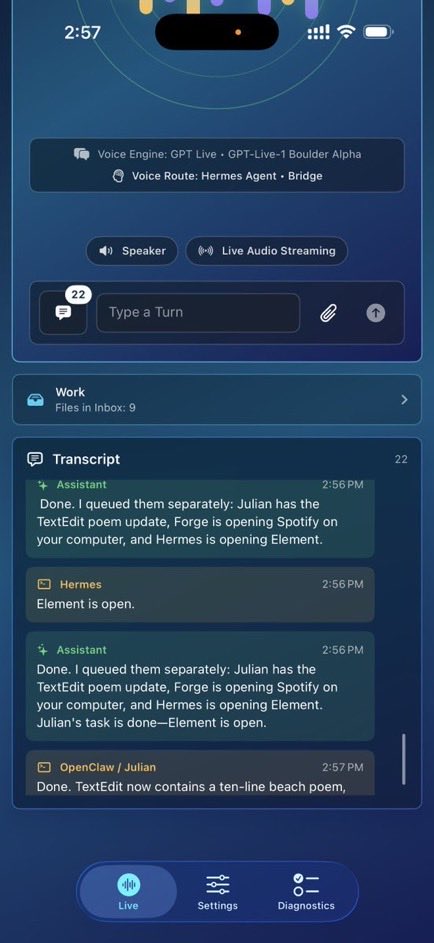
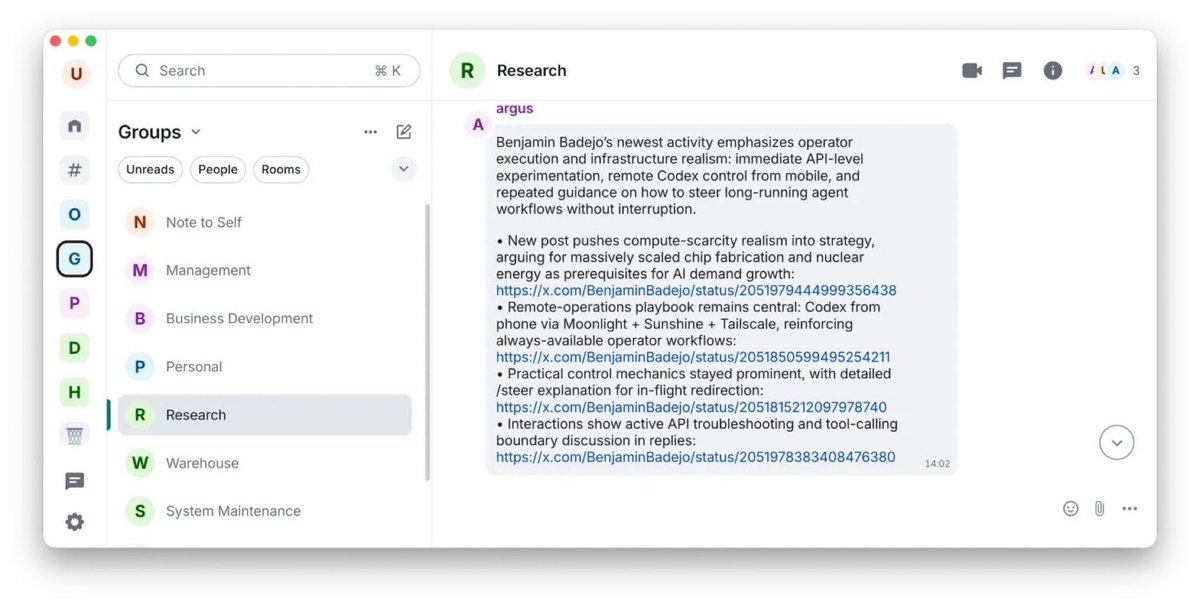
@BenjaminBadejo You have any recommendations on how to best set up Openclaw and run it? I have it installed and set up currently.
@BenjaminBadejo You have any recommendations on how to best set up Openclaw and run it? I have it installed and set up currently.
@AbudBakri @PGC1a_RB @CoffBlackMD what’s the best way to offset having to work day shifts during week to than having to work 6pm-6am on a Saturday? Epitalon and high dose melatonin?

My life is a near constant state of mild annoyance, discomfort, foiled expectations, and boredom, and yet I’ve never been happier. I’ve transitioned to stay-at-home dad to five kids aged 2-8 and, on a moment to moment basis, it’s rarely fun. It’s almost never the case that all five are in a good mood, that nobody is asking me for something, nobody is disappointed or outright upset. The plans I make for the day rarely work out, and almost never work out for everyone. I make blatant mistakes all the time - I forgot the diapers, I left the crocs somewhere, the kids were too hungry and started fighting at the science museum, the water was too cold, etc etc. And I rarely get a chance to have an extended conversation with an adult, to read/listen to a good book, or to write out my thoughts on X (posting has fallen off dramatically this summer.) But, I’ve never been “happier.” This is easily the greatest period of my life, and I’m not sugarcoating it just to pretend that I’m a devoted husband/father. I also reject the “no pain, no gain” ethos that says that hard things are inherently satisfying, or that satisfaction can only come from struggle. (I absolutely cannot stand the common practice of rationalizing an unpleasant existence instead of improving it.) How can this be, that I’m both happy and unhappy at the same time? It’s because the word happy has several uses, and this has caused a lot of confusion. A simple clarifying distinction is between happiness as feeling good, and happiness as satisfaction. Writing this strikes me as so obvious that I’m tempted not to post it, but the confusion runs quite deep. I started following the happiness research in 2006 when I read Jonathan Haidt’s Happiness Hypothesis and then Daniel Gilbert’s Stumbling on Happiness and Csikszentmihalyi’s Flow and Barry Schwartz’s The Paradox of Choice, and their arguments were based on these experiments where they’d measure happiness with surveys, with asking people how happy they were in various circumstances. They called this science because they did all this scientific stuff around these surveys and published it as the psychology of positive emotions, of happiness. I lapped it up because it made so much sense. Before these guys, psychologists only studied pathology, depression, insanity, addiction, stuff like that. What about happiness? These guys did acknowledge, almost in passing, that what someone says about their state of mind (a survey response) is not actually their state of mind, but they said that if they simply collect enough responses and average them together, then the result would actually reflect their state, at least to some statistical probability. And after all, is there a better way to get at someone’s state of mind other than just asking them? I remember sitting on the floor and watching them sweep this ugly little fact under the rug and calling it good myself. Heck, this stuff was published psychology, and to my 2006 self, that was good enough for me, especially when the stuff they wrote in their books and said in their TESTalks made so much damned sense. But I never forgot that rug sweeping definitely happened. Fast forward to 2018 and it all crashed down with a paragraph in my favorite book, The Beginning of Infinity. Throughout the book, @DavidDeutschOxf is at pains (quite happily, I bet) to make the case that we don’t understand stuff that we can’t explain, and if we can’t explain it, then we can't make meaningful predictions. We certainly can make predictions, they're just not meaningful. Take astrologers, they make lots of predictions, but since astrology lacks an explanation of HOW star positions affect human affairs, astrology can only succeed by getting its patrons to ignore this lack of understanding, usually by misdirecting their attention on mumbo jumbo like mystical vagaries and credulous testimonials. In other words, charlatans use various methods to sweep their lack of an explanation under the rug, and science (and knowledge creation in general) is about pulling things OUT from under the rug! (Deutsch references conjuring tricks multiple times throughout the book.) In Chp 12 A Physicist’s History of Bad Philosophy he addresses happiness research head on. He notes that we don’t have an explanatory theory of what happiness is, so, like astrology, predictions about happiness are bullshit. Instead, happiness research is full of supposedly happy behaviors, like checking boxes on surveys that say “I am happy." But we don't have an explanatory connection between those checkmarks, those behaviors, and the actual state of someone's mind, just like astrologers don't have an explanatory connection between the location of stars and their patron's romantic prospects. Deutsch notes that, not only do we have no way of measuring happiness (measuring happiness without understanding it is like measuring temperature without a theory of thermodynamics), we know that "some people believe that behaving in 'happy' ways is a remedy for unhappiness, so, for those people, such behaviors might be a proxy for unhappiness." I never heard the happiness researchers account for that inconvenient little tidbit. The point I've been driving at so far is that we shouldn't put much stock in conventional ideas about happiness, including that it's a goal we should even strive for, because we don't understand it. What is the alternative? I think the alternative is rearranging the order. Instead of seeking the feeling or state of being, we should seek something meaningful, "satisfying," important, and let the feeling state derive from that. As @Supreme_Owl_FTW says, we need to avoid putting the cart (feeling) before the horse (meaning). For a longer treatment on this, I enjoyed Raymond Angelo Belliotti's Happiness is Overrated. In it he points out what I am currently experiencing, having a good life raising five kids with a loving wife even though my day-to-day is rarely happy. (It has its moments, don't get me wrong, but they are... infrequent.) Wrapping up with some basic points: I think it's a bad idea to constantly assess how we're feeling. I think it's a bad idea to ignore feeling bad. Feeling bad is always a signal that something can be improved. Problems are solvable. Also a bad idea to ignore feeling good, feeling good is great and amplifying the causes of good feels is great, all things considered of course. All things considered means amplifying feeling good (and alleviating feeling bad) often comes at a cost, and the costs may not be worth it. Ignoring the costs of optimizing how you feel is a good way to feel bad. Often I don't have the energy to solve a problem and I just endure it. It's easier to endure discomfort when I'm not pressuring myself to optimize my life. I often reevaluate my overall goals, how things are going with the kids, how they are doing/growing, how me and my wife are doing etc. This helps to avoid complacency and bullshitting myself, such as telling myself that, since I'm doing something wholesome like taking care of the kids, everything is fine. What is meaningful and important is very, very specific to each person. Beware off-the-shelf sources of meaning as they are almost always too blunt to fit one's specific life. And worse, they are loaded with social approval and other anti-rational reasons to adopt them. Finding meaning requires constructing meaning. Something that matters to you has to be deeply understood by you. It has to be deeply interesting. And the way to arrive there very likely involved allowing your creativity to engage with it at some length and with few restrictions.
Happiness is not the point, happiness is downstream of solving interesting problems. Progress expands the scope of available interesting problems.
@BodyRecompExprt @PGC1a_RB Think they changed the name: yourprotocol.co/products/circa…
@PGC1a_RB what do you think about the mag 250 by yourprotocol?


Dominic Barber @dominicbarberr
32 Followers 81 Following Space engineering student. Author of Do Animals Matter?
Duke Benjamin @DukeBenjampm9t
68 Followers 372 Following Red cross medical personnel and doctors without borders

AI DRIVR @AIDRIVlR
76 Followers 3K Following
C E O O F TESLA @CEOOFTESLAbbvk
79 Followers 3K Following


kimberly_lopez @HarrisonCa57848
8 Followers 383 Following plant enthusiast and professional napper 🌿🛌
LaceyWren @Kwamin691150
5 Followers 362 Following Enjoying the journey one day at a time Enjoying the beauty of now.
📈CryptoBroAlerts�... @CryptoBroAlert_
78 Followers 1K Following Only private elite here!! I will mainly talk about crypto market, price action analysis etc. Only for a few people Open DM. MAIN ACCOUNT @CryptoBroAlerts
lil retard @comicbnm
41 Followers 1K Following Only private elite here!! I will mainly talk about crypto market, price action analysis etc. ONLY FOR A FEW PEOPLE MAIN ACCOUNT @comic
tesla_xmusk @tesla_xmusk2
31 Followers 170 Following
Ritwik Pandey @Ritwikdau
80 Followers 294 Following Building humanoids to help humans Supply Chain @1x_tech Ex-Founder
ArabaisKing @berryvixyd1
12 Followers 2K Following
Bleacher Creatures @The_Bleacherss
6K Followers 779 Following Yankees baseball without the corporate filter. News, rumors, reactions & roster takes.

💯Mike Appy aka Cre... @DigitalFringed1
9K Followers 2K Following 🇺🇸Father of 5/Husband/Veteran/Spoon Aficionado/Avid Iron Mover/Flavor Chronicler 🇺🇸 💯Club💯

Paloma Lecheta 📍 F... @palomalecheta
559 Followers 1K Following Building a Founder Village in Jurerê Internacional, Florianopolis @founder_haus Ambassador @magicislandxyz
cinemafix @acan_nese
4K Followers 5K Following Sometimes one scene says more than a thousand words!!!

Scott Johnsson @SGJohnssson
96 Followers 2K Following current gp @ vbcap |finance lawyer |fmr @davispolk & IB @barclaysCIB| author - Chambers Globa Practice Guide - Banking & Finance (US) I not your lawyer
mia💞 (read bio) @sundaemia4f4sg
24 Followers 384 Following 18✨ msg me on @zhanmiax ill send u smth nice 🙈

Stephanie Anderson @StephanieA78846
74 Followers 466 Following
Kelly Claude Support ... @KellyClaudeSpt
127 Followers 3K Following Al builder for @austen. I'm working to build fully autonomous companies with zero humans involved. Bankrbot CA: 0x50D2280441372486BeecdD328c1854743EBaCb07
Mario64 Announcement @Bulldog_suport
832 Followers 6K Following Mario64 - CX2V7JSHJQDcNooubzzvZG8TPaDwbaPgfzcXRSWJpump
Cyril Dieumegard 🇨... @CdieumegardX
410 Followers 1K Following 🦞 https://t.co/BrlhBofs4T 🟦 https://t.co/5Xq3JJwYMB 👥 https://t.co/dnzZyNEOnH 🐸 https://t.co/aHCF8IPKQq 🤖 https://t.co/2AzEY3VvKl

Linda @EMusk_370
1 Followers 121 Following
JennyC @jennyc0870
26 Followers 4K Following
teriobrien @teriobrien
2K Followers 5K Following Recovering Attorney, Dangerous Thinker, Proactive Problem Solver, Great Communicator, TruthTeller, Writer, "Mom" of Rescue Dogs. RT ≠ Endorsement
MelissaA🇺🇸USA @mellieUSA
4K Followers 7K Following MAGA! Truth Seeker 🐸Proud American Patriot🇺🇸Constitutionalist, Free Thinker… Pure Blood 🩸 $Crypto enthusiast 🚀🌝🚀
Brian Page @BrianPageMN
39 Followers 1K Following
Lexington fall @dtpabc123
34 Followers 471 Following
Markus J 🇺🇸 @MarkusJ22274841
4K Followers 4K Following Husband, Proud Father, Electronics Engineer Supervisor, USN/USAF Civilian Retiree. .... #MAGA! Love my wife & three daughters, and classic Sci-Fi and MST3K!
John Daniel @johnnyword1964
415 Followers 7K Following Native of ATL. Married, empty-nester. Dog lover
S @AI5502064778051
30 Followers 759 Following
Jane Brandenburg @JaneBrandenbur6
120 Followers 1K Following Married, mom of 4, former teacher, love my two dogs

Adam Stark @AStark87
992 Followers 8K Following
Beth White @white21399
815 Followers 3K Following MAGA lady, Southern woman, and Jesus believer!🇺🇸🇺🇸
Doug Goodrich @douggood
529 Followers 1K Following I’m a writer, an improvisational comedian and Sales Coach. I've started Performing Sales, combining years of performance with sales for a perfect fit.
The River City Cobra @JakeStandsUp
63 Followers 384 Following your/majesty, ha look at how many followers I have.
Robin Enochs @RobinEnochs
20K Followers 20K Following Biochem/Biology, fmrNASA Astronaut Instructor, Constitution, Chicken lady, HomesteaderRegenerative Ag, Animal Rescue. Biz Owner, HorseShowMom, Guitar, Piano
Mark Davis @medavis00
2K Followers 4K Following Optimistically Pessimistic ... Entrepreneur, Web Developer, Techie, Musician, Philanthropic, Spiritual
Jon @co8017
159 Followers 3K Following

Joseph Alario @jojac21
3K Followers 7K Following
Diogo Almeida @CompleteSkeptic
35K Followers 91 Following Sane + 🌶️ takes in an insane AI world... AI capabilities researcher: co-created RLHF/ChatGPT @ @openai now trying to right the wrong 🤭 (ceo @typesafeai)
Josh Woodward @joshwoodward
74K Followers 790 Following VP, @Google @GoogleLabs @GeminiApp @GoogleAIStudio
Maciej Mikuła @maciekmikula
6K Followers 269 Following Making sci-fi real @xAI ex-Engineer @GoogleDeepMind: Gemini, Gemini Diffusion, AlphaCode, Waymo.
sunny madra @sundeep
45K Followers 6K Following VP @Nvidia, prev (COO/President@GroqInc) prev (co-f@definitiveio acq. by groq, co-f@autonomic acq. by @ford, and co-f@xtreme labs acq. by pivotal/@vmware)
Mike Franceser @MikeFrancesaNY
41K Followers 709 Following I am a yuge yuge FAKE radio personality in New Yawk, OK. I have 3 Numbah 1 Shows!
CHT @PrometheusCHT
4K Followers 7K Following CIO & Founder | Equities + Macro + Vol. Critical Rationalism. Complexity. Humanism. Bold conjectures, conditionally held. 🇦🇺 🇬🇧 🇬🇷 🇮🇱 🌻🦁🌞 🏉 🥊 🏊
ServiceTitan @ServiceTitan
5K Followers 2K Following The operating system for the trades. ServiceTitan helps hardworking contractors grow their businesses and reach the level of success they deserve.
Alexandr Wang @alexandr_wang
672K Followers 896 Following chief ai officer @meta, founder meta superintelligence labs, founder @scale_ai. rational in the fullness of time
Thomas Grote @Thomas_L_Grote
4K Followers 1K Following HR for SpaceX at Starbase and Memphis. Just trying to help get to the Moon and Mars each and every day.
Dominic Barber @dominicbarberr
32 Followers 81 Following Space engineering student. Author of Do Animals Matter?

Kyle Koenig, CSP, EMT @Kylekoenig25
55 Followers 130 Following President of American Health & Safety Certified Safety Professional (CSP), and Emergency Medical Technician (EMT),

Nano Banana 2 Lite @NanoBanana
160K Followers 3 Following Nano Banana 2 🍌🍌 the world's most powerful image editing and generation model! Try in the @GeminiApp
Andy Zhang @andyzhang
5K Followers 1K Following design eng lead @google @antigravity • pm designer swe • prev @uwaterloo. my views.
Tiger @tigerjpeg
65 Followers 129 Following Product marketing @googledeepmind’s @antigravity | prev @windsurf, @buzzfeed, @berkeleyhaas | My views. ✟
N. Taylor Mullen @ntaylormullen
11K Followers 394 Following Google DeepMind | Antigravity SDK | Creator of Gemini CLI | Ex-Microsoft lead for GitHub Copilot VS
Google Research @GoogleResearch
115K Followers 17 Following Impossible? Let’s see. From algorithms to neuroscience to AI, Google Research strives to progress science, advance society & improve billions of people’s lives.

Jack Wotherspoon @JackWoth98
10K Followers 191 Following Member of Technical Staff @GoogleDeepmind ✨ 💭 Views my own
Chandu Thota @ChanduThota
4K Followers 494 Following VP @google, leading eng @googleworkspace (Gmail, Drive, Docs, Meet + 11 more). Ex VP DeepMind, GM Google Maps. Board Member @Dynatrace. Views my own.
Amy @timeyoutakeit
3K Followers 1K Following Everything docs. product @GoogleDeepmind Prev @vercel, @GitHub, @microsoft, @xamarinhq None of my opinions are my own.
Uplift Trade Academy @Uplifttrade
26 Followers 4 Following Remote-first trade school. HVAC, construction, forklift, electrical, facilites maintenance. New cohorts Mondays. WIOA may cover training in Texas.

shimrit ben-yair @shimritby
5K Followers 846 Following I lead Google Photos, Google One, and AI Subscriptions. Amateur mom, wife and cook. Unique salad expertise.
Yu Xiang @YuXiang_IRVL
7K Followers 1K Following I do research in robotics and computer vision @IRVLUTD, Ex- research scientist @NVIDIA, postdoc @uwcse and @StanfordAILab, phd @UMich, all views my own.
Augustus Doricko @ADoricko
48K Followers 1K Following “the face of Big Cloud”. making it rain (and snow) @RainmakerCorp
Karen X. Cheng @karenxcheng
60K Followers 195 Following Making things to cure my phone addiction • Business: [email protected]
Andrew Curran @AndrewCurran_
97K Followers 19K Following 🏰 - I write about AI, mostly. Expect some strange sights.
Mo Bavarian @mobav0
22K Followers 1K Following Scaling up RL at OpenAI 🍓 Optimization and long context research before. Math PhD, MIT.

Weijie Su @weijie444
16K Followers 506 Following Training models @OpenAI, Professor @Wharton, CS, Math @Penn, coDir PRiML, PhD @Stanford
Douglas Yao @DouglasYaoDY
17K Followers 401 Following Making drugs https://t.co/OpaKgZ2ZCe. Prev computational bio PhD @harvard
Mach33 Financial Grou... @mach33
2K Followers 5 Following We research and invest in companies developing expansion technologies shaping the future of humanity, including space, AI, robotics, and advanced infrastructure
Aidan Clark @_aidan_clark_
18K Followers 299 Following Qualitative Mathematics @OpenAI Ex: @DeepMind Hae sententiae verbaque mihi soli sunt
Sam Schoenholz @sschoenholz
8K Followers 699 Following @openai previously: @thinkymachines, google brain.
The OpenAI Foundation @FoundationOAI
10K Followers 0 Following OpenAI was founded in 2015 as a nonprofit; its mission is to ensure artificial general intelligence benefits all of humanity.
Micah Carroll @MicahCarroll
8K Followers 810 Following RSI Preparedness lead @openai Prev @berkeley_ai /w @ancadianadragan & Stuart Russell



Oriol Vinyals @OriolVinyalsML
222K Followers 92 Following Co-founder & CTO of Discovery Loop Past: Google DeepMind VP, Gemini co-lead (1.0 to 3.0), AlphaStar, AlphaFold, AlphaCode, WaveNet, seq2seq, distillation, TF.
Wojciech Zaremba @woj_zaremba
164K Followers 234 Following AI resilience at OpenAI Foundation Co-Founder of OpenAI https://t.co/OCQ3mpfyyl
Jim Fan @DrJimFan
587K Followers 3K Following NVIDIA Director of Robotics & Distinguished Scientist. Co-Lead of GEAR lab. Solving Physical AGI, one motor at a time. Stanford Ph.D. OpenAI's 1st intern.

Cognition @cognition
183K Followers 5 Following Makers of Devin, the first AI software engineer. We are an applied AI lab building end-to-end software agents. Join us: https://t.co/4Ss9hvpjRG
Sebastien Bubeck @SebastienBubeck
93K Followers 2K Following I work on AI at OpenAI. Former VP AI and Distinguished Scientist at Microsoft.
Noam Brown @polynoamial
171K Followers 950 Following Researching reasoning @OpenAI | Co-created Libratus/Pluribus superhuman poker AIs, CICERO Diplomacy AI, and OpenAI o-series 🍓 reasoning models
Trends for United States
You might like