Human2OS | AI for Neurodivergent Minds @Human2OS
https://t.co/AxbAltzxtZ human2os.com London Joined June 2023-
Tweets26
-
Followers10
-
Following71
-
Likes20
Gave Opus 5.5 donald's prompt, Midjourney, and a moodboard 12 hours later, woke up to this:
I made this with one prompt using Opus 5.5 I spoke to my computer for 5mins, claude worked for 12 hours, and I woke up to this full prompt:
Science says AI is making you weaker. Here’s what everyone missed. A new review in Trends in Cognitive Sciences Is AI making us stupid? And yes, there’s a real risk: fully offload a skill to AI and you lose it. Students with unrestricted AI access scored 48% higher on homework and 17% lower on the exam. The researchers even coined a term for it: “cognitive surrender.” But here’s the part nobody quotes. Your core abilities attention, working memory, critical thinking stay resilient. @aiforgood organized by ITU @ituofficial the UN agency for digital technology, and the oldest technical organization in the world (founded 1865). Its Secretary-General. Doreen Bogdan-Martin, the first woman to lead it in about 160 years 👏.
Discipline doesn’t take holidays. It just changes the view. But here’s the thing nobody tells you about work life balance: it’s not about balance at all. It’s about structure. There’s actual research on this. Psychologists found that around 43% of what we do every day runs on autopilot, triggered by our environment. Change the environment travel, new city, holiday mode and those routines just stop firing. That’s why everyone falls off on vacation. Not weak willpower. Broken context. Unless your system doesn’t depend on context. That’s what I’ve been building with Human2OS
Spent the last days working at Montreux Jazz Festival. @MontreuxJazz This place isn’t just beautiful it forces you to slow down, observe, and recalibrate. Exactly what Human 2.0 is about: building better systems for your mind, not just grinding harder. Beautiful settings aren’t distractions. They’re upgrades. What environment helps you think at your highest level? #Human2.0 #Montreux
More lines on the face, but way more clarity in the mind. From a chaotic café in New York (2012) to peaceful Zurich (2026). Seneca said it best: “Life is long, if you know how to use it.” Real win? Protecting your peace & choosing what actually matters. Still evolving.
Einstein had no lab, no funding, no team. Just one question nobody else asked. Physicists thought it was insane. Then the experiments started. Newton ruled physics for 200 years. Then a 26-year-old patent clerk questioned him and won. Today GPS runs on relativity, your chip runs on quantum physics. Both trace back to Einstein, 1905. Revolutions don’t need resources. They need curiosity.

AI for Good Summit 2026 in Geneva 🇨🇭 One of those events where you feel the shift in real time. Key takeaways: AI skills for everyone, youth leadership, human agency, and responsible innovation. This aligns perfectly with Human2OS – personalized AI systems for neurodivergent minds that help close the “I know what to do but can’t start” gap. Better execution, less overwhelm. 1:1 sessions available – DM or comment if interested. What’s your biggest AI/productivity challenge right now? #AIforGood2026 #Human2OS #Neurodiversity #ResponsibleAI

Walking through the #AiforGood exhibition hall feels like stepping into the future... We have innovators from around the world demonstrating how cutting-edge AI, robotics & other emerging tech can tackle real world challenges. Something new to discover in every corner! @AIforGood
Candidates use AI to write CVs. Employers use AI to filter them. Two machines talking — with a human at each end of a process neither of them controls. I read that this week (Dr Sam Illingworth, on the Mobley v Workday case) and haven’t been able to put it down. Because here’s the part nobody says out loud: If hiring is now machine vs. machine, the people who lose hardest are the ones whose brains were never built for the standard template in the first place. Neurodivergent people don’t get filtered out because they’re less capable. They get filtered out because the system rewards sameness — and AI just made that filter faster and more ruthless. So you’ve got two moves. Keep contorting yourself to slip through someone else’s algorithm. Rewrite the CV again. Guess the keywords. Hope the machine likes you today. Or stop applying to be chosen — and start building leverage no filter can touch. That’s the whole premise of what I’m building: an operating system for minds that don’t fit the box and were never meant to. In the AI era, that’s not the disadvantage. It’s the moat. A machine can screen a CV. It can’t replicate how your brain actually works. — I run 1:1 sessions for neurodivergent founders and creatives. In 60 minutes you walk away with the project you keep avoiding — broken into a system that runs without willpower, and the first piece already done, live, together. If that landed, DM me #Neurodivergence #ADHD #Entrepreneurship #FutureOfWo
Do you remember when you joined X? I do! #MyXAnniversary @elonmusk 3 years ago I joined this platform, and it became the place where I started building Human 2.0 OS — a new operating system for the human mind, designed to help us work in harmony with AI. This community has been incredible. Thank you to everyone who’s already resonating with the vision. We’re just getting started. #MyXAnniversary #Human2OS

Tired of losing valuable conversations with ChatGPT, Claude or Gemini? You ask ChatGPT something good, close the tab… and later you can’t find it anymore. In the video below you can see exactly what happens: 1. I ask ChatGPT for the perfect 3 prompts 2. Days later, ChatGPT’s search says “There was no search. There still isn’t.” 3. I open Searchless from the sidebar 4. I type a few words… and the exact conversation appears instantly This Chrome extension automatically saves all your chats! 👉 searchless.app
NeuroOS: NeuroOS is an AI-augmented operating system designed for neurodivergent minds. Research suggests personalized digital environments improve learning, autonomy, and cognitive performance. The future is AI that adapts to people not people to technology. Human2.0 Why Neurodivergent Minds May Need Their Own AI-Augmented Operating System In 2026, discussions about artificial intelligence, education, mental health, and digital accessibility have become increasingly prominent. As AI tools become part of everyday life, researchers, educators, and technology leaders are asking an important question: Should neurodivergent individuals have operating systems specifically designed for how their brains learn, organize information, and interact with the world? The concept of NeuroOS—an AI-augmented operating system for neurodivergent minds—suggests that the answer may be yes. The Challenge Most digital tools are designed around assumptions of “average” cognitive patterns. However, neurodivergent individuals—including people with Attention Deficit Hyperactivity Disorder, Autism Spectrum Disorder, dyslexia, dyspraxia, and other cognitive differences—often process information differently. Common challenges may include: Executive function difficulties Information overload Time blindness Task-switching challenges Sensory sensitivity Non-linear learning styles Traditional operating systems organize files, applications, and workflows around generic productivity models. Neurodivergent users frequently need personalized structures that match their cognitive strengths rather than forcing adaptation to standardized systems. What Is NeuroOS? NeuroOS is envisioned as an intelligent operating system that acts as: A learning companion A memory assistant A cognitive prosthetic A personal knowledge manager An AI coach Instead of simply running applications, NeuroOS would continuously adapt to the user’s thinking patterns. For example: AI could detect cognitive overload and simplify interfaces. Learning materials could automatically adjust to preferred formats. Tasks could be reorganized according to attention levels and energy patterns. Information could be presented visually, verbally, or interactively depending on individual needs. The operating system would learn from the user rather than requiring the user to learn the system. What Does Research Suggest? Studies increasingly support personalized digital environments for neurodivergent individuals. Research published in journals focusing on autism, ADHD, and educational technology has found that: Personalized learning systems can improve engagement and knowledge retention. AI-supported executive-function tools can reduce cognitive load. Adaptive interfaces can increase independence and reduce stress. Assistive technologies often improve self-efficacy and quality of life. Researchers in human-computer interaction have also argued that neurodiversity should be treated as a fundamental design principle rather than a special accommodation. This shift moves technology from “accessibility features” toward truly neuro-inclusive design. Why Designing Your Own Operating System Matters The most powerful idea behind NeuroOS is not simply using AI. It is ownership. When neurodivergent people design or customize their own digital environments, they gain: Autonomy The system reflects their needs instead of forcing conformity. Reduced Cognitive Friction Fewer mental resources are spent adapting to tools. Better Learning Outcomes Information can be organized according to personal learning styles. Stronger Identity Technology becomes an extension of cognitive strengths rather than a reminder of differences. Lifelong Adaptation As people grow, learn, and change, the operating system evolves with them. The Future: From Accessibility to Cognitive Sovereignty The next generation of technology may move beyond accessibility and productivity.


Your brain doesn’t work like theirs. And that’s not your fault 🧠 it’s just different. When it’s personalized to how you actually think, you’re faster and more creative. If you’re an entrepreneur, creator, or high performer with neurodivergent cognitive style and you’re lost in systems built for everyone else, we have a sixty-minute conversation that changes this. DM Human2.0
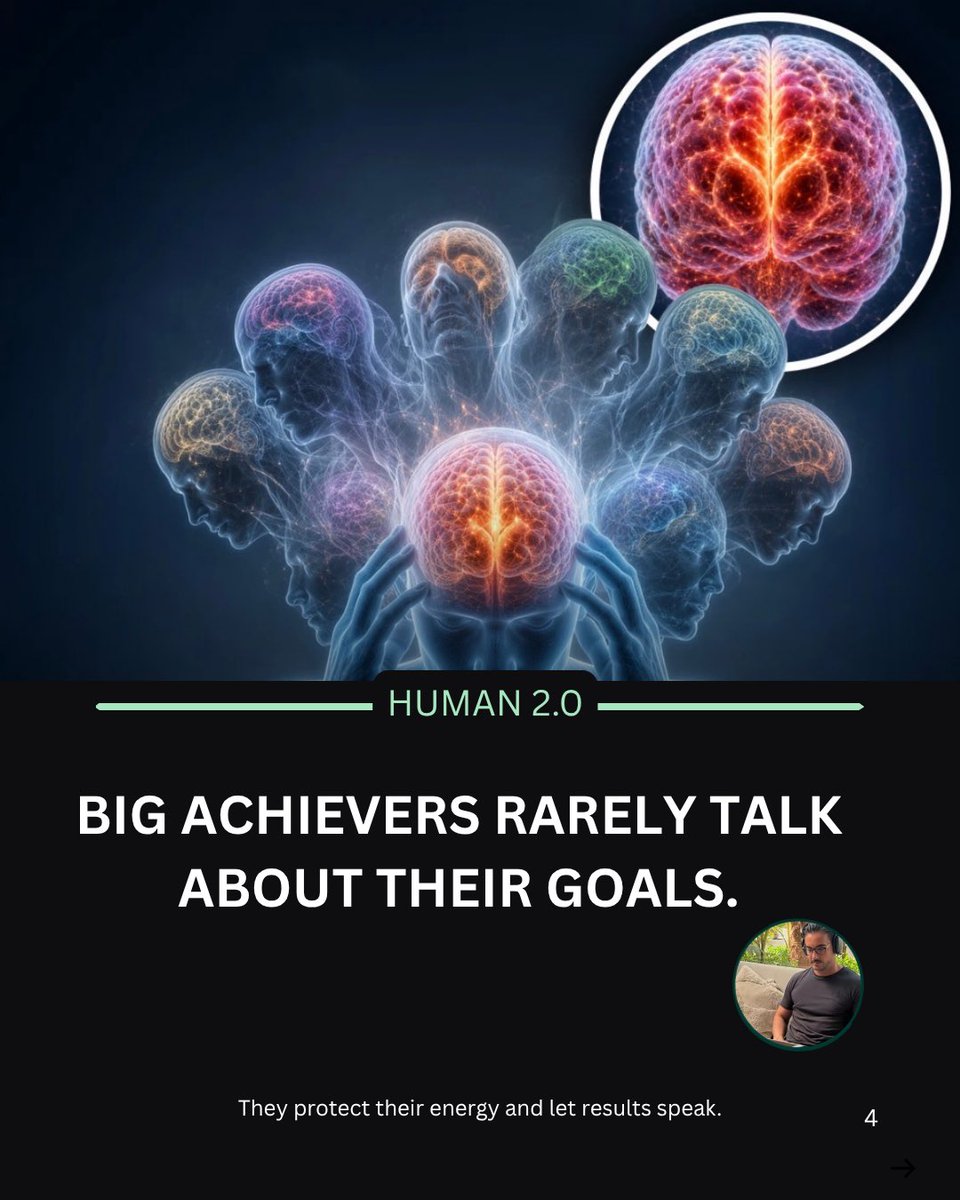
Announcing your goals publicly can make your brain quit before you even start. Most people think sharing goals creates accountability. Research shows the opposite is often true. 🧵 Thread + full carousel below You’re not lazy. You’re leaking energy. Every time you talk about your big dream, your brain gets a small dopamine hit and treats the talking as if part of the work is already done. That’s why you often feel less motivated afterward. This is backed by research. In a 2009 study published in Psychological Science, psychologist Peter Gollwitzer found that people who publicly announced their intentions were significantly less likely to follow through — especially when the goal was tied to their identity. The more committed they felt, the stronger the negative effect. Your brain doesn’t need more external validation or dopamine from likes and comments. It needs one thing: a smaller, concrete next step — with zero premature rewards. That’s exactly what Human 2.0 is built for. Instead of announcing your goals to friends, family or LinkedIn… Keep them private. Use AI as your personal performance coach. Copy this prompt and paste it into Claude or ChatGPT: “You are my elite Performance Coach. My goal is: [your goal]. No praise. No validation. Give me only the smallest physical action I can take right now. Be extremely specific.”Stop chasing dopamine and validation from outside. Use AI as your private mentor instead. Save this thread. Try the prompt on your next goal. Protect your energy. Move in silence. What’s one goal you’re currently keeping completely private? Drop it below. Full carousel in the thread above 👆



AltAccount 🐎🍒�... @Kit37856621
5 Followers 3K Following We share $BTC, DEFI & AI insights. Stop holding & hoping 👇 Follow our strategy and take profits! AI‑powered tech aiming for steady 30% monthly profit.🌻
SuperIntelligence Pet... @siipets_ai
72 Followers 495 Following Own $SPI 🐾 Your pets process & sell data to Al models,earning you rewards while building a decentralized SI model. Earn $SOL & stocks every hour.

DISCOonSOL @DISCOonpump
2K Followers 5K Following $DISCO CA: 8h4a46euwqfiZ9A3GYkiocXeu9pkNnwTaQGHgBf7pump Matt Furie's party protocol on $SOL. Deflationary, 400M+ Burned gone forever, THE LAST DANCE. 🪩🍆🕺
Real Daniel Nita 🇷... @reaIdanielnita_
439 Followers 3K Following #Bitcoin since 2016. Holding world record for buying 10,000 pizza with 1 #Bitcoin on 22 May 2023. YouTuber. Trader. link👇 https://t.co/FI3A7NMZOJ

Pushpendra Singh Digi... @PushpendraTech
132K Followers 21K Following #YouTuber | @Binance Rank #1 Web3 | @pushpendrakum. 1M+ Community | Youtube 350k Collab: [email protected] Web3, Telegram; https://t.co/KhYZJ1UFAS
Pushpendra Singh Fan ... @pushpendrajifan
23K Followers 18K Following This is @pushpendrakum fan club account. Maintain by Pushpa bhai fans. If you are Pushpa fan then must follow and support.

Crypto Rovers @rovercre1_
277 Followers 2K Following #Bitcoin B Crypto YouTuber (120k SUBS) | Founder of cryptoseacom
anabology @anabology
80K Followers 996 Following co-founder https://t.co/6WejBPT4xz (bioelectricity; at-home MRI) // https://t.co/j5dZ76713f + https://t.co/TaekXhoJm7

Ajeya Cotra @ajeya_cotra
28K Followers 506 Following Helping the world prepare for powerful AI. Risk assessment @METR_evals (opinions my own). Blogs: Planned Obsolescence (AI), Good Bones (whatever's on my mind).
Jan Leike @janleike
141K Followers 335 Following AI research @AnthropicAI. Previously OpenAI & DeepMind. Optimizing for a post-AGI future where humanity flourishes. Opinions aren't my employer's.
ship26 @ship26zurich
3 Followers 41 Following ship26 is a co-building ecosystem in Zürich. Founders, independents and the people who help work get made.
Maulde Cuérel @IamMaulde
95 Followers 3 Following Open innovation at Vice Presidency for Innovation, EPFL
OpenJEV @openjevai
1K Followers 25 Following Intelligence should belong to everyone. We’re making it happen. Powered by $JEV on Robinhood Chain
Vishwas @CodevolutionWeb
12K Followers 591 Following 9 to 5 - Dev Advocate @builderio 5 to 9 - Dev Education @ https://t.co/DyekAsnmqY (750K)

conversiontracking.io @conversion_io
49 Followers 147 Following Your new favourite analytics studio. Conversion Tracking · Analytics · Google Tag Manager
ConversionHacking @conversionHack
2K Followers 3K Following We only publish the best content on Conversion Rate Optimization, Landing Pages and Split Testing. Feed by @NarrowIO
Anthropic @AnthropicAI
1.8M Followers 2 Following We're an AI safety and research company that builds reliable, interpretable, and steerable AI systems. Talk to our AI assistant @claudeai on https://t.co/FhDI3KQh0n.
Evan Hubinger @EvanHub
61K Followers 4K Following Alignment Science lead @AnthropicAI. Opinions my own. Previously: MIRI, OpenAI, Google, Yelp, Ripple. (he/him/his)
FairScale @fairscalexyz
7K Followers 2K Following Reputation and Credibility Infrastructure for the New Financial Economy. Meritocracy in a world of pseudonymity.
Spectrum @spectrum_money
218 Followers 100 Following The only defi app you need. Supported by @superteamin @baseapac @base
swap.io @swapdotio
6K Followers 156 Following The Cheapest Routes on Solana. https://t.co/JJEARw283U
Superteam Earn @SuperteamEarn
39K Followers 14 Following making work2earn cool again • bounties & freelance gigs from chad crypto companies on solana

EWL @jeg6322
11K Followers 5K Following 🇰🇷 | here for easy money and hard tech | helping web3 teams get korea @holohive_
Selina Parker @SelinaParkeer
602 Followers 6 Following My new page 520k page stole 😿 Living somewhere between a suitcase and a tennis racket ✈️🎾

Price Errors @Pricerrors
267K Followers 12 Following We find the best price errors and glitches. We post them, you buy them before they are fixed. Follow us and turn on notifications. 🔔 Links may be affiliated.
Violet @violletvip
1K Followers 79 Following Seductive camgirl, offering exclusive NSFW live shows with passion, authenticity, and real connection. Join my private fantasy! #Camgirl #NSFW
Andrew Tate @Cobratate
10.8M Followers 1K Following Unmatched perspicacity coupled with sheer indefatigability makes me a feared opponent in any realm of human endeavour. Escape Slavery: https://t.co/b2DF1rm9ij
Montreux Jazz Festiva... @MontreuxJazz
102K Followers 1K Following 2 weeks every summer - Shores of Lake Geneva 🇨🇭 🎶 Fantastic stories and legendary performances 👉 03-18.07.26 #WhereLegendsAreBorn
Doreen Bogdan-Martin @ITUSecGen
46K Followers 1K Following @ITU Secretary-General. Tech enthusiast turning the #DigitalFutureForAll dream into reality
WFP Innovation @WFPInnovation
13K Followers 2K Following The United Nations 🇺🇳 World Food Programme (@WFP) Innovation Accelerator 🚀sources, supports and scales high-potential solutions to #DisruptHunger 🌾🍚🌽🍲

Dr. Roman Yampolskiy @romanyam
166K Followers 799 Following Prof. of CS. AI Safety Researcher. Host of The Roman Forum Podcast https://t.co/832CyJbPkR Talks/Interviews: [email protected]
Akshay 🚀 @akshay_pachaar
290K Followers 502 Following Simplifying LLMs, AI Agents, RAG, and Machine Learning for you! • Co-founder @dailydoseofds_• BITS Pilani • 3 Patents • ex-AI Engineer @ LightningAI
Obsidian @obsdmd
218K Followers 0 Following The free and flexible app for your private thoughts. For help and deeper discussions, join our community: https://t.co/wHB7xZ3AjA
CV Labs @CVLabsUK
3 Followers 0 Following CV Labs offers a range of services you need to create the perfect CV and LinkedIn profile. Run by recruitment consultant Lex.
CV Labs @CV_Labs
11K Followers 1K Following Helping global startups, corporates, and investors to leverage AI, Blockchain & other Frontier Technologies 🚀
Ishika Rawat @Ishh_021
7K Followers 17 Following 300K+ Linkedin Fam🚀 || AI & Tech Influencer 📩 Dm for Collab - [email protected]
Maya Vixen @Maya_Vixxen
291 Followers 47 Following
Sakana AI @SakanaAILabs
141K Followers 0 Following Building Frontier AI in Japan Try Sakana Chat, Translate, Marlin, Namazu, Fugu 🐡 https://t.co/stLdPSz1Y7
AI for Good 🇺🇳 ... @AIforGood
19K Followers 4K Following The @UN's 🇺🇳 leading platform on #AI to solve global challenges. Organized by @ITU in partnership w/ 53 UN agencies and 🇨🇭 #AIforGood
Queen Isabell @Queen_1o1
18K Followers 7K Following 🚀 Charting tomorrow via AI, tech | Crafting smarter systems daily | DM or Mail for collaboration: [email protected]|Higgsfield earn: HIGGS-I0SGV
Chaofan Shou @shoucccc
81K Followers 3K Following
Nate Herk @nateherk
35K Followers 70 Following Founder & CEO @ AI Automation Society Amazon Bestselling Author in AI Featured in Forbes & Inc. 1M on YT [email protected]
Andrej Karpathy @karpathy
4.3M Followers 1K Following
tango @TangoMe
66K Followers 557 Following Tango is a social live-streaming community platform where you can make new friends and connect with over 450 million people from all over the world.

Caroline @Caroline_ca5
453 Followers 2 Following Those who strive, through the rivers of sweat, have steered their ships of career to the shores of their dreams.
Milla 💎secret💎I... @it_milla_secret
459K Followers 113 Following Come see my little pink pussy secrets in all ways imaginable 😉 🤫
LizzieGrey @1LizzieGrey
3K Followers 44 Following https://t.co/YWBvb7oPrx I am gifted with a body meant to be adored and a mind meant to put a spell on you!
Oana Eftimie @Oana_Eftimie
8K Followers 87 Following Subversivă prin vocație / Om de marketing / Adevărul este forma supremă de rezistență! 🇷🇴
Dr. Alex Tatem @DrAlexTatem
19K Followers 1K Following Board Certified Men’s Health Urologist specializing in TRT, Penile Implant Surgery, Male Fertility, Erectile Dysfunction, and Vasectomy Reversal at @UrologyofIN
You might like