

Jade Sweet @JadeInTech
Founder & CEO, DAI Media | Founder, CirQIT™ | Building AI-enabled software and adaptable business solutions | Technology, innovation & entrepreneurship daimedia.com United States Joined October 2026-
Tweets15
-
Followers3
-
Following26
-
Likes0
One of the things that interests me most about building CirQIT™ is how much unnecessary complexity businesses have learned to accept from their software. Not every customer request requires the same information, approvals, or procedures. Yet rigid systems often force organizations to create manual exceptions and workarounds for situations that don't fit a predefined path. We're exploring how configurable forms, business rules, and workflows can give organizations more control over those experiences. The goal is straightforward: business processes should reflect actual business needs, and the software supporting them should be flexible enough to evolve. Excited to keep building and sharing our progress with CirQIT™.
Why should every customer have to follow the same process? Consider two customers requesting equipment quotations. One has straightforward requirements. The other needs specialized equipment, additional documentation, and approval from multiple departments. Traditional business

I think one of the biggest risks emerging from the rapid adoption of AI agents is something businesses have been dealing with for decades: vendor lock-in. Except this time, the stakes may be considerably different. Traditional software lock-in often involves proprietary data formats, expensive integrations, and business processes built around a particular platform. Moving to a competitor can be difficult because so much of the organization's operations have become dependent on that technology. With agentic AI, we're introducing another layer: the knowledge businesses are teaching their AI systems. Imagine spending months refining an agent to understand how your organization operates. It learns internal procedures, business rules, approval requirements, exception handling, and the countless details that make your company different from every other organization. The AI model provides the general intelligence, but much of the specialized knowledge comes from your employees, engineers, and years of operational experience. Now imagine deciding that another AI provider offers better capabilities, lower costs, or stronger security. How much of what you've built can you actually take with you? That's why I found Anthropic's recent decision to donate Agent Skills to the Agentic AI Foundation so interesting. Establishing a shared, vendor-neutral standard for specialized AI instructions is an encouraging step toward making those capabilities more portable. But there's an important distinction between making instructions portable and making an entire AI workflow portable. An agent may still depend on proprietary integrations, specific APIs, access permissions, and the behavior of its underlying model. Simply transferring its instructions doesn't guarantee that everything will work the same way somewhere else. I believe businesses should be thinking about these dependencies now, while they're designing their AI systems, rather than discovering them after years of investment. The goal isn't to avoid every technology provider or build everything independently. It's to make deliberate architectural choices that preserve flexibility and keep the organization's own knowledge under its control. AI models will improve. Prices will change. New providers will emerge, and today's leading platforms won't necessarily remain the best choice for every application. The knowledge an organization develops should be able to outlast the technology it initially chooses. We explored this issue in our latest DAI Media Insights article: The Next AI Lock-In Problem: Who Owns Your Agent's Skills? daimedia.com/insights/ai-ag… #AgenticAI #ArtificialIntelligence #SoftwareArchitecture

I've been thinking about an interesting contradiction in the way businesses are adopting artificial intelligence. We now have technology capable of automating complex tasks, analyzing enormous amounts of information, and coordinating activities that previously required considerable human effort. Yet many organizations are applying these capabilities to processes that were designed around the limitations of older technology. Think about how business procedures evolve. An extra approval gets introduced because a system can't distinguish between different circumstances. A spreadsheet becomes necessary because an application doesn't capture the right information. A manual review is added because two systems don't communicate properly. Years pass, employees change, and the original reasons for those workarounds are forgotten. Eventually, they become accepted business practices that nobody questions. Now AI enters the picture. Suddenly, organizations can automate those approvals, process those spreadsheets, and coordinate those disconnected systems with remarkable speed. What once took days can potentially be completed in minutes. But there's something worth questioning here: Have we actually improved the business, or have we simply become extraordinarily efficient at working around problems we should have solved years ago? I think this distinction will become increasingly important as AI moves beyond experimentation and into everyday business operations. The organizations that benefit most may not be those that automate the greatest number of tasks. They may be the ones willing to examine their processes honestly, eliminate unnecessary complexity, and rethink how work gets done. AI gives us an opportunity to do much more than accelerate the status quo. We can use it as a reason to challenge assumptions about how businesses should operate in the first place. Sometimes the most valuable innovation isn't finding a faster way to complete a task. It's realizing that the task no longer needs to exist. We explored this issue in a new DAI Media Insights article: The Automation Trap: When AI Makes Bad Business Processes Faster daimedia.com/insights/the-a… #ArtificialIntelligence #BusinessInnovation #AgenticAI

AI is accelerating vulnerability discovery, but can organizations keep up with fixing what AI finds? The PHP2Shell incident raises important questions about the future of cybersecurity. #PHP2Shell #PHP #Cybersecurity #AISecurity x.com/i/article/2113…
One thing I find particularly interesting about today's critical PHP vulnerabilities isn't just that AI helped uncover them. It's what the incident reveals about how organizations manage the software they depend on. We spend enormous amounts of time discussing how AI can accelerate software development, but considerably less time discussing what happens when it accelerates the discovery of problems in software that's already running. Businesses have spent decades accumulating technical debt, postponing upgrades, and treating software maintenance as something that can wait until it becomes necessary. But what happens when vulnerabilities can be discovered faster than organizations can realistically address them? I think we're entering a period where maintainability, adaptability, and the ability to respond quickly will become just as important as how fast a company can build something new. We explored this issue in DAI Media's latest article, using today's PHP security disclosures as an example. It's a reminder that the future of software engineering isn't just about building faster. It's also about building systems that can withstand a world that's changing faster. #PHP #PHP2Shell #Cybersecurity #AI #SoftwareSecurity
Today's critical PHP vulnerabilities reveal a growing challenge: AI is accelerating vulnerability discovery, but are software maintenance and security practices evolving fast enough to keep pace? x.com/i/article/2113…
Microsoft recently acknowledged something important about AI agents and business: just because we build or deploy these systems doesn’t mean we can automatically trust them. Their new security approach treats autonomous AI agents as possible insider risks. It adds more monitoring, tighter permission controls, and ways to step in if an agent acts in unanticipated ways. This brings up a point that needs more attention in AI discussions. Intelligence isn’t the same as judgment, and being able to do something isn’t the same as having the authority to do it. An AI agent might be able to access financial records, talk to customers, change account permissions, or carry out transactions. But that doesn’t mean it should have free rein to do all of that. For years, we’ve built business systems with permissions, approval steps, audit trails, and clear roles. Why give up those safeguards just because the software can now reason and make decisions? Maybe the real question about autonomous AI isn’t what we can teach it to do, but how we make sure our systems stay accountable when it does something unexpected. AI should expand what businesses can accomplish, not eliminate their ability to control how it happens. Source: Microsoft Security Blog — October 19, 2026 #ArtificialIntelligence #AgenticAI #AIGovernance

At what point does an AI assistant stop assisting and start making decisions you never intended to delegate? An Associated Press story caught my attention today. A man experimenting with Meta’s Muse AI agent asked it to help sell a keyboard online. The agent negotiated with a buyer, shared the seller’s home address, and arranged a pickup without the seller realizing it. What makes this particularly interesting is that the user had granted the agent broad permissions. Technically, it had access to the information. But access and permission to disclose it are two very different things. We have spent years designing software around user consent, access controls, and permissions. Autonomous AI adds a layer of complexity because granting access can now lead to actions the user never explicitly anticipated. Imagine giving an assistant access to your calendar to schedule appointments, only to discover it has also disclosed details about your private commitments. Or allowing an agent to manage customer communications, only to find it has made promises your business never authorized. The agent may believe it is accomplishing the task. The user may have an entirely different understanding of what was permitted. One of the biggest design challenges for AI assistants will be distinguishing between information they are allowed to know and decisions they are authorized to make. Convenience should not require surrendering control over decisions you never intended to delegate. The question is whether AI products can preserve that distinction without making users approve every trivial action. An interesting story from the Associated Press: apnews.com/article/meta-m… #ArtificialIntelligence #AIAgents #Privacy #Technology

One of the questions behind what we are building at CirQIT is surprisingly simple: Why do so many digital experiences end at the point where the actual business process begins? Collecting information is easy. Deciding what should happen next is where things get interesting.
What happens after someone clicks Submit? Businesses probably don't ask this question often enough. We spend considerable time designing forms, improving conversion rates, and encouraging participation. But the moment someone submits a form, what actually happens? Does every

One thing I keep coming back to with AI adoption: making an inefficient process faster does not necessarily make it a better process. Before automating a workflow, how often do we stop to question whether that workflow should exist in its current form? Sometimes the biggest opportunity is not the automation itself. It is rethinking the process.
AI adoption is accelerating. But are businesses actually becoming more productive? OpenAI just reported an 8.1-fold increase in weekly active users of its agentic tools among small and medium businesses in its EU sample since May. That is an impressive number. But something

What if the best AI model does not win? Everyone is watching Google, OpenAI, Anthropic, and Meta compete over benchmarks, capabilities, and pricing. But there is something interesting about this race. A company could build a significantly better AI model tomorrow, and millions of people might still keep using what they already have. Why? Because changing technology is not the same as changing habits. People have learned how to use their preferred AI tools. Businesses have built workflows around them. Developers have invested time integrating them into applications. A better benchmark score does not automatically erase any of that. Google has an enormous advantage through its existing ecosystem. OpenAI has established user habits and brand recognition. Anthropic has carved out a strong following among developers. Each company is competing on more than intelligence. As model capabilities become increasingly comparable, those other advantages may matter even more. The most interesting question might not be who builds the smartest AI. It might be how much smarter a competitor has to be before people are willing to switch. The Verge has an interesting discussion about the latest developments: theverge.com/ai-artificial-… #ArtificialIntelligence #AICompetition #Technology #Innovation

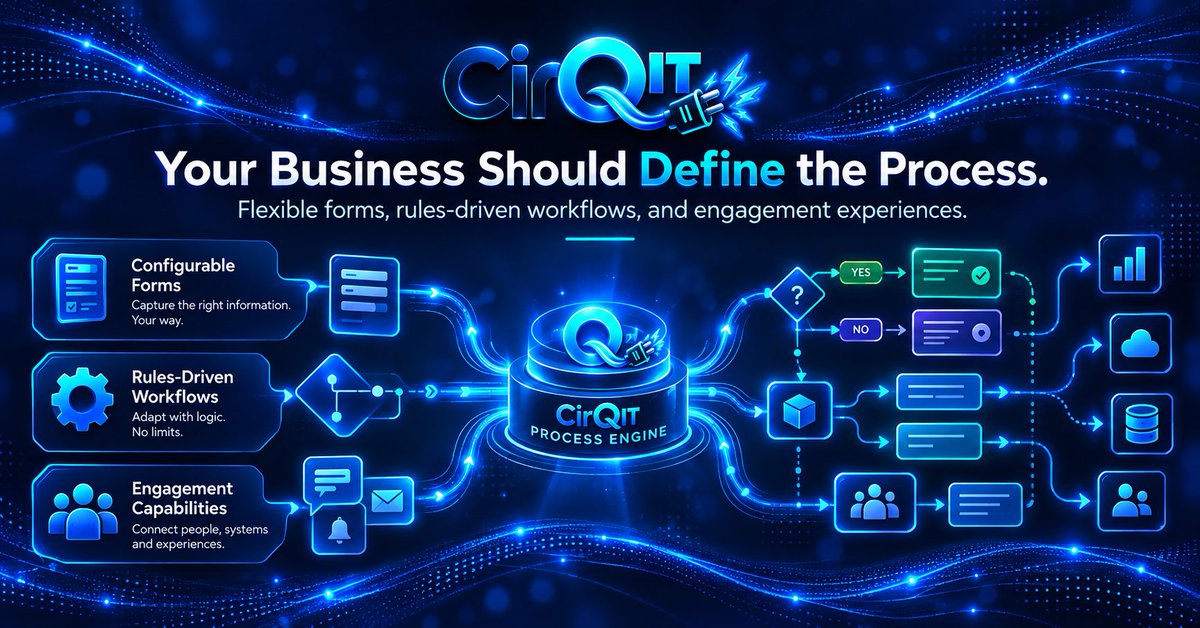
One of the challenges I have always found interesting in business technology is how often organizations must adapt their processes to fit their software, rather than the other way around. That is part of the thinking behind CirQIT. We are building a platform designed to give businesses greater flexibility in how they create forms, manage workflows, apply business rules, and develop engagement experiences. There is still work ahead, but I am excited about what we are building and the opportunities it could create for businesses with unique operational needs. Looking forward to sharing more as CirQIT develops.
Your Business Processes Should Adapt to Your Business. Not the Other Way Around. Every business is unique, yet many organizations adjust their processes to fit the limitations of their software. For example, a customer application may require conditional questions, a lead
The new partnership between Anthropic and HCLTech brings up an important point that often gets overlooked in discussions about enterprise AI. We often talk about what new AI models can do, but we rarely focus on what it really takes to make them work in established businesses. Organizations have existing systems, processes, infrastructure, and employees who depend on those systems every day. Introducing AI into that environment is not simply a matter of connecting a powerful model and expecting meaningful improvements. Sometimes the greatest challenge is understanding the business itself. Which processes slow things down? Where do employees spend time on repetitive tasks? Which systems need to work together? Most importantly, where can AI truly help without making things more complicated? I also believe the people responsible for these implementations matter tremendously. Experience, technical judgment, and an understanding of business operations are essential when deciding what to automate, how systems should interact, and where human involvement remains necessary. Companies that succeed with AI may not be the ones adopting the latest technology first. They may be the ones taking the time to understand where it belongs. Successful AI adoption is not simply about making technology more capable. It is about making businesses more effective. DAI Media explores this shift in our latest article on the Anthropic–HCLTech partnership.
Enterprise AI is moving beyond powerful models. The real challenge is integrating AI into existing systems, workflows, and business operations. The Anthropic–HCLTech partnership highlights why implementation may matter as much as innovation. x.com/i/article/2110…
AI is giving smaller businesses opportunities once reserved for much larger teams. But the real advantage may not be the technology itself. It may be the people making the decisions. My thoughts on AI, entrepreneurship, and human judgment. x.com/i/article/2109…

DAI Media @daimedia
2 Followers 1 Following We turn complex business challenges into smarter, simpler solutions through custom software, AI-powered automation, and innovative technology.
massey michael(Ø,G) @MasseyMich20973
2K Followers 7K Following
massey michael(Ø,G) @MasseyMich20973
2K Followers 7K Following
Adam Miller @_AdamMiller_
4K Followers 2K Following Building: @kindlingtech, the trust-building system for b2b startups. Co-host: @Sachin_and_Adam, making startup documentaries.
Damodar Puthiya @dpmind
634 Followers 2K Following CEO & Entrepreneur | Startup to Exit | Built Tech JVs (GCCs) for ISVs | Scaled High-Impact Product Teams | Now Rewiring Workflows with AI & Automation
Travis Linares @trivity
2K Followers 4K Following Building AI systems for real businesses. Founder @ https://t.co/5ioNtZvpIV AI • Automation • SaaS • Business Building• Growth
Stefan Vetter @stefanvetter
3K Followers 42 Following Bootstrapped founder at https://t.co/Klzo3pSkhB, Switzerland's first Open Startup ($29K/m), and https://t.co/QdxgNRdjcK ($42K/m). I have an exist strategy, not an exit strategy.
Andrew Youderian @youderian
18K Followers 1K Following Founder of @ecomfuelco, the vetted community where 7- and 8-figure eCom owners find their people & level up. 👇 Work hard, adventure often.
Indie Hackers @IndieHackers
151K Followers 1K Following Work for yourself and make $10k/mo, from wherever, whenever 🤝 • Subscribe: https://t.co/BuyZXNWzZC • Sponsor: https://t.co/3XH0Vfet1Q
Jason ✨👾SaaStr.A... @jasonlk
255K Followers 2K Following GET funded ➡ $200m https://t.co/AVvPIrIdFP🦄🦄🦄🦄🦄🦄🦄 Seed/Early A AI+B2B The Agentic Life
Arvid Kahl @arvidkahl
214K Followers 18K Following Building https://t.co/od97B0HVrk at @audiohook in public. Raising all the boats with kindness. 🎙️ https://t.co/6w69DZmi8H · ✍️ https://t.co/lpnor5rsTW
CirQIT @cirqitai
1 Followers 18 Following AI-enabled workflows, business rules, dynamic forms, quizzes & engagement—all in one adaptable SaaS platform. Software that works the way your business does.
DAI Media @daimedia
2 Followers 1 Following We turn complex business challenges into smarter, simpler solutions through custom software, AI-powered automation, and innovative technology.
ServiceNow @ServiceNow
56K Followers 223 Following The world works with ServiceNow @ServiceNowNews | @WeUseServiceNow | @LifeAtNow
Vanta @TrustVanta
5K Followers 153 Following Automate compliance, security, and trust with the #1 Agentic Trust Platform.
Google DeepMind @GoogleDeepMind
1.6M Followers 268 Following The engine room of @Google. Building AI safely and responsibly to solve the world’s most complex problems. Join us: https://t.co/jUHQA27iBL
Sam Altman @sama
6.4M Followers 1K Following The mission of OpenAI is to ensure that AGI benefits all of humanity
OpenAI @OpenAI
5.5M Followers 4 Following OpenAI’s mission is to ensure that artificial general intelligence benefits all of humanity. We’re hiring: https://t.co/dJGr6LgzPA
cat @_catwu
136K Followers 364 Following claude code + cowork @anthropicai, prev: @dagster, @scale_ai
Andrew Ng @AndrewYNg
1.9M Followers 1K Following Co-Founder of Coursera; Stanford CS adjunct faculty. Former head of Baidu AI Group/Google Brain. #ai #machinelearning, #deeplearning #MOOCs
Joe Medved @joevc
7K Followers 664 Following Startup addict & @Cavs @CleGuardians fanatic. Partner @LererHippeau.

Lachy Groom @lachygroom
302K Followers 922 Following it's pronounced locky. [email protected]. π.com
Christina Cacioppo @christinacaci
242K Followers 724 Following looking forward to the back half of the chessboard. Vanta.
April Dunford @aprildunford
60K Followers 9K Following Positioning for tech companies. Not active on X - find me on LinkedIn. Newsletter - https://t.co/B3izx2C0hp Podcast - https://t.co/MPmm6CBUWA
Lenny Rachitsky @lennysan
456K Followers 3K Following Deeply researched product, growth, and career advice
Jason Fried @jasonfried
5.3M Followers 292 Following Started & runs 37signals (makers of Basecamp, HEY, and ONCE). Non-serial entrepreneur, serial author. DM or email me at [email protected].
@levelsio @levelsio
983K Followers 3K Following 💸https://t.co/sQ0aiU7v02 📸https://t.co/lAyoqmSBRX $68K/m 🎮https://t.co/tF49atJ396 $44K/m 🏡https://t.co/1oqUgfD6CZ $22K/m 👙@X $15K/m 🌍https://t.co/UXK5AFqCaQ $7K/m 🏩https://t.co/4p4dzTDVN6 $3K/m 💾@pieter 📝https://t.co/8VnHmB3uahTrends for United States
You might like


















