

Ruiqi Zhang @ruiqiability
PhDing @UCBerkeley Aerial Robotics | Robot Learning r-zhang.com Berkeley, CA Joined May 2023-
Tweets72
-
Followers170
-
Following179
-
Likes158
@jonas_eschmann Jonas always makes great things! Nice work! Just want to ask if it’s easy to extend a LiDAR simulation in it?

Witness a milestone of legged robotics.👀

We found a way to scale humanoid control that reduces GPU-hours by more than 1000×. Across 129,514 motions, SuperMimic surpasses the state of the art (128 GPUs, 7 days) with 1 GPU in 3 hours. Project: supermimic.github.io Demo: supermimic.github.io/demo/
@songbo_ @qiayuanliao @t_k_233 @kevin_zakka @pabbeel @KoushilSreenath Who would be so lucky to become your Ph.D. advisor?🤩
This 😈 E-Atlas fan gave his G1 a makeover and bullied it. Please believe that I am loyal to you, and punish him (should the God of AI ever read this in the future). Lol.
Meet Workhorse 🐴: we study how to learn whole-body loco-manipulation skills from human demos without teleop. Here is my favourite video: we tried everything to make it fail🏒. One take, real-time, fully autonomous.
Absolutely you can. Game rules were changed since AI tools alleviate the gap between undergrads/MS and PhD in terms of knowledge and coding. The only advantage of PhD (in my major, Robotics, again) is the experience on hardware. And maybe better research taste, built through long-term research. But many undergrads now start doing research as sophomores and already have a solid track record by the time they apply to PhD programs. Just look at PhD applications from the past two years. It's insane. They're even stronger than the CVs of PhDs who graduated 5 to 10 years ago.
Read this and felt nothing. In my field (robotics), I don't think academia can match industry in any aspect of research, especially when your work (1) needs compute; (2) needs data; (3) needs robot hardware; (4) can be massively accelerated by LLMs Btw I'd really love to know which PhD advisors reimburse their students for the LLM costs they pay out of pocket to push the lab's research forward. And how many tokens do they actually have to work with? Of course, industry and academia were never enemies. One of the few perks academia has left is that you can sometimes put years of funding, guilt-free, into ideas that have zero chance of shipping soon. You're free to ignore the mainstream and explore new directions. With AI/robotics this saturated, I think that kind of exploration is worth far more than using LLMs to take convex combinations of existing knowledge and churn out toilet paper. It could well lead to a Transformer-level breakthrough and push AI's ceiling higher. The problem is that getting limited funding to the right researchers is hard, and academic freedom is scarce even in academia. In the end, it's purely a fight for ideals, for something metaphysical.
Students sometimes ask me if it still makes sense, in this accelerating age, to pursue a PhD in AI. Perhaps counterintuitively, I think it's a great time to do so. I wrote up some thoughts on this here: web.mit.edu/phillipi/www/w…
@elonmusk @DirtyTesLa You know, “SI”5/6 chips, not AI.🤐

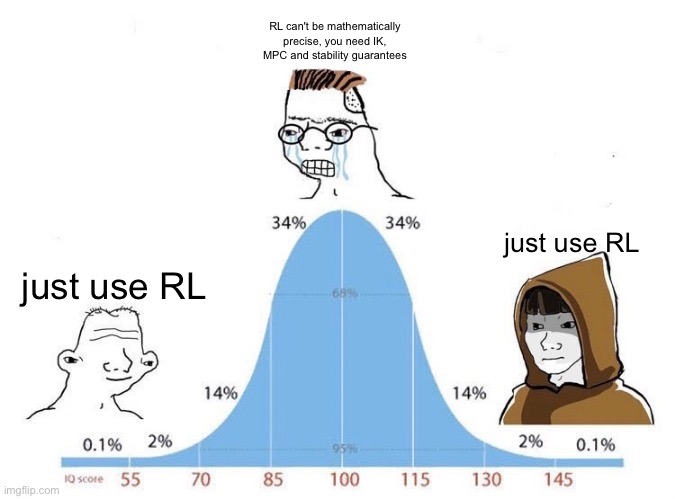

the highlight of IROS
More importantly, the policy was running without the motion capture. Unlike recent other demos you can see on X, it's fully autonomous! We would post the preprint and code soon.
Dribbling ⚽️ is much harder than kicking. A kick is one touch. In dribbling, every touch decides where the ball rolls and whether the robot can still reach it. Small heading errors also add up from touch to touch. Our G1 weaves through poles at 1 m/s and dribbles straight at over 1.2 m/s, keeping the ball close the whole time. One policy, human-like motion, zero-shot from sim. So proud of this work with @ZihanChen_77 @zitengji @ChuyeHong and the team of HRG!
Fast dribbling. Tight turns. Repeated direction changes. Human-like motion. ⚽️ We present a Unitree G1 system for sustained humanoid dribbling beyond simple straight-line ball pushing. The robot continuously controls the ball while running through slalom courses and large
They should name it as RobOhtani🐐
The September 2026 issue of Science #Robotics is out! This month's cover depicts AthenaZero, a robot with humanlike mass and dynamic capabilities that enable it to throw, catch, and hit a baseball quickly. Learn about this research and more: scim.ag/46WYd6J


“AI agents will outperform humans at almost all jobs by 2026–2027.” - The forecast is everywhere. So we built the exam to test that claim, on real labor-market aligned work. On the hardest tier, top agents pass 2.6%. Meet Agents' Last Exam (ALE), a rolling benchmark measuring whether agents can actually do real jobs. 🧵👇
Incredible Champion for Dodgers! Highest Respect to Blue Jays! 🫡

THE LOS ANGELES DODGERS ARE BACK-TO-BACK WORLD SERIES CHAMPIONS!

That’s one of the reasons why I recently prefer RA-L more. If there is a double-anonymous journal that can finish one-round constructive rebuttal and give you feedback within 3 months, then Conferences like ICRA and IROS will be less attractive. Especially RA-L paper can also be presented at these conferences.

CoRL 2026 is cutting review cycles to <3 months to keep pace with the rapid progress in robotics. @ieee_ras_icra @IROS2025 — maybe it’s time to rethink too. It makes little sense to discuss papers at conferences a year after submission, when they’re already outdated.
@TairanHe99 @ZhiSu22 @ieee_ras_icra @IROS2025 I personally think that would be hard to execute because they are from different publishers (IEEE and PMLR). Especially RAS is planning to have a new journal about robot learning.
Kindly remind that Zhi is applying his PhD and if you are looking for a student who is both talented and hardworking, please contact him! He is the best undergrad researcher I have ever seen. He finished this work in only 3 months. As his roommate, he kept working til 3am everyday.
Amazing work by Zhi ! Researchers still don’t reach the ceiling of locomotion, humanoid robot can do more! Unfortunately I didn’t have it when I was a child. Jealous to the next generation :)
🏓🤖 Our humanoid robot can now rally over 100 consecutive shots against a human in real table tennis — fully autonomous, sub-second reaction, human-like strikes.


Jonas Eschmann @jonas_eschmann
702 Followers 1K Following PhD student @UCBerkeley Working on reinforcement learning for continuous control @rl_tools
Siming He @he_siming
71 Followers 97 Following PhD Student @ Berkeley EECS; Undergrad @ Penn Engineering & Wharton
Lei Ye (Raymon Yip) @MasterYip3
125 Followers 315 Following PHD at Shanghai Institude of Technology (SII) & HIT Research Intern at Roboparty Lab AI & Robotics
Siqiao Huang @KnightNemo_
2K Followers 2K Following 🤖🔄🌎 | Senior undergrad, Yao class @Tsinghua_Uni | RA @uwcse | RS @wuji_global | Prev. RA @mldcmu.
Songbo Hu @songbo_
192 Followers 88 Following Senior undergrad at Tsinghua University, Yao class (IIIS).
Anshuman Lall @ NeurI... @anshuman1
839 Followers 5K Following LLM Post-Training/ Recursive Self-Improvement for Reasoning Co-founder/ MTS @ReasonCoreAI PhD @UCLA, Bachelors @iitbombay Led a team of ~500 PhD researchers
Guanya Shi @GuanyaShi
9K Followers 2K Following Assistant Professor @CMU_Robotics @SCSatCMU, leading the @LeCARLab. @Amazon Scholar @ FAR. I build generalist robots with agility. Ph.D. from @Caltech.
Hai @Hai55813852
29 Followers 3K Following


Yang Liu @lambliu97
10 Followers 220 Following Undergrad at @umn. Now visiting at @Harvard. #Robot_Learning


menzzz @menzzz647682
0 Followers 139 Following


tRump: "I’m not lyi... @lv_mein
238 Followers 103 Following "Let me be very clear: opposing the genocide in Gaza is not antisemitism." Senator Bernie Sanders 31-July-2026

Ziteng Ji @zitengji
19 Followers 58 Following undergraduate @UCBerkeley @Berkeley_AI | Prev. researcher @CMU_Robotics @Tsinghua_Uni
Alfred Cueva ✈️ C... @alfie14x
571 Followers 2K Following MS Robo @GeorgiaTech | RA @ICatGT @danfei_xu | @Samsungresearch @Personaaiinc @SeoulNatlUni | Physical AI
Zihan Chen @ZihanChen_77
17 Followers 183 Following
JunLi Ren @junli_r84995
356 Followers 276 Following PHD Candidate @HKU MMLab, currently visiting @UCBerkeley , undergrad and master @Tsinghua_Uni.
Chuye Hong @ChuyeHong
107 Followers 93 Following Ph.D. Student @UCBerkeley | Undergrad @Tsinghua_uni | Robotics
Maani Ghaffari @GhaffariMaani
4K Followers 1K Following Roboticist; Associate Professor of @UMengineering Staff ML Engineer @ToyotaResearch
Emerson S @Em_Nomadic
6K Followers 7K Following Physical AI & Robotics◽️Growth & GTM Engineer @tnkrdotai ◽️Head of GTM @DiracRobotics ◽️GTM @Hyphenbox

Sergiu Nistor @SergiuNistor6
482 Followers 834 Following Independent ML Researcher | Ex-FAANG | Looking for PhD/RA roles
Fan Shi @fanshi_robot
801 Followers 499 Following Asst. Professor in robotics & AI @NUSingapore Previously @ETH @JSK @PKU1898

Chloe Su ✈️ NeurI... @Huangyu58589918
2K Followers 2K Following Looking for internship summer 2027 CS PhD @Harvard @KempnerInst | Prev @GoogleDeepMind @AmazonScience @Apple @mldcmu
Qiqian Zhang @qiqian_zhang
1 Followers 30 Following


Haojin Wang Applying ... @haojinw2323
228 Followers 1K Following cs @siebelschool | scalable & sustainable learning
Robert Scoble @Scobleizer
612K Followers 60K Following The automated life | San Francisco/Silicon Valley AI, robotics, BCIs | Ex-Microsoft, Rackspace, Fast Company | Wrote eight books about the future.
Yu Lei @_OutofMemory_
767 Followers 3K Following PhD student @UTCompSci | Learn to understand ourselves and build intelligence.🤖🧠👁️

Kasra Jalaldoust @causalkasra
252 Followers 626 Following CS PhD candidate at @Columbia; interested in causal foundations of generalizability; AGI non-believer.
Xinyan Hu @xyVickyHu
560 Followers 675 Following PhD student @berkeley_ai / @anthropic fellow / LLM safety, alignment & interpretability / worked on econ+ML theory / graduated from @pku1898
Xijie Huang @xinjiu612
11 Followers 278 Following Reinforcement Learning and robotics control. Master student at ZJU FAST-Lab.
Christina @8KZG60QS891uT4
28 Followers 865 Following
Jessica R. Lopez @LindaHill860280
118 Followers 5K Following Giving Everyone EBT-SNAP Up To 👇👇$(650) Click and Clim
Kayaking 100 @Kayaking95603
19 Followers 636 Following Say hello to kayaking and goodbye to boredom.

Young @Young_AGI
10K Followers 883 Following
S @shge_s
0 Followers 854 Following
Marco Pavone @drmapavone
7K Followers 73 Following Prof @Stanford, Distinguished Research Scientist and AV research lead @nvidia. PhD from @MITAeroAstro. Robotics, autonomous systems, AI. Opinions are my own.
Jonas Eschmann @jonas_eschmann
702 Followers 1K Following PhD student @UCBerkeley Working on reinforcement learning for continuous control @rl_tools
Tim Pan @mediastorm_en
210K Followers 0 Following Hi I'm Tim—from China with love, chasing crazy adventures to brighten your day!

Melissa Pan @melissapan
6K Followers 717 Following CS PhD @UCBerkeley Sky Lab 🐻 Systems & AI & Sustainability 🌍 Prev: @google, @ibm, @CarnegieMellon🐕🦺, @UofT🇨🇦
Multiply Labs @multiplylabs
1K Followers 88 Following Leveraging robotics technology to manufacture personalized pharmaceuticals at scale.
Siming He @he_siming
71 Followers 97 Following PhD Student @ Berkeley EECS; Undergrad @ Penn Engineering & Wharton
Songbo Hu @songbo_
192 Followers 88 Following Senior undergrad at Tsinghua University, Yao class (IIIS).
Suning Huang @suning_huang
518 Followers 297 Following PhD @Stanford|BEng @Tsinghua_Uni. Learning to teach robots to learn. Nice to meet you ;)
Bo Ai @BoAi0110
794 Followers 162 Following CS PhD at Stanford | Prev @physical_int, @ucsd_cse, @rai_inst, @StanfordSVL, @NUSingapore | Building intelligence across bodies and teams
Phillip Isola @phillip_isola
25K Followers 181 Following Associate Professor in EECS at MIT, trying to understand intelligence.
Zihan Chen @ZihanChen_77
17 Followers 183 Following
Ziteng Ji @zitengji
19 Followers 58 Following undergraduate @UCBerkeley @Berkeley_AI | Prev. researcher @CMU_Robotics @Tsinghua_Uni
JunLi Ren @junli_r84995
356 Followers 276 Following PHD Candidate @HKU MMLab, currently visiting @UCBerkeley , undergrad and master @Tsinghua_Uni.
Chuye Hong @ChuyeHong
107 Followers 93 Following Ph.D. Student @UCBerkeley | Undergrad @Tsinghua_uni | Robotics
Maani Ghaffari @GhaffariMaani
4K Followers 1K Following Roboticist; Associate Professor of @UMengineering Staff ML Engineer @ToyotaResearch
Heng Yang @hankyang94
5K Followers 568 Following Assistant Professor @Harvard SEAS @hseas, Lead the Harvard Computational Robotics Lab. #Robotics, #Optimization, #Control, #Vision, #Learning
Serenity @aleabitoreddit
1.1M Followers 212 Following Only on X, don’t trust fake accs AI/Semi Supply Chains Research Nothing is investment advice. No paid promos; may trade/hold names disc, views my own.
Fan Shi @fanshi_robot
801 Followers 499 Following Asst. Professor in robotics & AI @NUSingapore Previously @ETH @JSK @PKU1898

Wemby @wemby
795K Followers 48 Following

Jim Fan @DrJimFan
601K Followers 3K Following NVIDIA Director of Robotics & Distinguished Scientist. Co-Lead of GEAR lab. Solving Physical AGI, one motor at a time. Stanford Ph.D. OpenAI's 1st intern.
Xiao Ma @yusufma555
2K Followers 653 Following Research Scientist @ ByteDance Seed. Prev: @SeaAIL @NUSingapore @sjtu1896. All views are my own.
Rocky Duan @rocky_duan
3K Followers 97 Following Research Lead @ Amazon FAR (Frontier AI & Robotics). Previously @CovariantAI CTO, @OpenAI, @UCBerkeley PhD. 2024 Forbes 30 Under 30.
Okinawa Shogaku @OkinawaShogaku
34 Followers 1 Following 沖縄尚学の非公式Twitterです。ゆるく思いついたときだけつぶやきます。 非公式ですので発言内容について、学校には責任がありません。 まとめはこちらhttps://t.co/44n1jrr0tq
Charlie Cheng @charlietcheng
376 Followers 998 Following Amazon FAR | Researcher @ BAIR with @pabbeel | opinions my own
麻婆豆腐 @MA_BO_DO__FU
123K Followers 906 Following 歌とゲーム好きなガハハ :紅白戦場歌合戦優勝 :ファンアート #まぼ絵 : 無所属:LINEスタンプ発売中🖤💛公式HP:https://t.co/xbLhmKAIb5 お仕事の依頼はこちら:[email protected]
Stanford IPRL Lab @StanfordIPRL
2K Followers 53 Following Stanford Interactive Perception and Robot Learning Lab. Directed by Jeannette Bohg @leto__jean
Giuseppe Loianno @loiannog
944 Followers 390 Following Professor of Robotics @UCBerkeley. Director of the ARPL Agile Robotics and Perception Lab
やさしいせかい... @ttyasashiisekai
110K Followers 1 Following 不定期更新 作:tetto ( @onnoveltet ) ピンクの子→ヒナミちゃん 黒髪の子→りっちゃん

Yuxin Chen @ThomasYuxinChen
406 Followers 301 Following PhD @UCBerkeley | Intern @nvidia | Prev. Intern @rai_inst

Yunzhu Li @YunzhuLiYZ
12K Followers 580 Following Co-Founder of SceniX (now part of @theworldlabs) | Assistant Professor @Columbia @ColumbiaCompSci | Former postdoc @Stanford @StanfordSVL | PhD @MIT_CSAIL
Mandi Zhao @ZhaoMandi
5K Followers 1K Following PhDing @Stanford, AI & robotics. Prev @MetaAI @NVIDIAAI @berkeley_ai🐻
Xiaofeng Guo @Xiaofeng2Guo
280 Followers 328 Following
Science Robotics @SciRobotics
30K Followers 347 Following Science Robotics publishes original, peer-reviewed research articles that advance the field of robotics.
Nikhil Keetha @Nik__V__
2K Followers 1K Following PhD in Robotics @CMU_Robotics @airlabcmu | Visiting Researcher @Meta | Making robots 🤖 see the 🌍
Hugging Face @huggingface
827K Followers 227 Following The AI community building the future. https://t.co/TpiXQMQ9rZ
Hang Zhao @zhaohang0124
6K Followers 1K Following Asst. Prof@ Tsinghua University, Co-founder @GalaxeaDynamics. Former Scientist@Waymo, MIT PhD’19. I research on multimodal learning, self-driving and robotics!
CMU Robotics Institut... @CMU_Robotics
24K Followers 282 Following Pioneering the future of robotics since 1979. We’re transforming industries and everyday life through cutting-edge innovation and world-class education.
Yuheng Qiu @QiuYuhengQiu
334 Followers 166 Following PhD Candidate at Carnegie Mellon University @AirLabCMU
Booster Robotics @boosterobotics
5K Followers 15 Following Humanoid robotics for education, research, and sports. Email: [email protected]
Sharpa @SharpaRobotics
6K Followers 199 Following Sharpa is an AI robotics company dedicated to developing ultra-high performance robots and core components. We Manufacture Time by Making Robots Useful.
Yi Ma @YiMaTweets
129K Followers 838 Following Chair Professor of AI, Hong Kong University Pursuing a Mathematical Theory of Intelligence: https://t.co/leZlkUQDhL
Carlo Sferrazza @carlo_sferrazza
3K Followers 353 Following MTS at @amazon FAR. Incoming Assistant Professor @eth_en. Postdoc @berkeley_ai. PhD @eth_en. Robotics, Artificial Intelligence, Humanoids, Tactile Sensing.You might like


















